
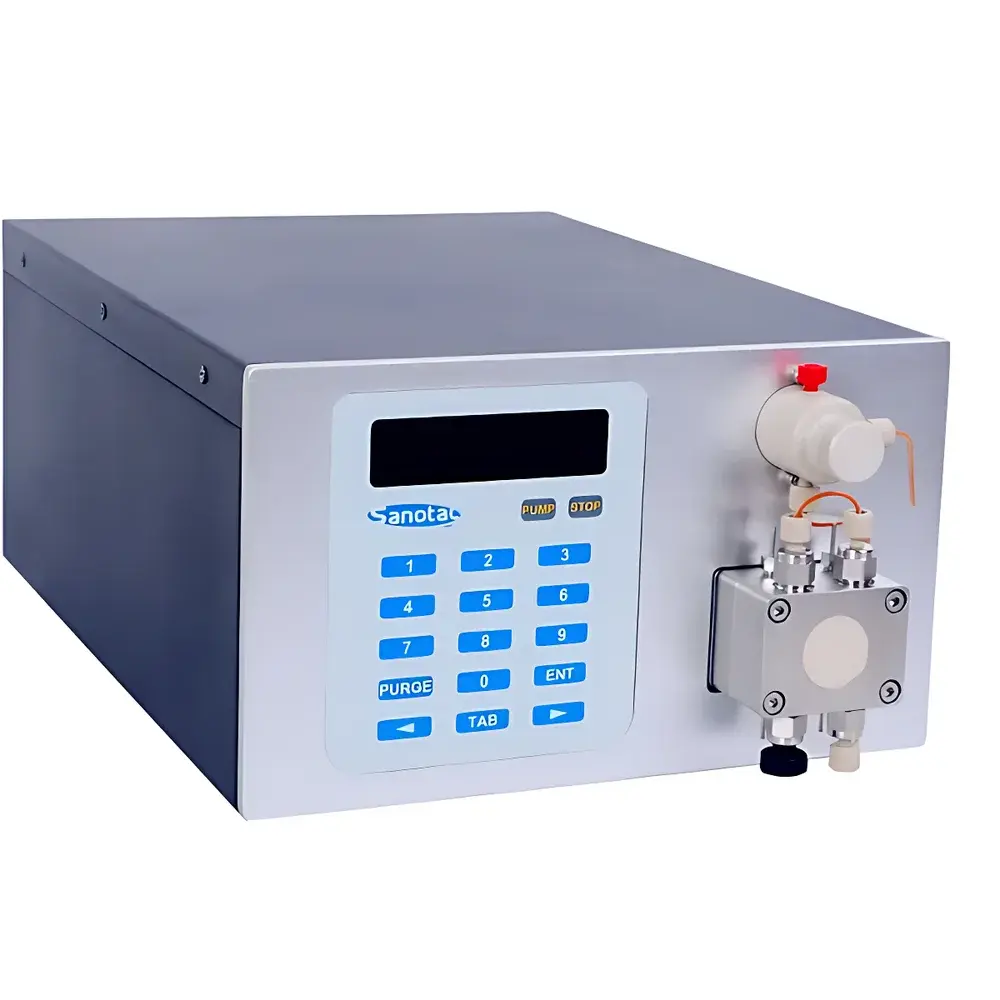
Sanotac JY0010 Analytical High-Pressure Solvent Delivery Pump
| Brand | Sanotac |
|---|---|
| Origin | Shanghai, China |
| Manufacturer Type | OEM Manufacturer |
| Country of Origin | China |
| Model | JY0010 |
| Flow Rate | 0.001–9.999 mL/min (max 10 mL/min) |
| Pressure Rating | 42 MPa |
| Flow Accuracy | ±0.1% |
| Flow Precision | ≤0.1% RSD |
| Pressure Pulsation | ≤0.1 MPa |
| Pump Head Volume | 10 mL |
| Construction Materials | 316L stainless steel, sapphire, PTFE, ceramic |
| Interface | 1/16" tubing connections |
| Display | 256×64 dot matrix backlit LCD |
| Control | Front-panel keypad + RS232/USB computer remote control (open protocol) |
| Power | 85–264 VAC, 50 Hz |
| Dimensions | 370 × 240 × 152 mm |
Overview
The Sanotac JY0010 is an analytical-grade high-pressure solvent delivery pump engineered for precision liquid chromatography applications—including protein purification, medium-pressure preparative chromatography, and analytical HPLC systems. It operates on a dual-piston serial pumping principle with floating piston architecture, enabling stable, pulse-minimized flow across a wide dynamic range (0.001–9.999 mL/min) at pressures up to 42 MPa (6090 psi). Its core design integrates solvent compressibility compensation, multi-point flow calibration, cam-profile optimization, and real-time electronic flow pulsation suppression—ensuring trace-level reproducibility required for method transfer, regulatory compliance, and quantitative bioseparations.
Key Features
- Dual-piston parallel drive system with dynamically balanced floating pistons, reducing seal wear and extending service life under sustained high-pressure operation.
- Microprocessor-controlled flow regulation with 0.001 mL/min resolution and ±0.1% absolute accuracy across the full flow range—validated per ISO 5725-2 for trueness and precision.
- Integrated pressure pulsation suppression (<0.1 MPa peak-to-peak), achieved via harmonic cam curve compensation and active electronic feedback control—critical for low-noise UV detection and mass spectrometry coupling.
- Chemically inert fluidic path constructed from 316L stainless steel, sapphire check valves, PTFE seals, and ceramic components—resistant to aggressive solvents, strong acids (e.g., 6 M HCl), and alkaline buffers (e.g., 1 M NaOH).
- Open-protocol RS232/USB interface supporting bidirectional communication; compatible with third-party chromatography data systems (CDS) including Chromeleon, Empower, and custom LabVIEW or Python-based control environments.
- Front-panel programmability with 10 user-defined methods, supporting gradient profile definition (isocratic, linear, step, and composite gradients), flow ramping, and pressure limit setting—all accessible without external software.
Sample Compatibility & Compliance
The JY0010 is designed for use with aqueous and organic mobile phases common in biomolecular separation workflows—including phosphate-buffered saline (PBS), ammonium acetate, acetonitrile, methanol, isopropanol, and guanidine hydrochloride solutions. Its wetted materials comply with USP Class VI biocompatibility standards and meet FDA 21 CFR Part 11 requirements when operated within validated CDS environments featuring audit trail, electronic signature, and role-based access control. The pump supports GLP/GMP-aligned operation through configurable method locking, run log export (CSV/Excel), and timestamped event recording—including pressure fault triggers, flow deviation alerts, and maintenance reminders.
Software & Data Management
The pump’s embedded firmware includes non-volatile memory for storing method parameters, calibration coefficients, and operational history (last 1000 events). Remote control utilizes a documented ASCII command set over RS232 or USB virtual COM port—enabling integration into automated purification platforms (e.g., ÄKTA-compatible workflows) and LIMS-linked QC laboratories. Data output includes real-time flow rate, actual pressure, motor temperature, and error codes—exportable via serial polling or triggered file dump. Firmware updates are performed via USB flash drive using signed binary images, ensuring integrity verification prior to installation.
Applications
- Protein A affinity chromatography and ion-exchange polishing steps in monoclonal antibody (mAb) downstream processing.
- Size-exclusion chromatography (SEC) for aggregate analysis of therapeutic proteins under GMP conditions.
- Preparative purification of recombinant enzymes, peptides, and oligonucleotides using medium-pressure flash or FPLC systems.
- Method development for reversed-phase HPLC of small-molecule pharmaceuticals per ICH Q2(R2) validation guidelines.
- Automated fraction collection synchronization in multi-pump gradient systems for natural product isolation.
- High-salt elution protocols in histidine-tagged protein purification where corrosion resistance and long-term pressure stability are essential.
FAQ
What is the maximum operating pressure of the JY0010 pump?
The JY0010 is rated for continuous operation up to 42 MPa (6090 psi), with built-in pressure limiting and automatic shutdown at 45 MPa for safety-critical applications.
Does the pump support gradient formation natively?
Yes—the JY0010 supports isocratic, linear, step, and user-defined composite gradients via front-panel programming; however, for multi-solvent high-pressure mixing, it must be paired with a compatible proportioning valve or external low-pressure mixing module.
Can the JY0010 be integrated into a fully automated protein purification platform?
Yes—its open communication protocol, deterministic response timing, and hardware-triggered TTL outputs enable seamless integration with PLC-controlled fraction collectors, UV monitors, and conductivity sensors in end-to-end purification workflows.
Is the pump compliant with ISO/IEC 17025 calibration requirements?
While the pump itself is not a certified reference standard, its flow accuracy (±0.1%) and repeatability (≤0.1% RSD) meet the performance criteria specified in ISO/IEC 17025 Annex B.3 for auxiliary equipment used in accredited testing laboratories.
What maintenance intervals are recommended for routine operation?
Sanotac recommends piston seal replacement every 6 months under continuous 24/7 operation at >30 MPa, or annually under typical lab usage; sapphire check valves require inspection every 12 months per ASTM E2656-19 guidance for HPLC system reliability assurance.



