
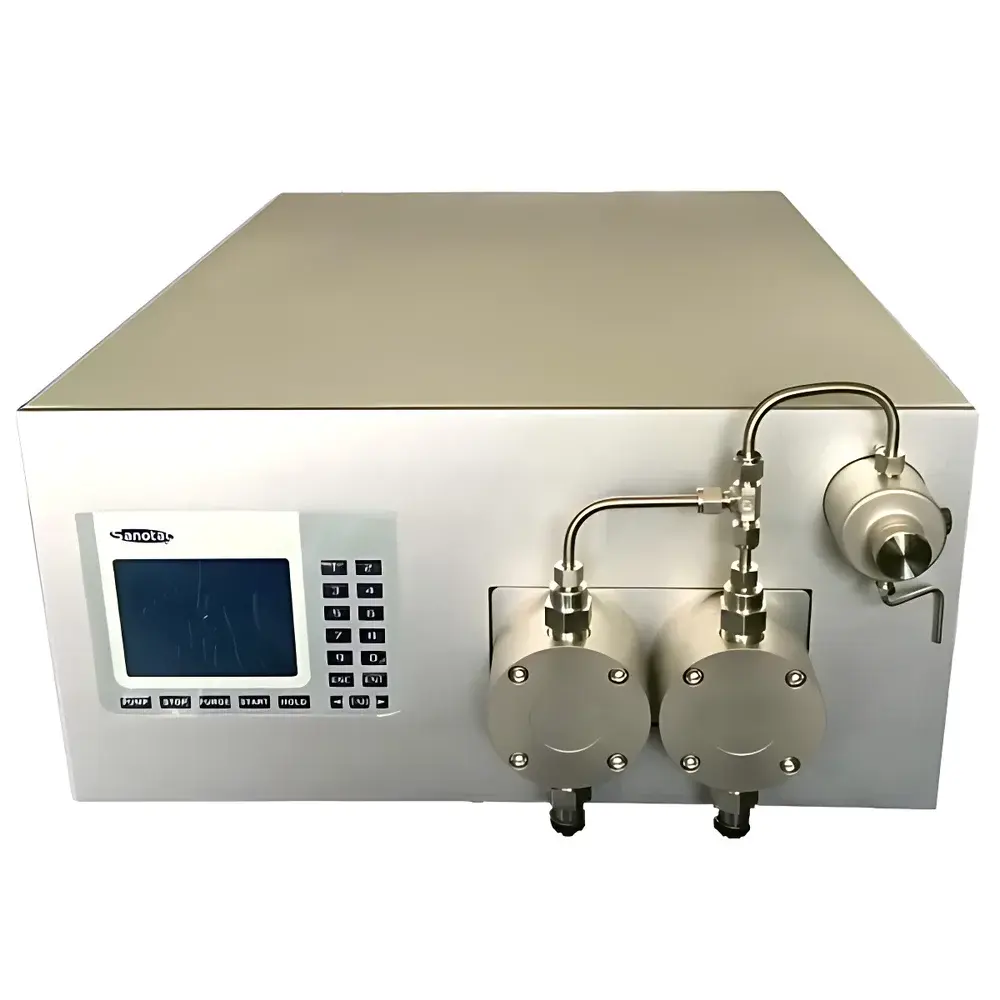
Sanotac KLP0110 High-Flow High-Pressure Dual-Piston Solvent Delivery Pump
| Brand | Sanotac |
|---|---|
| Origin | Shanghai, China |
| Manufacturer Type | Direct Manufacturer |
| Product Category | Domestic |
| Model | KLP0110 |
| Price Range | USD 2,800 – 7,000 |
| Flow Rate | 10–10,000 mL/min |
| Pressure Range | 2–42 MPa |
| Pump Head Volume | 1000 mL |
| Max Operating Pressure | 10 MPa (rated for continuous operation at 10 MPa |
| Construction Materials | Stainless Steel / Titanium / PTFE / PCTFE / Hastelloy C-276 / PEEK |
| Control Interface | Microprocessor-based dual-piston drive with solvent compressibility compensation and multi-point flow calibration |
| Gradient Capability | Isocratic, linear, step, and user-defined composite gradients |
| Pulse Damping | Cam-profile compensation + electronic flow pulsation suppression |
| Sealing Architecture | Floating plunger design with imported Swiss check valves |
| Software Integration | Open communication protocol (RS-485/Modbus RTU & optional Ethernet), compatible with third-party chromatography data systems (CDS) |
Overview
The Sanotac KLP0110 is a high-flow, high-pressure dual-piston solvent delivery pump engineered for precision fluid handling in demanding industrial and laboratory-scale applications. It operates on the principle of positive displacement via synchronized reciprocating pistons, incorporating real-time solvent compressibility compensation and dynamic cam-driven motion control to maintain volumetric accuracy across wide flow and pressure ranges. Unlike single-piston or peristaltic alternatives, the KLP0110’s parallel dual-head architecture ensures continuous, pulse-minimized flow—critical for applications requiring stable hydrostatic pressure, such as preparative liquid chromatography, continuous-flow catalytic reactors, supercritical fluid processing, and high-throughput chemical synthesis. Its rated continuous operating pressure of 10 MPa (1450 psi) and peak capability of 42 MPa (6090 psi) position it between mid-pressure and ultra-high-pressure pumping domains, making it suitable for both process development and pilot-scale deployment under GLP-compliant workflows.
Key Features
- Dual-piston architecture with independent microprocessor-controlled drives enables seamless flow continuity and eliminates dead-volume-induced pressure transients.
- Multi-point flow calibration algorithm corrects for solvent compressibility across 10–10,000 mL/min, delivering ≤±0.3% RSD flow accuracy over full dynamic range.
- Composite gradient generation supports isocratic, linear, step, and custom-defined gradient profiles—programmable via onboard interface or external workstation.
- Low-pressure-pulse design integrates mechanical cam-profile optimization and active electronic pulsation suppression, achieving <±0.5% pressure ripple at 10 MPa and 1000 mL/min.
- Floating plunger mechanism reduces radial load on high-pressure seals, extending seal service life by ≥3× versus fixed-plunger configurations; paired with OEM Swiss-made sapphire-seat check valves for long-term chemical inertness and leak-tight performance.
- Material flexibility includes wetted-path options in 316L stainless steel, titanium Grade 2, PTFE, PCTFE, Hastelloy C-276, and PEEK—enabling compatibility with aggressive solvents, halogenated reagents, and high-pH media.
Sample Compatibility & Compliance
The KLP0110 accommodates a broad spectrum of process fluids—from aqueous buffers and organic solvents (e.g., THF, DMF, acetonitrile) to corrosive acids (e.g., HCl, HNO₃), oxidizing agents (e.g., H₂O₂), and supercritical CO₂. Its modular wetted-material selection complies with ASTM F2136 (elastomer compatibility), ISO 15195 (laboratory pump performance verification), and USP (analytical instrument qualification). When configured with PEEK or Hastelloy components and operated within validated parameters, the pump meets GMP Annex 11 and FDA 21 CFR Part 11 requirements for audit-trail-enabled operation when integrated with compliant CDS platforms.
Software & Data Management
The pump features an embedded 10-program memory for standalone operation, supporting programmable flow ramps, gradient tables, and pressure-limit interlocks. Communication is implemented via open Modbus RTU (RS-485) and optional TCP/IP Ethernet, enabling bidirectional control and real-time telemetry—including flow rate, actual pressure, motor temperature, and valve status. The protocol documentation is publicly available, facilitating integration with Thermo Chromeleon, Waters Empower, Agilent OpenLab, or custom LabVIEW/Python-based control environments. All parameter changes are timestamped and logged internally, supporting ALCOA+ data integrity principles when used in regulated environments.
Applications
- Preparative and simulated moving bed (SMB) chromatography requiring >1 L/min flow at ≤10 MPa.
- Continuous-flow hydrogenation, oxidation, and cross-coupling reactions in fixed-bed or slurry reactors.
- Supercritical fluid extraction (SFE) and impregnation systems using CO₂ or ethane as mobile phase.
- High-shear polymer processing, including reactive extrusion and foam nucleation control.
- Electrolyte delivery in flow battery R&D and catalyst ink formulation for PEM fuel cell membrane electrode assembly (MEA) manufacturing.
- High-pressure material synthesis, such as hydrothermal crystallization and metal-organic framework (MOF) batch production.
FAQ
What is the maximum continuous operating pressure for the KLP0110?
The KLP0110 is rated for continuous operation at 10 MPa (1450 psi); its safety-rated burst pressure exceeds 63 MPa per ASME B31.3 process piping standards.
Can the pump handle abrasive slurries or particulate-laden fluids?
No—it is designed exclusively for homogeneous liquids; suspended solids >1 µm will accelerate wear and compromise seal integrity.
Is gradient mixing performed internally or externally?
Gradients are generated via time-based flow ratio control of two independently driven pump heads; no internal mixer is included—external static mixers are recommended for critical applications.
Does the pump support remote diagnostics or predictive maintenance?
Yes—motor current draw, plunger position feedback, and thermal sensor outputs are accessible via Modbus registers, enabling condition monitoring and failure mode trending.
How is solvent compressibility compensated during high-pressure operation?
The firmware applies real-time correction using preloaded isothermal compressibility coefficients for common solvents (e.g., water, methanol, acetonitrile), dynamically adjusting piston stroke volume based on measured system pressure.



