
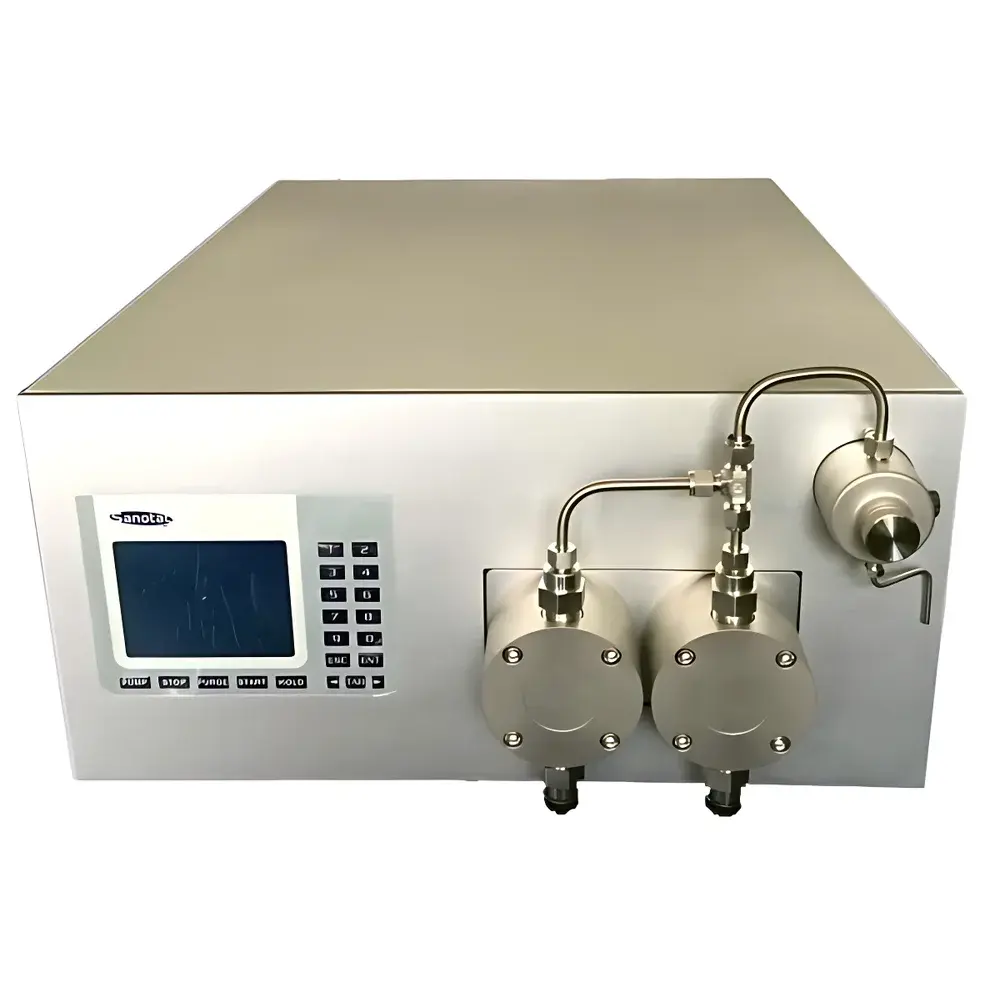
Sanotac LP1010 High-Pressure Preparative Dual-Piston Solvent Delivery Pump
| Brand | Sanotac |
|---|---|
| Origin | Shanghai, China |
| Manufacturer Type | Original Equipment Manufacturer (OEM) |
| Country of Origin | China |
| Model Capacity | 10,000 mL |
| Pressure Rating | 10 MPa |
| Flow Range | 0.1–10,000.0 mL/min |
| Flow Accuracy | ±1.5% |
| Flow Precision (RSD) | ≤1.0% |
| Pressure Pulsation | ≤0.5 MPa |
| Wetted Materials | 316L Stainless Steel, Sapphire, PTFE, Ceramic |
| Connection | 1/4" Standard Fittings |
| Display | 256×64 Dot Matrix Backlit LCD |
| Control Interface | Front Panel Keypad + Open-Protocol RS232/USB Computer Control |
| Power Supply | 85–264 VAC, 50 Hz |
| Dimensions | 730 × 540 × 280 mm³ |
Overview
The Sanotac LP1010 is a high-pressure preparative dual-piston solvent delivery pump engineered for precision fluid handling in demanding laboratory and pilot-scale applications. It operates on the principle of positive displacement via parallel-driven, floating piston assemblies—designed to minimize mechanical wear while maintaining consistent volumetric output across a wide dynamic flow range (0.1–10,000.0 mL/min). Its pressure capability of up to 10 MPa enables compatibility with high-backpressure systems such as preparative liquid chromatography (prep-LC), supercritical fluid processing (SFC), continuous-flow catalysis reactors, and high-viscosity reagent dosing in energy materials synthesis. The pump integrates microprocessor-based flow regulation with real-time solvent compressibility compensation and multi-point flow calibration—ensuring traceable accuracy per ISO 5725 and reproducibility aligned with ASTM D3418 standards for fluid metering instrumentation.
Key Features
- Dual-piston parallel architecture with floating piston design reduces seal stress and extends service life of 316L stainless steel–sapphire–ceramic sealing interfaces.
- Advanced pulse suppression system combining cam-profile optimization and electronic flow ripple correction achieves pressure pulsation ≤0.5 MPa—critical for stable detector baselines in UV/Vis or mass spectrometric detection.
- Open communication protocol (RS232/USB) supports bidirectional computer control; compatible with third-party chromatography data systems (CDS) and custom LabVIEW/Python automation frameworks.
- Ten onboard user-defined methods store gradient profiles—including isocratic, linear, stepwise, and composite gradients—enabling rapid method transfer between development and scale-up workflows.
- Full-wetted path constructed from chemically inert materials: 316L SS body, sapphire check valves (Swiss-sourced), PTFE seals, and ceramic plunger surfaces—validated for compatibility with aggressive solvents (e.g., TFA, HFIP, anhydrous THF) and corrosive catalyst solutions.
- Backlit 256×64 dot-matrix LCD provides real-time display of flow rate, pressure, gradient program status, error codes, and maintenance alerts—optimized for glove-box or fume hood integration.
Sample Compatibility & Compliance
The LP1010 is validated for use with organic solvents, aqueous buffers, ionic liquids, slurries (≤5 µm particle size), and low-to-medium viscosity polymer solutions (up to 500 cP at 25°C). Its wetted material set complies with USP Class VI biocompatibility requirements for non-implantable devices and meets ISO 10993-5 cytotoxicity screening thresholds. For regulated environments, the pump supports audit-trail-enabled operation when integrated with 21 CFR Part 11–compliant CDS platforms. All mechanical tolerances adhere to ISO 2768-mK general tolerancing standards; pressure transducers are calibrated per EN 837-1 and traceable to NIST-certified reference standards.
Software & Data Management
The pump’s embedded firmware supports ASCII-based command sets for remote triggering, parameter adjustment, and status interrogation. Raw operational logs—including timestamped flow/pressure values, valve actuation events, and thermal drift diagnostics—are exportable in CSV format. When paired with Sanotac’s optional PumpControl Studio (v3.2+), users gain access to gradient shape modeling tools, predictive maintenance scheduling, and GLP-compliant electronic signature workflows. All software modules undergo annual validation per ICH Q9 quality risk management principles.
Applications
- Preparative HPLC and flash chromatography systems requiring scalable, high-flow-rate eluent delivery.
- Catalytic reaction engineering: precise co-injection of catalysts, ligands, and substrates into continuous stirred-tank reactors (CSTRs) or tubular flow reactors.
- Supercritical CO₂ extraction and impregnation processes where stable subcritical-to-supercritical phase transitions demand zero-drift flow control.
- Battery electrolyte formulation R&D—accurate metering of LiPF₆, FEC, and fluorinated ethers under inert atmosphere.
- Pharmaceutical process development: API crystallization seeding, antisolvent addition, and controlled precipitation kinetics studies.
- Materials science: sol-gel precursor delivery for thin-film coating, MOF synthesis, and nanoparticle templating.
FAQ
What is the maximum operating pressure and flow range of the LP1010?
The LP1010 delivers flow rates from 0.1 to 10,000.0 mL/min at pressures up to 10 MPa (1450 psi), with full accuracy maintained across the entire range.
Does the pump support gradient elution in preparative LC?
Yes—the built-in gradient engine allows creation and execution of isocratic, linear, step, and user-defined composite gradients, fully programmable via front panel or external workstation.
How is flow accuracy verified and maintained over time?
Flow calibration uses gravimetric verification against certified balance standards (Class E2, ±0.1 mg), with automatic compensation for solvent density and compressibility stored in non-volatile memory.
Can the LP1010 be integrated into automated reactor control systems?
Absolutely—the open RS232/USB protocol enables seamless interfacing with PLCs, SCADA systems, and Python-based orchestration layers using standard Modbus RTU or ASCII command sets.
What maintenance intervals are recommended for long-term reliability?
Primary seal replacement is recommended every 6,000 hours of operation or after 12 months—whichever occurs first—under typical organic solvent usage; cam drive lubrication is specified per ISO 6743-9 class L-XCBB 0.



