
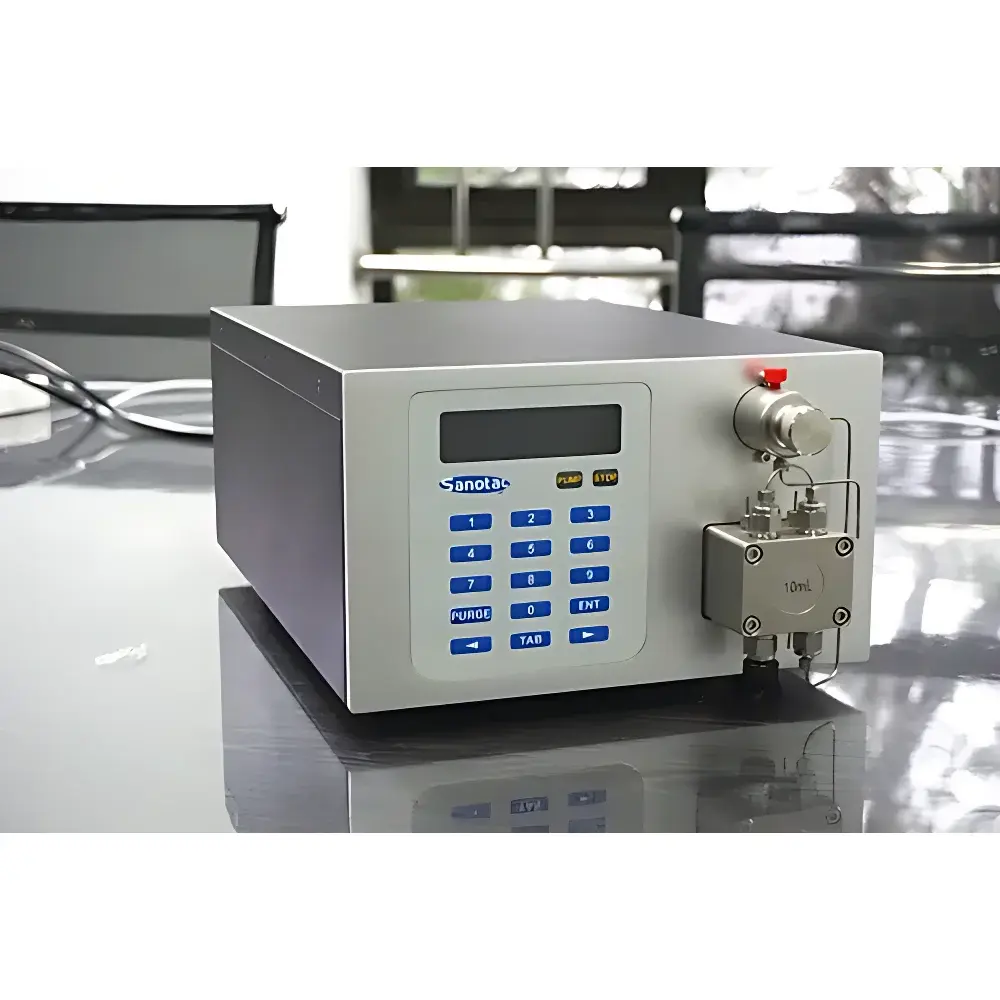
Sanotac MP1006-C Stainless Steel Parallel-Plunger High-Pressure Constant Flow Pump
| Brand | Sanotac |
|---|---|
| Origin | Shanghai, China |
| Manufacturer Type | Direct Manufacturer |
| Country of Origin | China |
| Model | MP1006-C |
| Flow Rate | 0.1–100.0 mL/min |
| Max Pressure | 6 MPa |
| Flow Accuracy | ±1% |
| Flow Precision (RSD) | ≤1% |
| Pressure Pulsation | ≤0.2 MPa |
| Wetted Materials | 316L Stainless Steel, Sapphire, Zirconia Ceramic |
| Communication | RS-232 (standard), RS-485/RS-422 (optional), Modbus RTU/ASCII, Sanotac Custom Protocol |
| Power Supply | 85–264 VAC, 50 Hz |
| Power Consumption | 75 W |
| Weight | 12 kg |
Overview
The Sanotac MP1006-C is a high-precision, parallel-plunger constant flow pump engineered for stable, pulse-minimized delivery of reactive and hazardous liquid reagents under elevated pressure conditions—specifically optimized for applications requiring strict stoichiometric control, such as the metering of di-tert-butyl peroxide (DTBP), a thermally sensitive organic peroxide widely used as a free-radical initiator in melt-blown polypropylene production, crosslinking of elastomers, and controlled polymerization reactions. Unlike single-plunger or syringe-based systems, the MP1006-C employs a dual-head cam-driven architecture where two plungers operate in counter-phase motion, synchronized with inlet/outlet sapphire check valves to achieve continuous, non-pulsating fluid displacement. This design ensures true constant volumetric flow across its full operating range (0.1–100.0 mL/min) at pressures up to 6 MPa, without reliance on downstream dampeners or active electronic flow correction loops. Its robust 316L stainless steel fluid path—combined with sapphire seating surfaces and zirconia ceramic plunger rods—provides exceptional chemical resistance against oxidizing agents, organic solvents, and mildly acidic or alkaline media, making it suitable for long-duration operation in demanding R&D and pilot-scale synthesis environments.
Key Features
- Parallel dual-plunger architecture with phase-shifted cam actuation for inherently low-pressure pulsation (≤0.2 MPa)
- Real-time pressure and flow rate curve visualization via integrated LCD interface with data logging capability
- User-configurable pressure limits (upper/lower bounds) with automatic shutdown and alarm output
- Multi-point volumetric flow calibration with solvent compressibility compensation algorithms
- Optional mass-flow mode (g/min) enabled by integration-ready load-cell input for gravimetric closed-loop control
- Column backflush function to prevent salt crystallization or precipitate accumulation on sealing surfaces
- Comprehensive communication suite: RS-232 (standard), RS-485/RS-422 (optional), supporting both Modbus RTU/ASCII and proprietary Sanotac protocol
- Scalable control architecture: supports standalone operation, dual-pump gradient mixing, or centralized 1-to-32 multi-pump coordination
- Configurable data export: pressure and flow time-series saved directly to Excel-compatible CSV files with timestamped metadata
- Full parameter persistence: user-defined settings—including port configuration, protection thresholds, and sequence programs—are retained after power cycling
Sample Compatibility & Compliance
The MP1006-C is validated for handling thermally unstable, low-viscosity organic peroxides including di-tert-butyl peroxide (CAS 110-05-4), as well as common reaction solvents (e.g., toluene, xylene, chlorinated hydrocarbons) and aqueous formulations containing dissolved salts. Its wetted materials meet ASTM F899-22 standards for corrosion-resistant metallic components and comply with ISO 8536-4 for medical-grade fluid pathway integrity. For regulated environments, the pump’s deterministic firmware architecture supports audit-trail-capable operation when interfaced with LIMS or SCADA platforms compliant with FDA 21 CFR Part 11 requirements. All electrical components conform to IEC 61010-1:2019 for laboratory equipment safety, and electromagnetic compatibility meets EN 61326-1:2013 Class A emission limits.
Software & Data Management
The MP1006-C operates via an embedded real-time OS with deterministic timing control for sub-second response to external triggers or serial commands. Its firmware includes built-in data acquisition buffers that record pressure and flow values at 10 Hz resolution, enabling post-hoc analysis of transient system behavior during initiation events or thermal ramping. Exported CSV files include header metadata (pump ID, timestamp, firmware version, calibration epoch), ensuring traceability in GLP/GMP workflows. Remote control is supported through Python, LabVIEW, and MATLAB drivers (available upon request), with full support for Modbus register mapping—including writable registers for setpoint modulation and read-only registers for live diagnostics. Optional PC-based configuration software provides graphical workflow scripting for multi-step protocols, including conditional branching based on pressure thresholds or elapsed time.
Applications
- Precision feeding of DTBP and other peroxide initiators into melt-blown PP extrusion lines for fiber morphology control
- Continuous-flow synthesis of functional polymers requiring stoichiometric oxidant dosing
- Microreactor and chip-based catalytic systems demanding stable residence time distribution
- High-pressure liquid chromatography (HPLC) auxiliary pumping for mobile phase blending or derivatization reagent injection
- Accelerated aging studies involving oxidative stress exposure of polymer films or composites
- Calibration reference standard for flowmeter validation in ISO/IEC 17025-accredited laboratories
- Integration into automated reaction stations (e.g., ChemSpeed, Unchained Labs) via Modbus TCP gateway adapters
FAQ
What is the maximum allowable viscosity for stable operation at 6 MPa?
The MP1006-C is rated for Newtonian fluids up to 50 cP at full pressure; higher viscosities require derating of maximum flow rate to maintain mechanical longevity and pulsation performance.
Can the pump be used with corrosive halogenated solvents like chloroform or carbon tetrachloride?
Yes—its 316L stainless steel body, sapphire valves, and zirconia plunger rods provide broad compatibility with halogenated organics; however, prolonged exposure to strong Lewis acids or anhydrous HF is not recommended.
Is flow calibration traceable to NIST standards?
While the pump itself does not include certified calibration documentation, its multi-point linearization algorithm accepts user-provided gravimetric calibration data derived from NIST-traceable analytical balances and certified volumetric glassware.
Does the system support fail-safe shutdown during loss of prime?
Yes—the firmware continuously monitors pressure differentials across the pump head and triggers immediate stop + alarm if inlet pressure falls below 0.1 MPa for >3 seconds, preventing dry-running damage.
How is temperature drift compensated during extended runs?
Thermal expansion effects are mitigated through dual-stage plunger position feedback and adaptive cam-profile adjustment; no external temperature sensor input is required for typical lab ambient variations (15–30°C).



