
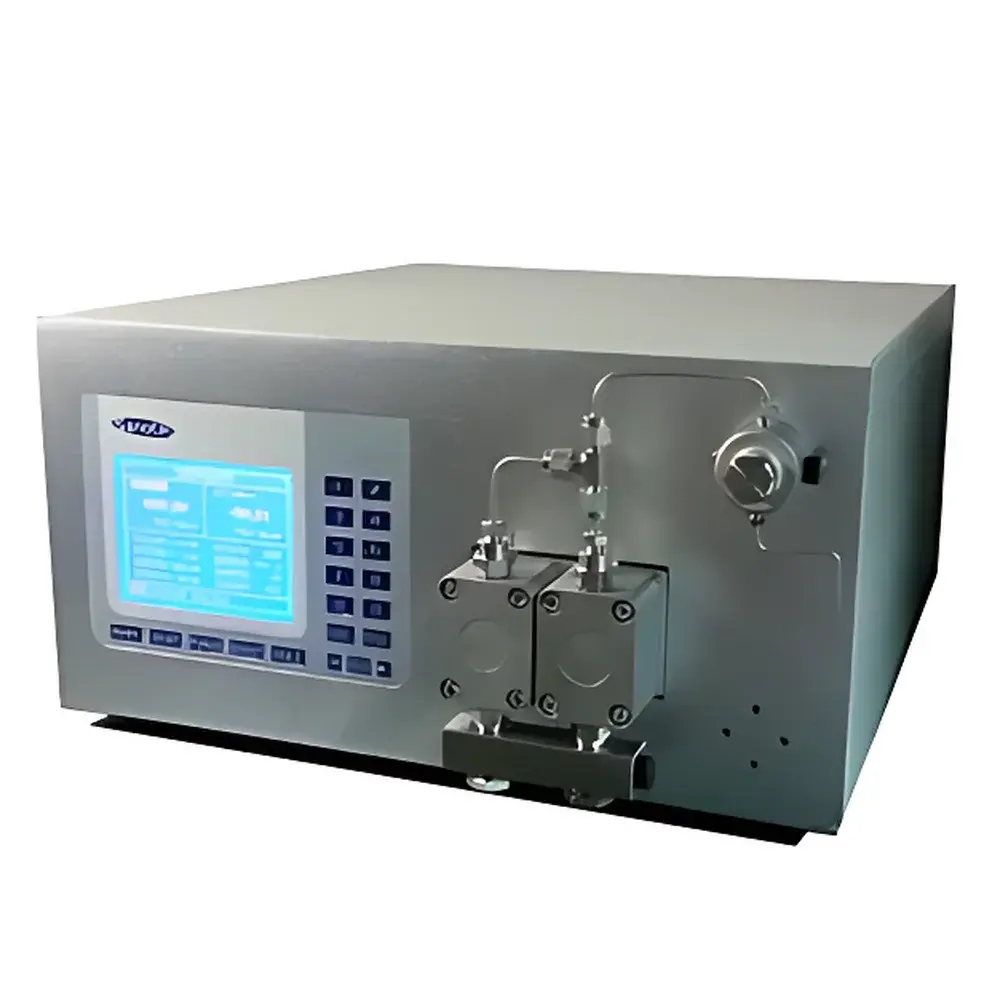
Sanotac N1000 High-Pressure Syringe Pump for LNP Formulation in mRNA/DNA Delivery Systems
| Brand | Sanotac |
|---|---|
| Origin | Shanghai, China |
| Manufacturer Type | Direct Manufacturer |
| Region Classification | Domestic (China) |
| Model | N1000 |
| Flow Rate | 0.1–1000.00 mL/min |
| Pressure Rating | ≤ 10 MPa |
| Flow Accuracy | ±0.5% |
| Flow Precision (RSD) | ≤ 0.5% |
| Pressure Pulsation | ≤ 0.2 MPa |
| Pump Head Material | 316L Stainless Steel, Sapphire, PTFE, Ceramic |
| Tubing Connection | 1/8" Standard |
| Display | Backlit LCD |
| Communication | RS232 & USB (standard), RS485/RS422/Ethernet (optional), Modbus RTU protocol |
| Power Supply | 85–264 VAC, 50 Hz |
Overview
The Sanotac N1000 High-Pressure Syringe Pump is an engineered fluid delivery system specifically designed for precise, reproducible, and scalable formulation of lipid nanoparticle (LNP) carriers used in mRNA and DNA therapeutic development. It operates on a dual-piston parallel displacement principle with floating plunger architecture—enabling stable, pulse-minimized flow under high backpressure conditions required for microfluidic mixing in LNP synthesis. Unlike conventional peristaltic or gear pumps, the N1000 delivers consistent volumetric output across its full operational range (0.1–1000.00 mL/min) while maintaining pressure stability up to 10 MPa (1450 psi), making it suitable for integration into collision-jet or T-junction microfluidic platforms where laminar co-flow of lipid ethanol solution and aqueous nucleic acid buffer must be precisely synchronized. Its mechanical design conforms to ISO 8536-4 and ASTM D329 standards for medical-grade fluid handling components, ensuring compatibility with GMP-aligned process development workflows.
Key Features
- Dual parallel plunger configuration with real-time cam-profile compensation to suppress flow pulsation (≤0.2 MPa pressure ripple at rated load)
- Full-range multi-point flow calibration traceable to NIST-certified gravimetric standards, achieving ±0.5% accuracy and ≤0.5% RSD over 0.1–1000 mL/min
- Modular pump head construction using biocompatible, chemically inert materials: 316L stainless steel wetted surfaces, sapphire check valves, PTFE seals, and ceramic plungers
- Integrated post-stroke plunger cleaning cycle to reduce seal wear and extend service life beyond 10,000 operational hours
- Configurable analog/digital I/O interface supporting 4–20 mA current loop input, dry-contact start/stop, and TTL-level trigger synchronization
- Multi-protocol industrial communication suite including Modbus RTU (RS232/RS485), Ethernet TCP/IP, and optional Profibus-DP/Profinet for PLC-level orchestration
Sample Compatibility & Compliance
The N1000 is validated for use with common LNP formulation solvents—including ethanol, isopropanol, and chloroform-based lipid solutions—as well as aqueous buffers containing mRNA, siRNA, or plasmid DNA. All wetted path components comply with USP Class VI and ISO 10993-5 cytotoxicity requirements. The pump meets CE marking directives for machinery safety (2006/42/EC) and electromagnetic compatibility (2014/30/EU). When deployed in regulated environments, audit trails generated via external SCADA or DCS systems can be configured to satisfy FDA 21 CFR Part 11 electronic record integrity criteria, provided timestamped event logging and user-access controls are implemented at the supervisory layer.
Software & Data Management
While the N1000 operates autonomously via front-panel LCD control, its embedded firmware supports seamless integration into centralized process monitoring architectures. It natively exports time-stamped flow and pressure telemetry via ASCII-formatted serial packets or JSON-over-TCP streams. Customers routinely integrate the device into LabVIEW-based validation frameworks, Siemens S7 PLC-controlled batch systems, and Ignition SCADA platforms using prebuilt Modbus register maps. Firmware version 2.3+ includes support for dynamic setpoint ramping, programmable pause/resume sequences, and error-state latching with non-volatile memory retention—facilitating deviation investigation during GLP/GMP audits.
Applications
- Controlled microfluidic mixing for scalable LNP production in preclinical and clinical-stage mRNA vaccine programs
- Process parameter optimization studies (e.g., flow rate ratio, total flow, pressure gradient) impacting particle size distribution (PDI 90%)
- Automated feed control in continuous manufacturing lines compliant with ICH Q5A(R2) and Q5D guidelines
- Parallelized multi-channel LNP synthesis setups using synchronized N1000 units coordinated via master-slave Modbus addressing
- In-line gravimetric feedback loops coupling pump output with reactor inlet load cells for closed-loop mass-balance control
FAQ
What is the maximum allowable operating pressure for the N1000 model?
The N1000 is rated for continuous operation up to 10 MPa (1450 psi); short-term pressure spikes up to 12 MPa are permissible within defined duty cycles.
Can the N1000 be integrated into a fully automated GMP-compliant LNP manufacturing line?
Yes—its deterministic timing behavior, deterministic communication latency (<50 ms Modbus response), and hardware-level fault signaling enable compliance with ISA-88 and ISA-95 automation hierarchies when paired with validated control software.
Does the pump support gradient elution profiles commonly used in analytical LNP characterization?
While primarily intended for isocratic delivery in formulation, firmware v2.3+ enables stepwise flow-rate transitions with programmable dwell times, supporting basic two-solvent mixing protocols for inline dilution or buffer exchange.
Is calibration documentation provided with each unit?
Each N1000 ships with a factory calibration certificate referencing NIST-traceable mass standards, including raw gravimetric test data, uncertainty budgets, and environmental condition logs.
How is maintenance access managed without compromising sterility in cleanroom deployments?
The pump head assembly is modular and tool-free; all consumables—including seals, check valves, and plungers—are replaceable under ISO Class 5 conditions using validated aseptic handling procedures outlined in the technical manual.
Related Products



