
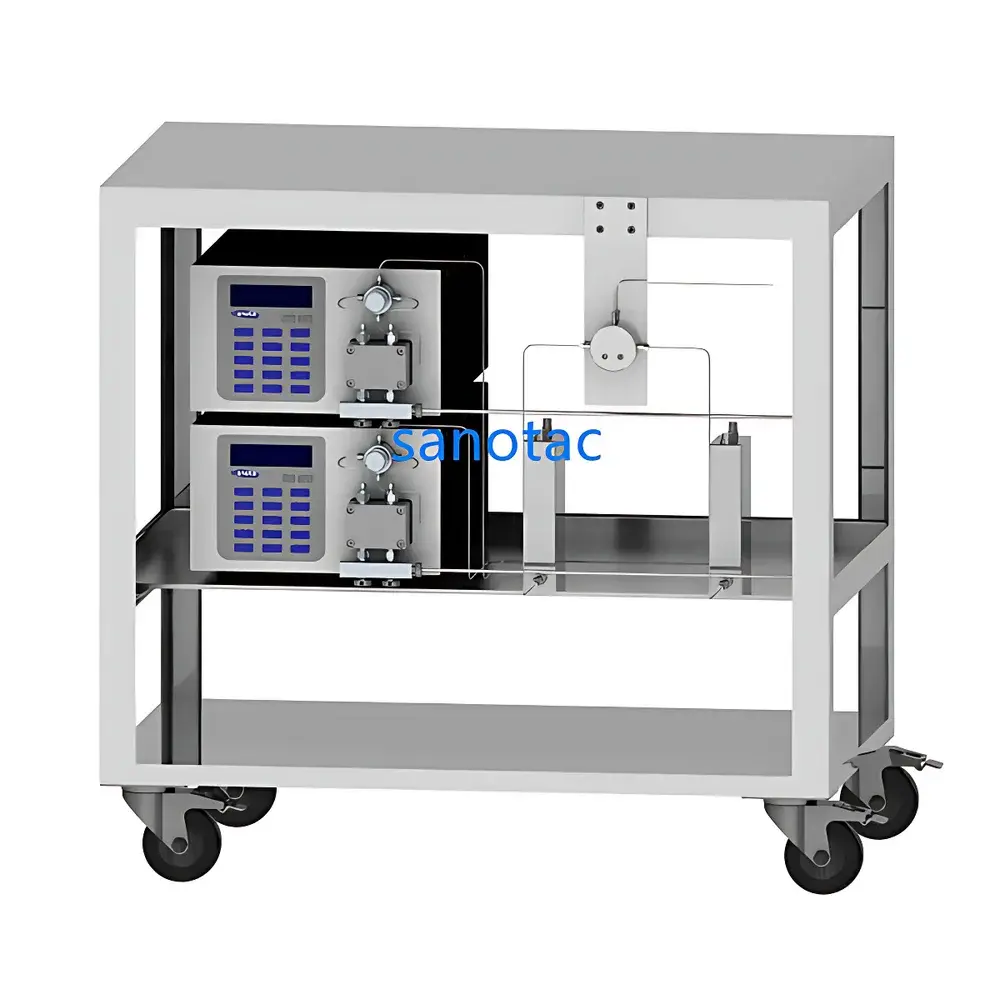
Sanotac NX-10 Microfluidic Lipid Nanoparticle (LNP) Synthesis System for DNA/mRNA Nucleic Acid Delivery
| Brand | Sanotac |
|---|---|
| Origin | Shanghai, China |
| Manufacturer Type | OEM Manufacturer |
| Regional Category | Domestic (China) |
| Model | NX-10 |
| Quotation | Upon Request |
| Carrier Type | Lipid Nanoparticle (LNP) |
| Flow Rate Range | 200 mL/min (total combined flow) |
| Flow Rate Reproducibility | ≤ ±0.5% |
| Maximum Operating Pressure | 10 MPa |
Overview
The Sanotac NX-10 Microfluidic Lipid Nanoparticle (LNP) Synthesis System is an integrated, GMP-aligned fluidic platform engineered for the precise, reproducible, and scalable preparation of nucleic acid–loaded lipid nanoparticles—specifically optimized for mRNA, siRNA, pDNA, and DNA vaccine delivery applications. It operates on the principle of controlled hydrodynamic focusing and rapid mixing via microfluidic laminar flow, where aqueous-phase nucleic acid solutions and organic-phase lipid ethanol solutions are simultaneously introduced into a microchannel geometry under precisely regulated pressure and flow conditions. This enables nanoscale self-assembly of LNPs through spontaneous liposome formation upon solvent displacement and diffusion-controlled phase separation. The system’s core architecture supports continuous-flow synthesis with real-time parameter control, eliminating batch-to-batch variability inherent in bulk ethanol injection methods. Its design conforms to fundamental principles of microfluidic mass transfer kinetics, wherein particle size distribution, polydispersity index (PDI), encapsulation efficiency, and structural integrity are directly governed by total flow rate (TFR) and flow rate ratio (FRR = aqueous/organic), enabling systematic process optimization aligned with Quality by Design (QbD) frameworks.
Key Features
- Dual high-precision 316L stainless steel high-pressure syringe pumps (N-series), each independently programmable for lipid and nucleic acid streams, with flow ranges spanning 0.001–1000 mL/min and reproducibility ≤ ±0.5%
- Integrated real-time pressure monitoring and user-configurable pressure limit protection (up to 10 MPa), preventing chip overpressure and ensuring operational safety during high-throughput synthesis
- Modular microfluidic interface supporting both jet impingement mixers (for high-pressure, high-throughput operation) and low-pressure microchip reactors (for R&D-scale screening)
- On-line dilution and quenching capability via auxiliary dilution pump, enabling immediate post-mixing stabilization and buffer exchange to arrest nanoparticle growth
- Pre-mixing modules and valve manifolds for automated stream routing, reagent priming, and multi-step protocol execution without manual intervention
- Full-system synchronization via NanoFlu Fluid Control Software, compliant with FDA 21 CFR Part 11 requirements for electronic records, role-based access control, audit trails, and electronic signatures
Sample Compatibility & Compliance
The NX-10 accommodates a broad spectrum of nucleic acid payloads—including unmodified and chemically stabilized mRNA, siRNA, antisense oligonucleotides (ASOs), and plasmid DNA—as well as diverse lipid formulations (e.g., ionizable lipids, DSPC, cholesterol, PEG-lipids). All wetted materials—including pump heads, tubing, mixer channels, and valves—are constructed from biocompatible, non-leaching, and corrosion-resistant components (316L stainless steel, PEEK, PTFE, ruby, and ceramic), minimizing extractables and ensuring compatibility with GMP-grade excipients. The system meets ISO 13485 design control requirements for medical device manufacturing and supports compliance with ICH Q5A(R2), Q5B, and Q5D for biological product characterization. Process data integrity adheres to ALCOA+ principles (Attributable, Legible, Contemporaneous, Original, Accurate, Complete, Consistent, Enduring, Available), facilitating regulatory submissions under FDA, EMA, and NMPA guidelines.
Software & Data Management
NanoFlu software serves as the central orchestration engine for the NX-10 platform. It provides deterministic control over all fluidic modules—including pump sequencing, gradient flow programming, real-time pressure/flow telemetry, and event-triggered valve actuation. Users may define custom flow profiles (constant, linear ramp, exponential decay, or imported mathematical functions) with millisecond-level timing resolution. All operational parameters—including TFR, FRR, dwell time, dilution factor, and quench volume—are timestamped, encrypted, and stored with full metadata (user ID, method name, version, instrument ID). Data export is available in CSV, PDF, and XML formats compatible with LIMS and statistical process control (SPC) platforms. The software supports remote diagnostics, firmware updates, and integration with SCADA, DCS, or PLC systems via Modbus RTU, Profibus DP, Profinet, and TCP/IP protocols—enabling seamless adoption into centralized manufacturing execution systems (MES).
Applications
- mRNA vaccine development and clinical manufacturing (Phase I–III)
- siRNA therapeutics formulation for hepatic and extrahepatic targeting
- CRISPR-Cas ribonucleoprotein (RNP) encapsulation for ex vivo cell therapy
- High-throughput screening of LNP composition–structure–activity relationships (CSAR)
- Process validation and tech transfer from lab-scale to pilot-scale continuous manufacturing lines
- Stability-indicating studies including freeze-thaw cycling, long-term storage, and forced degradation testing
FAQ
Can the NX-10 be integrated with third-party analytical instruments such as dynamic light scattering (DLS) or nanoparticle tracking analysis (NTA)?
Yes—the system features analog/digital I/O ports and standard communication protocols (RS485, USB, Ethernet) to synchronize with external particle analyzers for real-time size and PDI feedback control.
Does the system support Good Manufacturing Practice (GMP) documentation workflows?
Yes—NanoFlu software includes full 21 CFR Part 11 compliance functionality: electronic signatures, audit trail review, change control logs, and secure user authentication with four-tier permission levels.
What is the minimum required organic phase volume for stable LNP formation?
Typical ethanol-based lipid concentrations range from 2–10 mg/mL; minimum total organic phase volume per run is 50 µL when using calibrated low-flow pump configurations.
Is hardware calibration traceable to national standards?
All flow and pressure sensors are factory-calibrated against NIST-traceable references; users may perform in-house recalibration using certified volumetric standards and dead-weight testers.
Can the NX-10 operate under sterile conditions for aseptic processing?
While the base configuration is not Class A-certified, the system supports integration with isolators, gloveboxes, and sterilizable fluid paths (e.g., gamma-irradiated tubing, SIP-compatible chips) for cGMP-compliant operations.



