
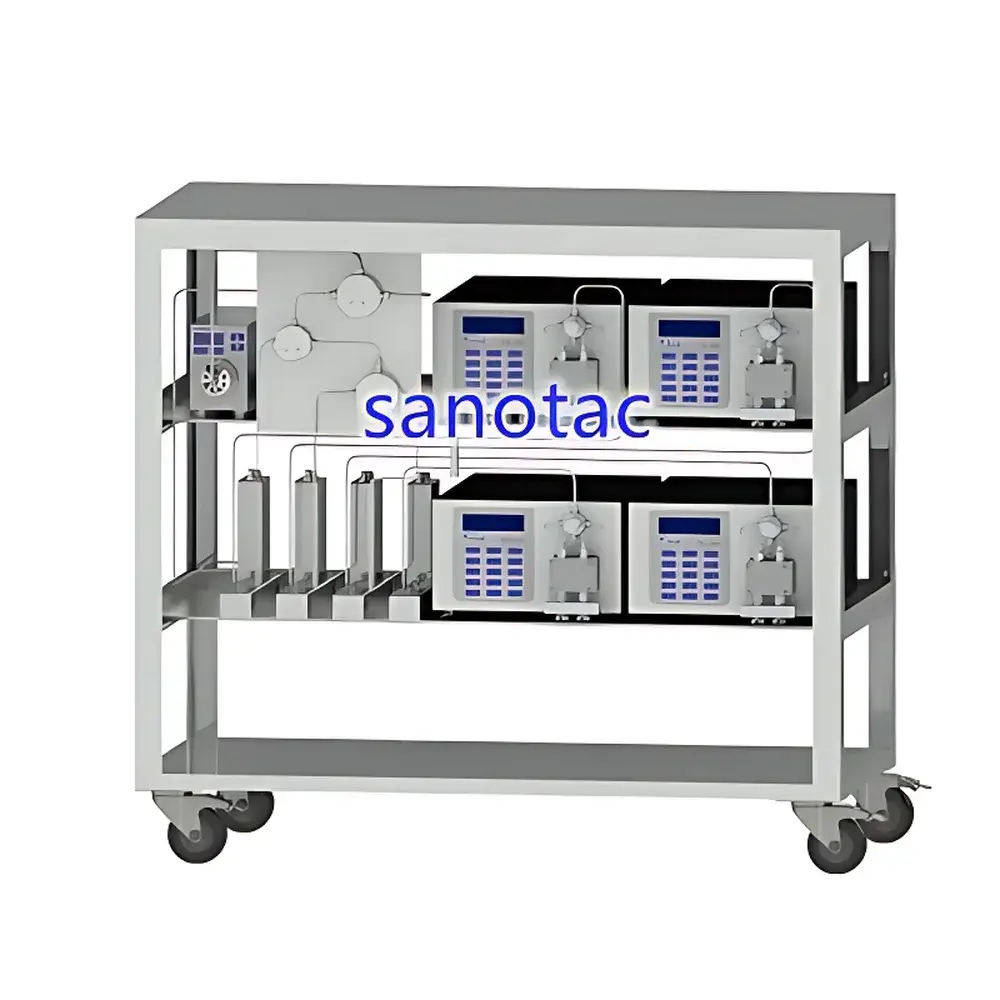
Sanotac NX-200 mRNA Lipid Nanoparticle (LNP) Formulation System
| Brand | Sanotac |
|---|---|
| Origin | Shanghai, China |
| Manufacturer Type | Direct Manufacturer |
| Country of Origin | China |
| Model | NX-200 |
| Carrier Type | Lipid Nanoparticle (LNP) |
| Flow Capacity | 200 mL/min |
| Pump Material | 316L Stainless Steel |
| Compliance | FDA 21 CFR Part 11 (via NanoFlu Software) |
| Patents | ZL202221027700.6, ZL202121807711.1 |
Overview
The Sanotac NX-200 mRNA Lipid Nanoparticle (LNP) Formulation System is an engineered fluidic platform designed for the reproducible, scalable synthesis of lipid nanoparticles used in mRNA-based therapeutics. It operates on the principle of controlled turbulent jet impingement mixing—where lipid-in-ethanol and aqueous mRNA solutions are delivered at precisely regulated flow rates through dual high-pressure streams that collide within a geometrically optimized impingement chamber. This rapid mixing induces spontaneous self-assembly of lipids around nucleic acid payloads, yielding monodisperse LNPs with tunable size (typically 70–120 nm), narrow polydispersity index (PDI 90%). The system supports both bench-scale process development and clinical-stage batch production, with architecture compliant with current Good Manufacturing Practice (cGMP) readiness requirements for early-phase biomanufacturing environments.
Key Features
- Dual-channel high-pressure fluid delivery: Two Sanotac N200 316L stainless steel syringe pumps (0.01–200.00 mL/min, ≤±0.5% accuracy, ≤0.1% repeatability) independently control lipid and mRNA solution flow rates.
- Impingement-based mixing core: A single precision-machined jet mixer enables robust, shear-controlled nanoparticle formation under pressures up to 10 MPa; optional microfluidic chip module available for low-flow (<5 mL/min), high-sensitivity applications.
- Integrated dilution & quench capability: Two auxiliary dilution pumps and two pre-mixing/quench modules allow inline buffer exchange and pH stabilization post-assembly—critical for maintaining RNA integrity and LNP stability.
- Modular expandability: Supports parallel unit scaling (N×NX-200 configurations) or serial throughput scaling via higher-capacity variants (NX-300 to NX-3000), enabling seamless transition from formulation screening to GMP-aligned manufacturing.
- Full digital integration: Equipped with RS232/485/422, USB, and Ethernet interfaces; compatible with Modbus RTU, Profibus DP, Profinet, and analog/digital I/O for direct integration into SCADA, DCS, or PLC control architectures.
Sample Compatibility & Compliance
The NX-200 accommodates a broad range of nucleic acid payloads—including unmodified and chemically stabilized mRNA, saRNA, and siRNA—as well as diverse lipid formulations (e.g., ionizable lipids DLin-MC3-DMA, SM-102, ALC-0315; phospholipids DSPC; cholesterol; PEG-lipids). All wetted materials—including pump heads, tubing, mixer chambers, and valves—are constructed from USP Class VI-certified 316L stainless steel, PTFE, PEEK, ruby, and ceramic components, ensuring chemical resistance to ethanol, acidic buffers, and organic co-solvents. The system conforms to ISO 13485 design controls and supports validation documentation packages aligned with ICH Q5A(R2), Q5B, and Q5D guidelines. When operated with NanoFlu software, it meets FDA 21 CFR Part 11 requirements for electronic records and signatures, including role-based access control, audit trails, electronic signatures, and immutable data archiving.
Software & Data Management
NanoFlu Fluid Workstation is the native control and data acquisition platform for the NX-200. It provides real-time monitoring and programmable control of all fluidic modules—including pump speed profiles (constant, linear ramp, gradient, user-defined function import), pressure feedback loops, and valve sequencing. The software logs time-stamped pressure vs. flow curves, calculates cumulative volume dispensed per channel, and exports structured CSV/Excel reports for statistical process analysis. Calibration routines support multi-point volumetric verification across the full flow range, with compensation for temperature- and viscosity-dependent deviations. NanoFlu Standard Edition manages up to four pumps; NanoFlu Multi-Station Edition supports centralized orchestration of multiple NX-series units. All versions include built-in cybersecurity features: TLS-encrypted network communication, session timeout, and encrypted local database storage.
Applications
- mRNA vaccine development: Rapid optimization of LNP composition, molar ratio screening, and dose-ranging studies for prophylactic and therapeutic candidates.
- Oligonucleotide delivery research: Formulation of siRNA, antisense oligos, and CRISPR-Cas ribonucleoprotein complexes with controlled particle size and surface charge.
- Process analytical technology (PAT) integration: Native compatibility with inline dynamic light scattering (DLS), UV-Vis spectrophotometry, and fluorescence intensity sensors for real-time particle size and encapsulation monitoring.
- Technology transfer support: Reproducible method transfer between NX-50 (R&D) and NX-1000 (pilot) systems using identical mixing geometry and flow dynamics—reducing scale-up risk.
- Academic and CRO use: Validated in over 12 Phase I/II mRNA clinical trials; referenced in peer-reviewed publications on LNP physicochemical characterization and in vivo biodistribution modeling.
FAQ
What is the minimum and maximum total flow rate supported by the NX-200 system?
The NX-200 supports combined flow rates from 0.1 mL/min to 200 mL/min, with independent control of lipid and aqueous streams across the full range.
Can the system be validated for GMP manufacturing?
Yes—the hardware design follows ASME BPE surface finish standards (Ra ≤ 0.4 µm), and NanoFlu software includes IQ/OQ documentation templates and 21 CFR Part 11 compliance features required for GMP audits.
Is microfluidic chip mixing available as an alternative to jet impingement?
Yes—a replaceable microfluidic chip module (pressure-rated to 2 MPa) is offered for low-volume, high-precision applications where laminar diffusion-based mixing is preferred.
How does the system ensure batch-to-batch consistency in LNP size distribution?
Consistency is achieved through closed-loop flow control, real-time pressure monitoring, geometrically invariant mixer design, and automated calibration traceability—enabling RSDs <2% in hydrodynamic diameter across consecutive runs.
Does Sanotac provide technical support for process parameter optimization?
Yes—application engineers offer remote and on-site assistance for DoE-based formulation optimization, including lipid:mRNA ratio mapping, ethanol concentration tuning, and buffer exchange protocol development.



