
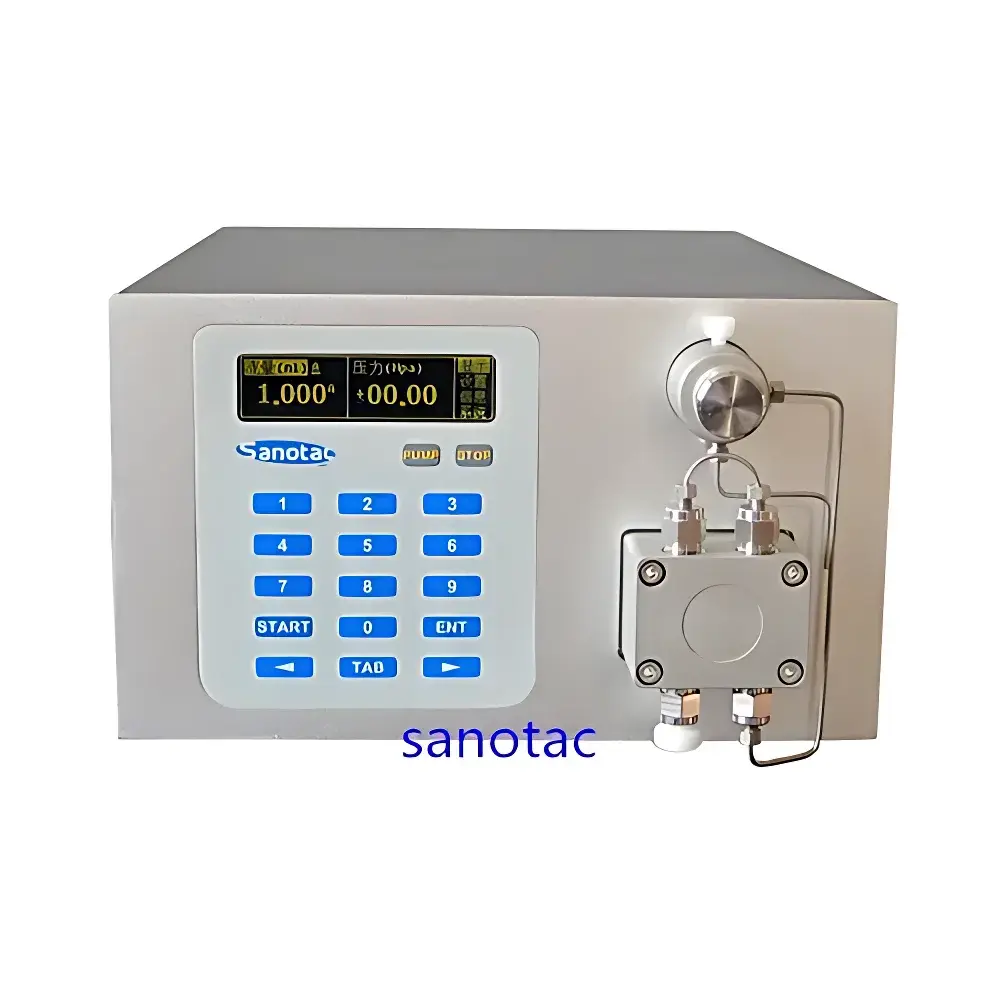
Sanotac Omnito CP0010 Constant-Pressure Infusion Pump
| Brand | Sanotac |
|---|---|
| Origin | Shanghai, China |
| Manufacturer Type | Original Equipment Manufacturer (OEM) |
| Product Category | Domestic |
| Model | Omnito CP0010 |
| Price Range | USD 1,400 – 2,800 |
| Pump Type | Dual-piston串联 constant-pressure/constant-flow precision infusion pump |
| Pressure Range | 1–42 MPa |
| Pressure Accuracy | ±0.1 MPa |
| Flow Range | 0.001–9.999 mL/min |
| Flow Increment | 0.001 mL/min |
| Flow Accuracy | ±0.1% |
| Flow Precision (RSD) | ≤0.1% |
| Pump Head Material | 316L stainless steel (optional PEEK or titanium) |
| Fluidic Path Materials | 316L SS, ruby, PTFE, ceramic |
| Tubing Connection | 1/16″ standard fittings |
| Display | 256×64 dot-matrix backlit LCD |
| Control Interface | Front-panel keypad + open-protocol computer remote control (RS-232/USB) |
| Power Supply | 85–264 VAC, 50 Hz |
| Dimensions | 370 × 240 × 152 mm |
| Compliance | Designed for GLP-compliant lab environments |
Overview
The Sanotac Omnito CP0010 is a high-precision, dual-piston constant-pressure infusion pump engineered for applications demanding stable hydraulic pressure over extended durations—distinct from conventional constant-flow peristaltic or single-piston systems. It operates on a closed-loop pressure feedback principle: real-time pressure sensing at the outlet drives dynamic adjustment of piston stroke velocity and dwell timing via embedded motion control algorithms. This architecture enables true constant-pressure delivery even under variable downstream resistance—critical in organ perfusion, microfluidic chip loading, and catalytic reactor feed systems where pressure stability directly governs reaction kinetics, membrane integrity, or cellular viability. Unlike fixed-displacement pumps, the CP0010 continuously modulates volumetric output to maintain user-set pressure within ±0.1 MPa tolerance across its full 1–42 MPa operating range. Its floating piston design minimizes seal shear stress, extending service life while maintaining leak-tight performance at ultra-high pressures.
Key Features
- Dual-piston tandem architecture with cam-profile compensation and active electronic pulse suppression—reducing pressure ripple to ≤0.1 MPa (peak-to-peak) at all flow rates
- Two operational modes: constant-pressure infusion (user-defined setpoint) and constant-flow infusion (with ±0.1% accuracy and ≤0.1% RSD)
- Modular fluid path constructed from chemically inert, high-strength materials: standard 316L stainless steel pump head; optional PEEK or titanium heads for aggressive solvents or saline environments
- Full fluidic compatibility with ruby check valves (Swiss-sourced), ceramic plungers, PTFE seals, and USP Class VI–certified wetted components
- Open-protocol remote control interface (RS-232 and USB) supporting custom LabVIEW, Python, or MATLAB integration—no proprietary drivers required
- Backlit 256×64 pixel LCD display with real-time visualization of pressure, flow rate, elapsed time, and system status flags
- Robust mechanical design compliant with IEC 61010-1 safety standards for laboratory equipment; CE-marked and RoHS-compliant
Sample Compatibility & Compliance
The Omnito CP0010 accommodates a broad spectrum of liquids—from aqueous buffers and cell culture media to organic solvents (e.g., acetonitrile, THF), corrosive acids (HCl, HNO₃ ≤2 M), and viscous polymer solutions (up to 500 cP). Its fluid path materials meet ISO 10993-5 cytotoxicity requirements and USP biological reactivity testing, making it suitable for ex vivo organ perfusion (e.g., Langendorff heart, isolated kidney) and preclinical drug delivery studies. All wetted surfaces are electropolished to Ra ≤0.4 µm, minimizing protein adsorption and biofilm formation. The system supports audit-ready operation under GLP and GMP frameworks: event logs (including pressure deviations, error codes, and mode switches) are timestamped and stored internally for ≥30 days, with export capability via serial interface.
Software & Data Management
The CP0010 does not rely on vendor-locked software. Its ASCII-based command protocol enables direct integration into existing LIMS or ELN platforms. Each command (e.g., “PSET 25.0” to set 25.0 MPa pressure) returns a machine-readable response (e.g., “ACK|P=24.98|T=123456”) including actual measured pressure, internal temperature, and epoch timestamp. Data logging intervals are programmable from 100 ms to 60 s. For regulated environments, users may configure the pump to generate CSV-formatted session reports—including start/stop times, cumulative volume dispensed, max/min pressure excursions, and calibration history—compatible with 21 CFR Part 11–compliant digital signature workflows when paired with validated third-party acquisition software.
Applications
- Ex vivo organ perfusion: Maintains physiologically relevant coronary or renal perfusion pressure during ischemia-reperfusion studies without flow-induced endothelial damage
- Controlled chemical dosing: Delivers precise stoichiometric reagent addition to high-pressure reactors (e.g., hydrothermal synthesis, supercritical CO₂ extraction)
- Microfluidic platform priming: Enables bubble-free, pulse-free loading of nanoliter-scale channels and droplet generators
- Gene therapy vector formulation: Provides laminar, low-shear infusion during liposome or AAV encapsulation processes
- Petrochemical catalysis research: Supplies consistent pressure-driven feed to fixed-bed or fluidized-bed reactors under harsh thermal/chemical conditions
- Calibration traceability: Serves as a primary pressure source for validating pressure transducers and flow meters per ISO/IEC 17025 requirements
FAQ
What distinguishes constant-pressure mode from constant-flow mode on the CP0010?
In constant-pressure mode, the pump dynamically adjusts piston velocity to hold outlet pressure at the user-defined setpoint—ideal when downstream resistance varies (e.g., clogging filters or expanding gels). In constant-flow mode, it delivers a fixed volumetric rate regardless of backpressure, up to 42 MPa.
Can the CP0010 be integrated into automated synthesis platforms?
Yes—the open ASCII protocol supports bidirectional communication with PLCs, robotic liquid handlers, and SCADA systems. Command latency is <50 ms, enabling real-time pressure-triggered event responses.
Is the pump compatible with aggressive solvents like DMSO or chlorinated hydrocarbons?
With PEEK or titanium pump head options and ceramic/ruby valve assemblies, the CP0010 handles DMSO, dichloromethane, and 30% H₂O₂ without degradation—validated per ASTM D543 immersion testing.
Does the system support regulatory compliance for pharmaceutical development?
While the pump itself is not FDA-cleared, its design aligns with ICH Q5C stability testing guidance and supports data integrity requirements for Annex 11 and ALCOA+ principles when deployed with validated software layers.
What maintenance intervals are recommended for long-term reliability?
Seals and check valves require replacement every 1,500 hours of operation at >30 MPa; the floating piston mechanism extends seal life by ~40% versus conventional designs. Full calibration verification is recommended annually per ISO/IEC 17025 Clause 6.5.



