
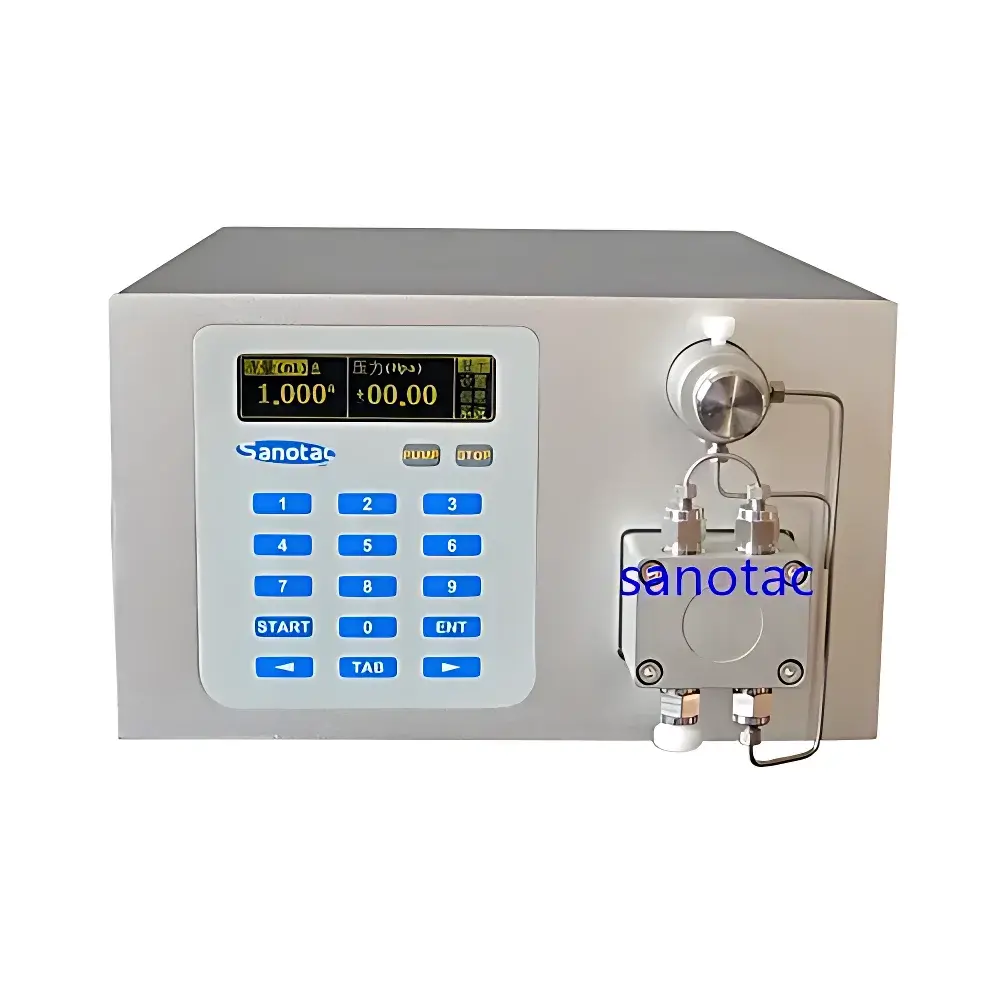
Sanotac Omnito CP0530 Constant-Pressure Infusion Pump
| Brand | Sanotac |
|---|---|
| Origin | Shanghai, China |
| Manufacturer Type | Direct Manufacturer |
| Model | Omnito CP0530 |
| Flow Range | 0.01–50.00 mL/min |
| Pressure Range | 1–30 MPa |
| Pressure Accuracy | ±0.1 MPa |
| Pressure Pulsation | ≤0.2 MPa |
| Flow Accuracy | ±0.5% |
| Flow Precision (RSD) | ≤0.1% |
| Pump Head Material | 316L Stainless Steel (PEEK/Titanium optional) |
| Wetted Materials | 316L SS, Ruby, PTFE, Ceramic |
| Tubing Connection | 1/16" Standard |
| Display | 256×64 Backlit LCD |
| Control Interface | Front Panel + Open-Protocol Computer Remote Control (RS232/USB) |
| Power Supply | 85–264 VAC, 50 Hz |
| Dimensions | 370 × 240 × 152 mm |
| Drive Mechanism | Cam-Compensated Dual-Piston Serial Architecture with Floating Piston Design |
| Check Valves | Swiss-sourced Single-Direction Valves |
Overview
The Sanotac Omnito CP0530 is a high-precision, dual-piston constant-pressure infusion pump engineered for applications demanding stable hydraulic pressure control rather than fixed volumetric delivery. Unlike conventional syringe or peristaltic pumps, the CP0530 employs a closed-loop pressure feedback system coupled with real-time flow rate modulation—enabling it to maintain user-defined pressure setpoints across varying fluid viscosities, backpressures, and microchannel resistances. Its core architecture implements Couette-type piston motion driven by a precision-machined cam profile, integrated with electronic pulse suppression algorithms that actively dampen mechanical flow oscillations inherent in reciprocating displacement systems. This design ensures minimal pressure transients (<0.2 MPa pulsation), critical for sensitive biological perfusion, microfluidic laminar flow stabilization, and controlled reagent addition in exothermic or catalytic reactions. The pump operates in two distinct modes: constant-pressure infusion (primary mode) and constant-flow infusion (secondary mode), each governed by independent calibration tables traceable to NIST-traceable reference standards.
Key Features
- Dual-piston serial architecture with floating piston mechanism—reduces seal wear and extends service life under continuous high-pressure operation.
- Cam curve compensation and real-time electronic flow pulse suppression—minimizes pressure ripple without external accumulators or passive dampeners.
- Swiss-sourced sapphire-seated check valves—deliver long-term leak-free performance at pressures up to 30 MPa and compatibility with aggressive solvents and saline media.
- Modular wetted path construction using 316L stainless steel, ruby, PTFE, and ceramic components—supports compliance with USP Class VI and ISO 10993 biocompatibility requirements.
- Open-protocol remote control interface (RS232/USB) with documented ASCII command set—enables integration into LabVIEW, Python-controlled workflows, and automated GLP-compliant test sequences.
- Backlit 256×64 dot-matrix LCD with real-time display of pressure setpoint, actual pressure, flow rate, elapsed time, and system status flags.
Sample Compatibility & Compliance
The Omnito CP0530 accommodates a broad range of liquid media—including aqueous buffers, organic solvents (e.g., acetonitrile, THF), low-conductivity oils, and viscous polymer solutions—without degradation of pressure stability. Its wetted materials meet ASTM F2477 for elastomer compatibility and are rated for continuous exposure to pH 1–14 and temperatures up to 60 °C. For regulated environments, the pump supports audit trail generation when operated via computer control (aligned with FDA 21 CFR Part 11 data integrity principles), and its pressure calibration protocol conforms to ISO/IEC 17025 requirements when performed using certified deadweight testers. It is routinely deployed in laboratories adhering to GLP (OECD Series 1, ICH S7A) and GMP (ICH Q5C, Annex 15) frameworks for organ perfusion, bioreactor feed control, and analytical method development.
Software & Data Management
The CP0530 includes a vendor-provided Windows-based configuration utility for parameter setup, firmware updates, and diagnostic logging. More critically, its open ASCII command protocol allows full bidirectional communication: users can initiate runs, adjust setpoints on-the-fly, query real-time sensor values, and retrieve timestamped pressure/flow logs with millisecond resolution. When embedded in Python or MATLAB automation scripts, the pump supports synchronized triggering with high-speed cameras, pressure transducers, or electrochemical detectors—facilitating time-resolved studies of transient phenomena such as thrombus formation during vascular perfusion or reaction kinetics in segmented-flow microreactors. All control sessions can be logged with operator ID, timestamp, and parameter history—meeting ALCOA+ data integrity criteria for regulatory submissions.
Applications
- Ex vivo organ and tissue perfusion (e.g., Langendorff heart, isolated kidney, liver lobule models) requiring physiologically relevant pressure profiles (10–25 kPa arterial, 0.5–2 kPa venous).
- Controlled reagent infusion into stirred-tank reactors and flow-through catalytic beds—maintaining constant interstitial pressure despite evolving slurry viscosity or catalyst fouling.
- Microfluidic chip priming and steady-state flow establishment in organ-on-chip platforms, where pressure-driven flow avoids bubble nucleation common with syringe-based actuation.
- High-pressure solvent delivery in preparative HPLC and supercritical fluid extraction systems operating below 30 MPa.
- Gene delivery vector formulation—precise pressure-controlled mixing of plasmid DNA with lipid nanoparticles under laminar shear conditions.
FAQ
Does the CP0530 support pressure ramping or programmable pressure profiles?
Yes—the open command protocol allows stepwise or linear pressure ramping via external scripting; however, dynamic profile execution requires host computer coordination, as onboard memory does not store multi-segment programs.
What maintenance intervals are recommended for the floating piston seals?
Under continuous operation at ≤20 MPa with compatible solvents, seal replacement is recommended every 12 months or after 5,000 hours of cumulative runtime—documented in the included maintenance log template.
Is the pump compatible with non-aqueous electrolytes used in battery electrolyte research?
Yes—when equipped with titanium or PEEK pump heads and ceramic/ruby valves, the CP0530 has been validated for use with LiPF₆ in EC/DMC and ionic liquid-based electrolytes, provided temperature remains below 45 °C.
Can multiple CP0530 units be synchronized for parallel infusion control?
Yes—via TTL trigger input/output ports and shared master clock signals, enabling phase-aligned pressure delivery across up to four units within ±10 ms timing tolerance.
How is pressure accuracy verified during factory calibration?
Each unit undergoes three-point pressure calibration (5 MPa, 15 MPa, 25 MPa) using a Fluke 754 Documenting Process Calibrator referenced to a 0.01% FS deadweight tester, with raw sensor output and compensated readings recorded in the Certificate of Conformance.



