
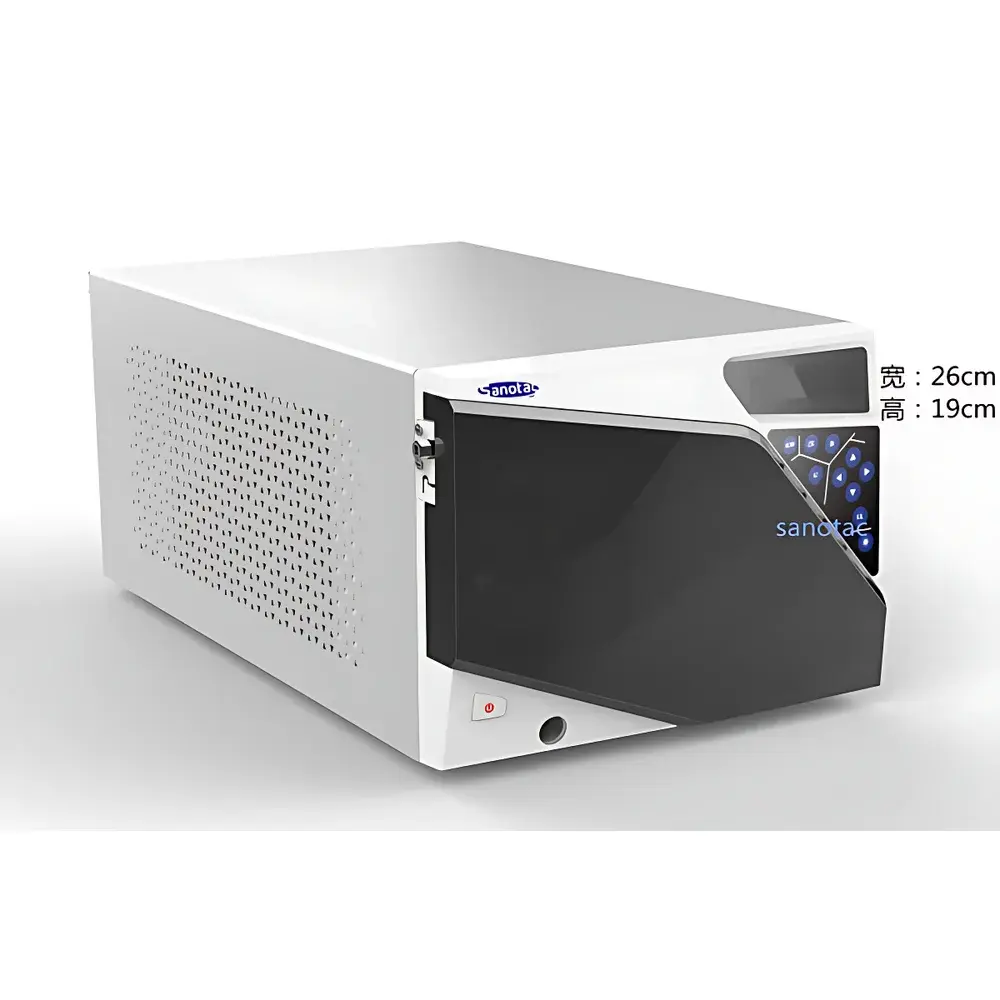
Sanotac Omnitor Series Low-Temperature Evaporative Light Scattering Detector (ELSD)
| Brand | Sanotac |
|---|---|
| Origin | Shanghai, China |
| Manufacturer Type | Original Equipment Manufacturer (OEM) |
| Product Category | Domestic |
| Model | Omnitor |
| Instrument Type | Evaporative Light Scattering Detector (ELSD) |
| Wavelength | 650 nm |
| Detection Mode | Low-Temperature Evaporation |
| Light Source | Semiconductor Laser |
Overview
The Sanotac Omnitor Series Evaporative Light Scattering Detector (ELSD) is a high-performance, universal mass-sensitive detector engineered for integration with high-performance liquid chromatography (HPLC), ultra-high-performance liquid chromatography (UHPLC), and preparative chromatography systems. Unlike UV-Vis or fluorescence detectors, the Omnitor ELSD operates on the principle of nebulization, solvent evaporation, and light scattering detection—making it inherently insensitive to chromophore presence, molecular absorption characteristics, or optical activity. This physical detection mechanism enables reliable quantification of non-volatile and semi-volatile analytes—including carbohydrates, lipids, polymers, saponins, glycosides, amino acids, and excipients—that lack UV absorbance or exhibit weak/variable spectral response. The detector employs a 650 nm semiconductor laser as its coherent light source and a photomultiplier tube (PMT) for highly sensitive scattered-light signal acquisition. Its low-temperature evaporation architecture (up to 150 °C evaporator, up to 60 °C nebulizer) minimizes thermal degradation of thermolabile compounds while maintaining robust baseline stability and low system drift—critical for regulated QC/QA environments.
Key Features
- Compact footprint (260 × 190 × 460 mm) optimized for benchtop stacking with HPLC modules or modular chromatography platforms
- Ultra-low baseline noise ≤ 0.01 mV and drift ≤ 0.2 mV / 30 min—enabling high signal-to-noise ratio for trace-level quantitation
- Programmable linear gain adjustment (0.3–30×) and output offset (–1000 to +1000 mV) for precise peak height optimization across wide dynamic ranges
- Motorized, angle-adjustable nebulizer capillary—facilitating method-specific optimization for viscous, oily, or high-salt mobile phases
- Integrated real-time monitoring of evaporator temperature, nebulizer temperature, gas pressure (±0.01 bar accuracy), and mass flow rate (±1% or ±0.02 L/min)
- Automated 16-point self-diagnostic routine at startup and during operation—monitoring gas valve integrity, heater functionality, PMT voltage stability, and optical alignment
- Dual-stage safety interlock preventing mobile-phase ingress into the detection chamber under abnormal pressure or temperature conditions
Sample Compatibility & Compliance
The Omnitor ELSD supports mobile-phase flow rates from 0.01 to 3 mL/min, compatible with standard analytical, microbore, and preparative LC configurations. It accepts clean, oil-free compressed air or nitrogen (2–5 bar inlet pressure; 1–4 L/min mass-flow-controlled delivery) and tolerates common reversed-phase solvents (e.g., water, acetonitrile, methanol, THF) and gradient elution protocols. Its detection universality extends to compounds with no chromophores—particularly valuable in natural product analysis (e.g., traditional Chinese medicine extracts), polymer characterization (SEC/GPC), lipidomics, and formulation excipient profiling. The system complies with ISO/IEC 17025 laboratory quality requirements and supports GLP/GMP workflows via full audit trail capability, electronic signatures, and data integrity controls aligned with FDA 21 CFR Part 11 and EU Annex 11.
Software & Data Management
Omnitor is controlled via Sanotac’s Clarity®-compatible dynamic-link library (DLL), enabling seamless integration with third-party chromatography data systems (CDS) including Thermo Chromeleon®, Waters Empower®, Agilent OpenLab CDS, and Shimadzu LabSolutions. Native control software provides structured menu navigation, method storage for up to 10 methods (25 parameters each), automatic method recall, and programmable external event triggering (e.g., laser shutdown, gas valve actuation, zero calibration). Data acquisition occurs at 20 Hz with analog output (–1200 to +1200 mV) and digital streaming via RS-232, RS-485, USB 2.0, or TCP/IP (HTTP) Ethernet. All user actions—including parameter changes, calibration events, and alarm acknowledgments—are timestamped, user-identified, and cryptographically logged in an immutable audit trail.
Applications
- Quantitative analysis of non-UV-absorbing natural products: polysaccharides, triterpenoid saponins, flavonoid glycosides, and alkaloid salts
- SEC/GPC characterization of synthetic and biodegradable polymers (e.g., PLGA, PEG, cellulose derivatives) without column calibration dependency
- Residual solvent and excipient profiling in pharmaceutical formulations (e.g., mannitol, lactose, polysorbates)
- Fatty acid methyl ester (FAME) and triglyceride analysis in food and biodiesel QC
- Method development support for LC-MS-incompatible compounds where MS ionization suppression or adduct formation limits sensitivity
- Stability-indicating assays for degradation products lacking chromophores
FAQ
What types of mobile phases are compatible with the Omnitor ELSD?
The detector supports volatile and semi-volatile mobile phases commonly used in reversed-phase, normal-phase, and HILIC chromatography—including water/acetonitrile, water/methanol, chloroform/methanol, and THF-based systems. Non-volatile buffers (e.g., phosphate, sulfate) must be avoided unless post-column removal is implemented.
Can the Omnitor ELSD be used with UHPLC systems operating above 1000 bar?
Yes—when paired with a low-dead-volume T-piece and appropriate backpressure regulation, the Omnitor accommodates flow rates down to 0.01 mL/min and is fully compatible with sub-2 µm particle columns and UHPLC pressure regimes.
How does the Omnitor ensure data integrity in regulated environments?
It implements role-based access control, electronic signatures, time-stamped audit logs for all configuration changes and acquisition events, and encrypted raw data storage—all compliant with FDA 21 CFR Part 11 Subpart B requirements.
Is nitrogen required, or can compressed air be used?
Both are acceptable; however, nitrogen is recommended for highest baseline stability and lowest background scatter, especially in low-concentration applications or when using high-water-content mobile phases.
What maintenance routines are recommended for long-term performance?
Daily: Nebulizer capillary cleaning with methanol/water; weekly: evaporator chamber wipe-down with lint-free cloth; quarterly: PMT gain verification and laser power calibration using factory-provided reference standards.




