
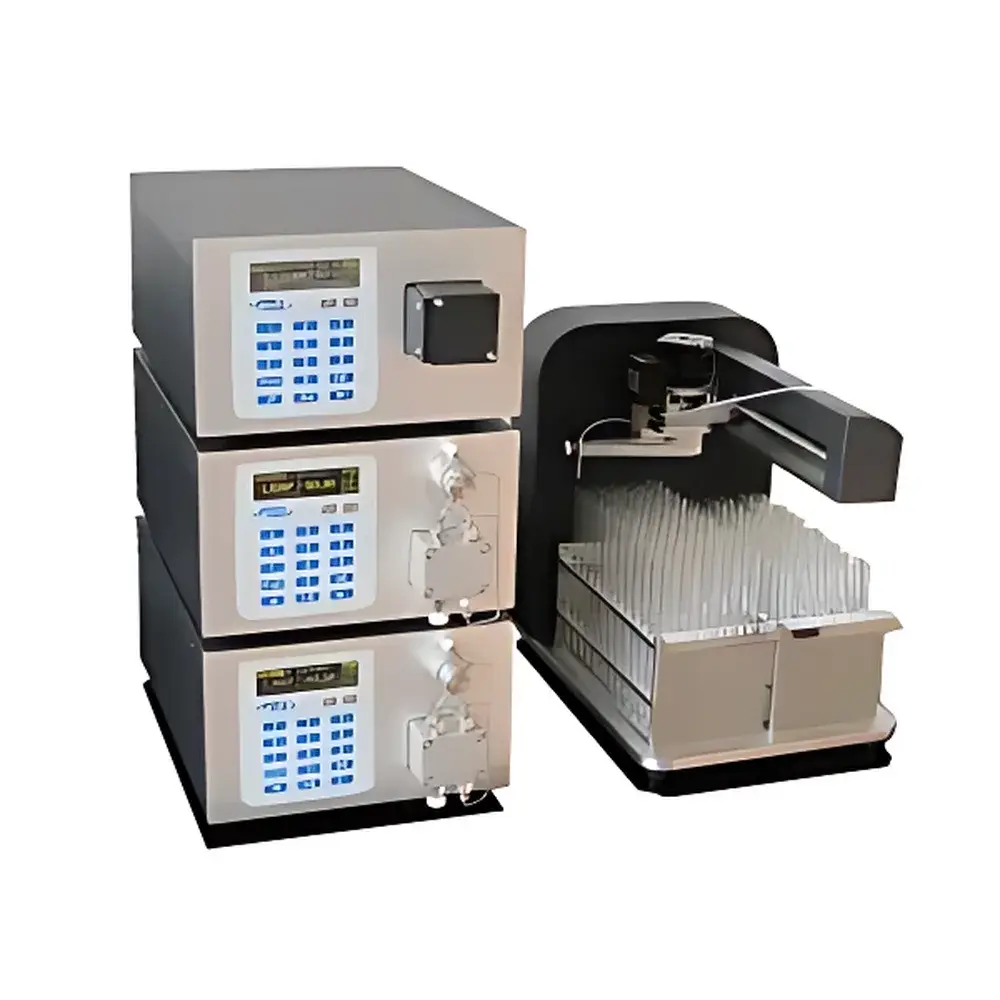
Sanotac Pilot-50 Preparative Liquid Chromatography System
| Brand | Sanotac |
|---|---|
| Origin | Shanghai, China |
| Manufacturer Type | Direct Manufacturer |
| Product Category | Domestic |
| Model | Pilot-50 |
| Price Range | USD 14,000 – 28,000 (FOB Shanghai) |
| Application Level | Laboratory-Scale |
| Instrument Type | Medium-to-Low Pressure Preparative LC |
| Flow Rate Range | 0.01–100.00 mL/min |
| Flow Accuracy | ±1% |
| Flow Precision (RSD) | ≤0.5% |
| Maximum Operating Pressure | 30 MPa |
| Wavelength Range | 190–700 nm |
| Wavelength Accuracy | ±1 nm |
| Wavelength Repeatability | ±0.2 nm |
| Baseline Noise | ±0.75×10⁻⁵ AU (254 nm, TC = 1 s) |
| Data Acquisition Rate | 10 Hz |
Overview
The Sanotac Pilot-50 Preparative Liquid Chromatography System is a medium-pressure, laboratory-scale preparative HPLC platform engineered for reproducible, scalable purification of organic compounds, synthetic intermediates, natural product isolates, and biomolecules. Based on classical high-performance liquid chromatography principles—employing gradient elution, UV/Vis absorbance detection, and fraction collection—the Pilot-50 operates within a pressure range up to 30 MPa (4350 psi), supporting both semi-preparative and low-to-medium throughput purification workflows. Its architecture integrates dual-piston reciprocating pumps with real-time chamber pressure feedback, solvent compressibility compensation, and dynamic flow recalibration—enabling stable delivery across the full flow range (0.01–100.00 mL/min) without manual recalibration. Designed for routine use in pharmaceutical process development, fine chemical synthesis support, and academic natural product isolation labs, the system complies with foundational analytical instrumentation design practices aligned with ISO/IEC 17025 general requirements for competence of testing and calibration laboratories.
Key Features
- Microprocessor-controlled dual-pump system with parallel pump heads and cavity pressure feedback for active solvent compressibility compensation and refill-phase correction.
- Flow pulsation suppression via cam-profile flow compensation algorithm, reducing baseline noise to ±0.75×10⁻⁵ AU (254 nm, 1 s time constant).
- Multi-point flow calibration curve stored in non-volatile memory, ensuring ±1% accuracy and ≤0.5% RSD across the entire 0.01–100.00 mL/min range.
- Floating plunger seal design extends high-pressure seal lifetime under continuous operation at up to 30 MPa.
- Ten user-definable method programs supporting gradient slope, flow ramping, dwell volume compensation, and multi-step hold protocols.
- Dual-lamp UV/Vis detector (deuterium + tungsten) with automatic lamp switching, wavelength scanning (stop-flow mode), and time-programmed dual-wavelength monitoring (e.g., 214 nm + 254 nm simultaneously).
- Adjustable-pathlength semi-preparative flow cell (1–5 mm optical path), optimized for sensitivity and linearity across 0–3 AU absorbance range.
Sample Compatibility & Compliance
The Pilot-50 accommodates standard stainless steel, PEEK, titanium, Hastelloy-C, and PTFE-lined columns with internal diameters from 10 mm to 30 mm—supporting reversed-phase (C18, C8), silica, amino, cyano, and ion-exchange chemistries. It is routinely deployed for purification of small molecules (<2 kDa), peptides, and early-stage biologics intermediates. While not validated per FDA 21 CFR Part 11 out-of-the-box, the system’s software architecture supports audit-trail-enabling configurations and electronic signature readiness when integrated into GLP/GMP-aligned lab environments. All hardware components meet CE marking requirements for electromagnetic compatibility (EN 61326-1) and electrical safety (EN 61010-1). Column oven and fraction collector modules (optional) are compatible with ASTM D8110 (standard practice for preparative LC method development) and USP chromatography guidelines.
Software & Data Management
The included Sanotac ChromaControl software provides native method building, real-time chromatogram visualization, peak integration (tangent skim, valley-to-valley, baseline correction), and automated fraction triggering based on threshold, time window, or UV area criteria. Raw data files adhere to ANDI/NetCDF format for long-term archival and third-party reprocessing (e.g., in OpenChrom or Chromeleon). Audit trail functionality logs all method edits, run start/stop events, parameter changes, and user logins—meeting minimum traceability requirements for ISO 17025 Clause 7.7 and EU Annex 11 principles. Export options include CSV, PDF reports, and XML metadata for LIMS integration. Software updates are delivered via secure HTTPS channel with SHA-256 hash verification.
Applications
- Purification of synthetic drug candidates and chiral intermediates during medicinal chemistry lead optimization.
- Isolation of bioactive constituents from plant extracts or fermentation broths for structure elucidation (NMR, MS).
- Preparation of certified reference materials (CRMs) and primary standards compliant with ISO Guide 35.
- Desalting and buffer exchange of peptide fractions prior to lyophilization or analytical characterization.
- Scale-down purification modeling for downstream process transfer to industrial preparative systems (e.g., 100–1000 mL/min platforms).
- Method scouting and robustness testing under ICH Q2(R2) guidance for forced degradation studies.
FAQ
What column dimensions are supported by the Pilot-50?
Standard column IDs range from 10 mm to 30 mm; length is user-selectable (typically 100–250 mm). Custom-packed columns with PEEK or stainless-steel bodies are fully compatible.
Does the system support gradient elution with four-solvent capability?
Yes—the integrated quaternary low-pressure mixing module enables precise binary or quaternary gradient formation with programmable dwell volume compensation.
Can the UV detector perform spectral scanning?
Yes, in stop-flow mode; full 190–700 nm scans are acquired with 1 nm resolution and stored as spectral overlays for peak purity assessment.
Is remote monitoring or control possible?
Local Ethernet connectivity allows browser-based status monitoring and method upload via HTTP; full remote operation requires optional VNC-enabled PC integration.
What maintenance intervals are recommended for the pump seals and UV lamp?
Pump seals: inspect every 500 hours of operation; replace every 1,500–2,000 hours depending on solvent aggressiveness. Deuterium lamp: nominal lifetime 1,000 hours; tungsten lamp: ≥5,000 hours.





