
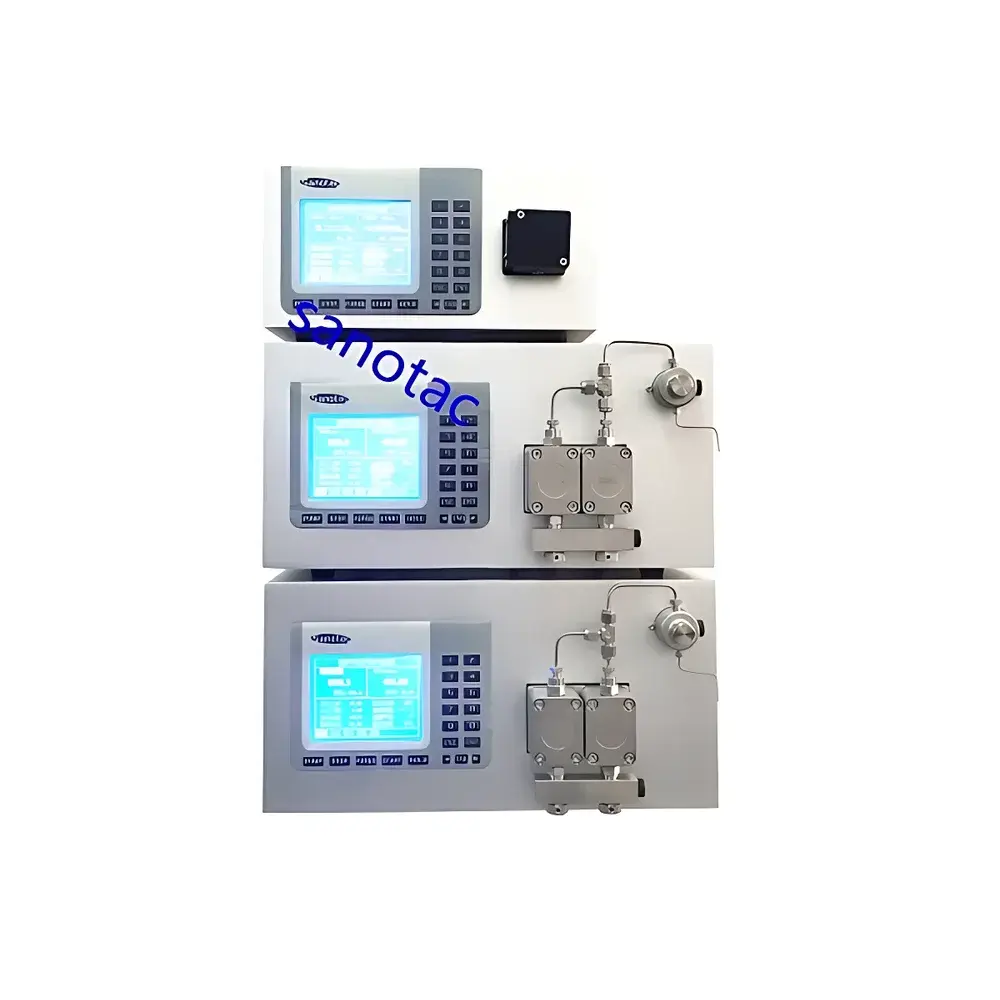
Sanotac Pilot-600 Preparative High-Performance Liquid Chromatography System
| Brand | Sanotac |
|---|---|
| Origin | Shanghai, China |
| Manufacturer Type | OEM Manufacturer |
| Product Category | Domestic |
| Model | Pilot-600 |
| Price Range | USD 14,000 – 28,000 |
| Application Level | Industrial-Scale Preparative |
| Instrument Type | High-Pressure Preparative HPLC |
| Flow Rate Range | 0.01–600.00 mL/min |
| Flow Accuracy | ±1% |
| Flow Precision (RSD) | ≤0.5% |
| Maximum Pressure | 10 MPa |
| Wavelength Range | 190–800 nm |
| Wavelength Accuracy | ±1 nm |
| Wavelength Repeatability | 0.2 nm |
| Baseline Noise | ±0.75×10⁻⁵ AU at 254 nm, TC = 1 s |
| Data Acquisition Rate | 10 Hz |
Overview
The Sanotac Pilot-600 Preparative High-Performance Liquid Chromatography (Prep-HPLC) System is an industrial-grade, high-pressure liquid chromatographic platform engineered for scalable purification of organic molecules, natural products, pharmaceutical intermediates, and synthetic compounds. Operating on the principle of differential partitioning in a pressurized liquid mobile phase across a stationary phase—typically silica- or polymer-based columns—the system delivers reproducible, high-resolution separations under precisely controlled gradient elution conditions. Designed for transition from analytical method development to gram- to kilogram-scale isolation, the Pilot-600 supports both small-molecule APIs and moderately sized biomolecules (e.g., peptides, nucleosides), with flow rates extending up to 600 mL/min and pressure tolerance up to 10 MPa (1450 psi). Its modular architecture enables seamless integration of sample introduction, dual-wavelength UV/Vis detection, fraction collection, and method-driven data governance—all within a single, validated workflow environment compliant with regulatory expectations for preparative process development.
Key Features
- High-stability dual-piston reciprocating pump with PEEK or 316L stainless steel wetted path options; cam-profile flow compensation minimizes pulsation and ensures baseline stability (noise ≤ ±0.75×10⁻⁵ AU at 254 nm, 1 s time constant)
- Full-spectrum UV/Vis detector with deuterium and tungsten lamp sources; simultaneous dual-wavelength monitoring (190–800 nm); wavelength accuracy ±1 nm, repeatability 0.2 nm
- Automated fraction collector supporting timed, peak-triggered, or threshold-based collection modes; compatible with standard 13 mm, 16 mm, and 28 mm test tubes, microtiter plates, and custom trays
- Intelligent lamp and flow cell exchange design enabling rapid maintenance without system recalibration
- Multi-point volumetric flow calibration across full range (0.01–600.00 mL/min), ensuring ≤0.5% RSD flow precision and ±1% absolute accuracy
- Self-cleaning pump head function prevents salt crystallization and buffer residue accumulation during long-duration runs
- Optimized low-dead-volume mixing chamber with gradient flexibility: linear, step, or user-defined profiles; real-time online modification of flow rate and gradient composition
Sample Compatibility & Compliance
The Pilot-600 accommodates diverse sample formats—including solid loading (via loop injection or direct column packing), liquid solutions, crude reaction mixtures, and post-extraction extracts—without requiring pre-filtration beyond standard 0.45 µm filtration. Its fluidic path supports chemically resistant materials: 316L stainless steel, PEEK, pure titanium, and Hastelloy C-276, permitting compatibility with aggressive solvents (e.g., TFA, HFIP, DCM/water blends) and acidic/basic mobile phases. The system meets fundamental requirements for GMP-aligned process development per ICH Q5A/Q5D and supports traceability in accordance with ISO/IEC 17025:2017 for testing laboratories. All hardware and software components are designed to support audit-ready operation under FDA 21 CFR Part 11, CFDA GxP, and EU Annex 11 frameworks—including electronic signatures, role-based access control, immutable audit trails, and secure electronic record retention.
Software & Data Management
Control and data acquisition are managed via a Windows-based workstation software platform compliant with 21 CFR Part 11 and CFDA GxP regulations. The system employs relational database architecture for project-centric data organization: each project stores associated instrument methods, sequence tables, raw chromatograms, processed results, and user annotations in a structured, searchable repository. Software features include automated method validation reporting, peak tracking across fractions, purity assessment tools, and customizable report templates exportable to PDF, CSV, or XML. Electronic records are timestamped, digitally signed, and protected against unauthorized modification; audit trails log all user actions—including parameter changes, run starts/stops, and data exports—with no ability to delete or edit historical entries.
Applications
- Purification of synthetic small molecules (e.g., kinase inhibitors, PROTACs) from complex reaction mixtures at 10 mg–50 g scale
- Isolation of natural product analogues and secondary metabolites from plant or microbial extracts
- Desalting and buffer exchange of peptides prior to lyophilization or structural characterization
- Removal of residual catalysts (e.g., Pd, Ru) and unreacted starting materials in API manufacturing workflows
- Preparative chiral separation using polysaccharide- or cyclodextrin-based columns under SFC or normal-phase HPLC conditions
- Supporting QC release testing by generating reference standards traceable to primary certified materials
FAQ
What is the maximum column internal diameter supported by the Pilot-600?
The system is optimized for columns ranging from 10 mm to 100 mm i.d., with full pressure and flow control validated up to 50 mm i.d. at 10 MPa.
Can the system be integrated with mass spectrometry for real-time fraction characterization?
Yes—via optional flow-splitting interface and auxiliary analog/digital outputs, the Pilot-600 supports synchronization with external LC-MS systems for fraction-triggered MS acquisition.
Does the software support method transfer from analytical UHPLC platforms?
Yes—scaling algorithms embedded in the software allow automatic conversion of analytical gradient methods (including dwell volume correction) to preparative equivalents based on column geometry and flow rate scaling laws.
Is remote monitoring and control available?
Remote desktop access and secure web-based status dashboards are supported through IT-administered network configurations, subject to local cybersecurity policies.
What validation documentation is provided with the system?
Factory-issued IQ/OQ protocols, as well as executable PQ templates aligned with ASTM E2500 and USP , are supplied; site-specific qualification support is available upon request.




