
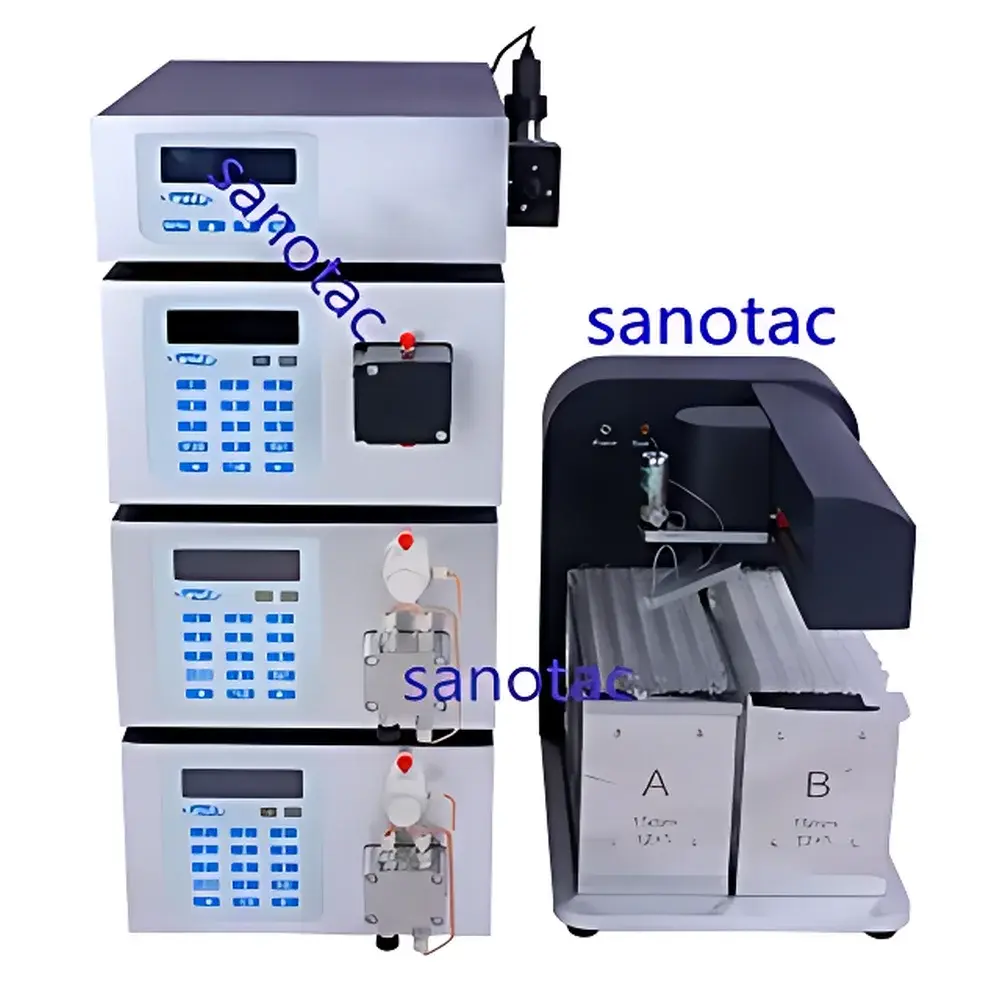
Sanotac Pilot Series High-Pressure Preparative Liquid Chromatography System
| Brand | Sanotac |
|---|---|
| Model | Pilot Series |
| Instrument Type | High-Pressure Preparative LC |
| Flow Rate Range | 0.01–100.00 mL/min (gradient) |
| Max. Operating Pressure | 30 MPa |
| Injection Volume | 1–20 mL |
| Column Temperature Control | 0–80 °C |
| UV Detection Wavelength Range | 190–800 nm (dual-wavelength simultaneous detection) |
| Data Acquisition Frequency | 10 Hz |
| Detector Wavelength Accuracy | ±1 nm |
| Absorbance Range | 0–2 AU |
| Gradient Types | Step, Linear, Real-time Adjustable |
| Flow Accuracy | ±0.5% |
| Pressure Pulsation | ≤0.2 MPa |
| Pump Material Options | 316L Stainless Steel, PEEK, Titanium, Hastelloy |
| Fraction Collector | Auto, 2 × 60 positions (Φ15 mm × 150 mm tubes), multiple collection modes |
| Software Compliance | Fully compliant with CFDA GxP and FDA 21 CFR Part 11 (audit trail, electronic signature, role-based access control, database-driven project management) |
Overview
The Sanotac Pilot Series High-Pressure Preparative Liquid Chromatography System is an engineered solution for scalable purification of active pharmaceutical ingredients (APIs), natural product isolates, synthetic intermediates, peptides, oligonucleotides, and other bioactive molecules. Based on high-pressure liquid chromatography (HPLC) principles—utilizing precise solvent gradient delivery, high-resolution column separation, and real-time UV/Vis detection—the system operates within a pressure range up to 30 MPa, enabling efficient resolution of structurally similar compounds across diverse polarity and molecular weight ranges. Unlike analytical HPLC systems optimized for detection sensitivity, the Pilot Series prioritizes robust flow stability, reproducible fraction collection, and seamless method translation from analytical to preparative scale. Its architecture supports both medium-pressure pre-purification (e.g., flash chromatography) and high-pressure final polishing in a single platform, facilitating rapid progression from crude extract or reaction mixture to gram-scale, characterization-ready material.
Key Features
- Modular high-pressure binary gradient pump with cam-profile flow compensation, delivering stable flow rates from 0.01 to 100.00 mL/min with ≤0.5% accuracy and ≤0.2 MPa pressure pulsation.
- Dual-lamp UV/Vis detector (deuterium + tungsten) covering full 190–800 nm spectrum; supports simultaneous dual-wavelength monitoring for selective tracking of main components, by-products, and impurities.
- Integrated auto-fraction collector with programmable collection logic—including time-based, peak-triggered, threshold-defined, sequential, and cyclic modes—accommodating standard 15 mm × 150 mm test tubes (2 × 60 positions) and custom tube formats.
- Temperature-controlled column compartment (0–80 °C) with PID regulation ensures retention time stability during extended runs and improves resolution for thermally sensitive biomolecules.
- Pump head options include 316L stainless steel (standard), PEEK, titanium, and Hastelloy—enabling compatibility with aggressive mobile phases (e.g., high-pH buffers, TFA-containing solvents) and minimizing metal-catalyzed degradation.
- Self-cleaning pump head design prevents crystallization of buffer salts and reduces maintenance downtime between runs.
- Optimized low-dead-volume mixer and flow path geometry enhance gradient fidelity and reduce band broadening during large-volume injections.
Sample Compatibility & Compliance
The Pilot Series accommodates a broad spectrum of sample matrices: crude botanical extracts, combinatorial synthesis libraries, fermentation broths, peptide cleavage mixtures, and oligonucleotide deprotection solutions. It interfaces seamlessly with reversed-phase (C18, C8), normal-phase (silica), ion-exchange, and size-exclusion columns—from analytical-scale (4.6 mm ID) to preparative (10–50 mm ID)—as well as SPE cartridges for inline desalting or cleanup. All fluidic contact materials meet USP Class VI biocompatibility standards. The system’s hardware and software architecture fully satisfy regulatory requirements for GLP and GMP environments: electronic records and signatures are cryptographically secured; audit trails log all user actions, method modifications, and data exports; and role-based permissions enforce segregation of duties per FDA 21 CFR Part 11 and CFDA GxP guidelines. Validation documentation packages—including IQ/OQ protocols—are available upon request.
Software & Data Management
Control and data acquisition are managed through Sanochrom Chromatography Workstation—a Windows-based application supporting Windows 7/8/10. The software implements a relational database structure where each project encapsulates instrument methods, sequence tables, raw chromatograms, processed results, and associated metadata. Method development tools include real-time gradient editing, peak integration with customizable baselines, and purity assessment via peak area normalization. All data files are stored in vendor-neutral formats (e.g., .cdf, .csv) alongside embedded XML metadata for long-term archival integrity. The system supports USB 2.0 and RS-232 connectivity, enabling integration into centralized lab informatics infrastructure (e.g., LIMS, ELN). Software validation documentation aligns with ISO/IEC 17025 and ASTM E2500-07 standards for analytical instrument software qualification.
Applications
- Purification of natural product actives (e.g., flavonoids, alkaloids, terpenoids) from plant extracts at milligram-to-gram scale for structural elucidation (NMR, MS) and bioassay screening.
- Isolation of synthetic drug candidates following solid-phase or solution-phase organic synthesis, including removal of residual catalysts, protecting groups, and diastereomeric impurities.
- Downstream processing of therapeutic peptides and modified oligonucleotides—particularly where RP-HPLC resolves closely eluting chain-length variants or failure sequences.
- Preparative separation of monoclonal antibody fragments (e.g., Fc, Fab) and ADC linker-payload conjugates under denaturing or native conditions.
- Method scouting and transfer from UHPLC analytical methods to preparative scale using built-in scalability calculators and retention modeling tools.
FAQ
Can the Pilot Series be used for both analytical and preparative separations?
Yes—the system supports method translation from analytical HPLC (e.g., 4.6 mm ID columns) to preparative scale (up to 50 mm ID) without hardware modification. Flow rate, injection volume, and gradient slope are independently adjustable to maintain linear velocity and resolution scaling.
What column chemistries are supported?
All standard HPLC column types: reversed-phase (C18, C8, phenyl-hexyl), silica, amino, cyano, ion-exchange (SAX, SCX), and size-exclusion (SEC). Custom-packed columns and third-party columns (e.g., Waters, Phenomenex, Agilent) are fully compatible.
Is the system suitable for GMP-compliant manufacturing?
While designed for R&D and process development, the Pilot Series meets core GMP data integrity requirements when deployed with validated Sanochrom software, calibrated instruments, and documented SOPs. For commercial production, it serves as a qualified pilot-scale platform prior to tech transfer to cGMP manufacturing suites.
How is detector lamp life managed?
The system automatically switches between deuterium and tungsten lamps based on selected wavelength, maximizing operational lifetime. Lamps and flow cells are tool-free replaceable, minimizing instrument downtime.
Does the software support multi-user environments with audit trail?
Yes—Sanochrom implements full 21 CFR Part 11 compliance: electronic signatures require two-factor authentication, audit trails record all data changes and user logins, and permissions are assigned by role (e.g., operator, supervisor, administrator).




