
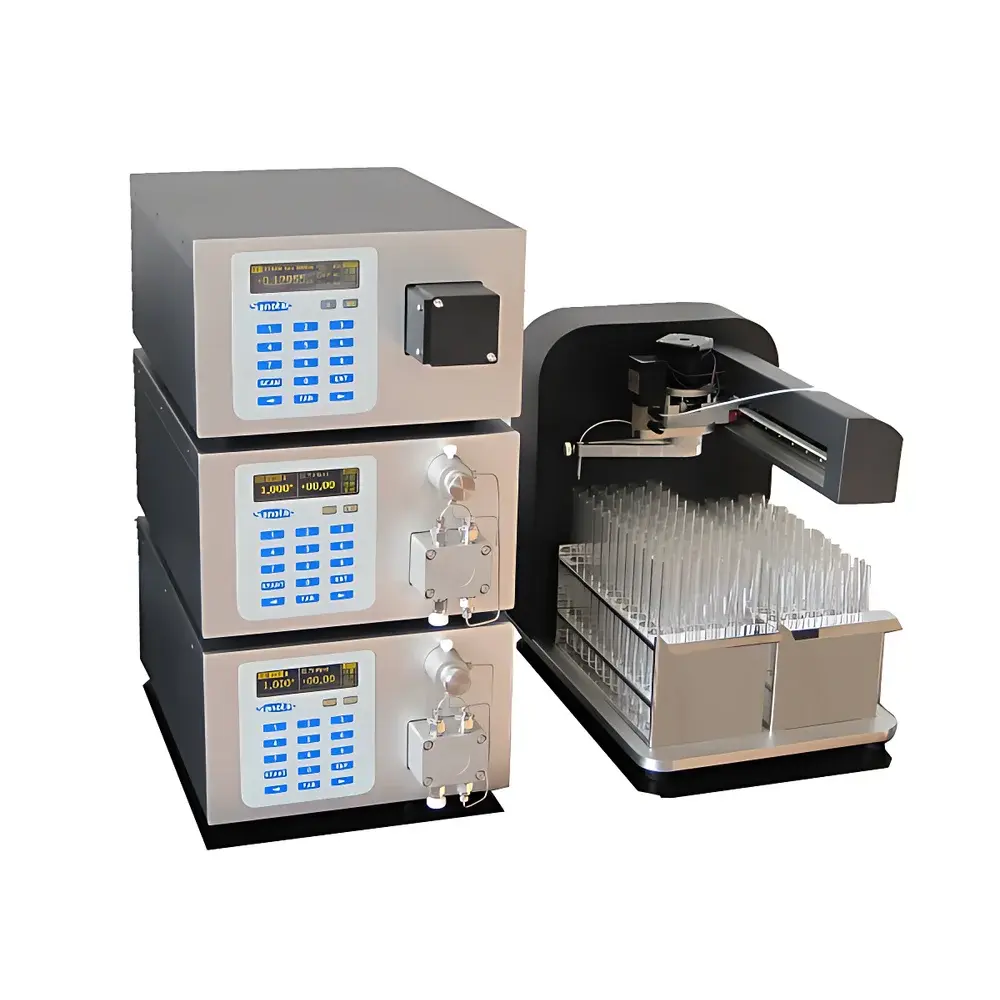
Sanotac Pilot50 Preparative Liquid Chromatography System
| Brand | Sanotac |
|---|---|
| Origin | Shanghai, China |
| Manufacturer Type | Manufacturer |
| Origin Category | Domestic |
| Model | Pilot50 |
| Application Level | Laboratory Grade |
| Instrument Type | High-Pressure Preparative LC |
| Flow Rate Range | 0.01–50.00 mL/min |
| Flow Accuracy | ±0.5% |
| Flow Precision (RSD) | ≤0.1% |
| Maximum Pressure | 30 MPa |
| Wavelength Range | 190–700 nm |
| Wavelength Repeatability | ±0.2 nm |
| Detection Modes | Dual-Wavelength UV, Time-Programmed Wavelength, Stop-Flow Scanning |
| Gradient Programming | 10 User-Defined Methods |
| Column ID Compatibility | 10–30 mm |
| Detector Cell Pathlength | Adjustable (1–5 mm) |
| Baseline Noise | ±0.5×10⁻⁵ AU (254 nm, TC=1 s) |
| Baseline Drift | 1.5×10⁻⁴ AU (254 nm, 1 h) |
| Time Constant Options | 0.1/0.2/0.5/1.0/2.0/5.0/10.0 s |
| Digital Zero Adjustment | Full-Scale Auto-Zero |
Overview
The Sanotac Pilot50 Preparative Liquid Chromatography System is a high-pressure, laboratory-grade preparative HPLC platform engineered for reproducible, scalable purification of organic compounds, synthetic intermediates, natural product isolates, and biopharmaceutical components. Based on classical reversed-phase and normal-phase liquid chromatography principles, the system employs dual-servo-controlled parallel piston pumps operating under closed-loop pressure feedback to deliver precise solvent delivery across a wide dynamic flow range (0.01–50.00 mL/min). Its architecture integrates gradient elution capability, dual-lamp UV-Vis detection (deuterium + tungsten), and intelligent optical path management—enabling robust method transfer from analytical to semi-preparative scale while maintaining compliance with fundamental chromatographic performance criteria defined in USP , ICH Q2(R2), and ISO/IEC 17025 requirements for method validation.
Key Features
- High-fidelity dual-piston pump system with real-time chamber pressure compensation, minimizing solvent compressibility artifacts and ensuring consistent dwell volume behavior across gradients.
- Flow pulsation suppression via cam-profile flow compensation technology, reducing baseline noise to ≤±0.5×10⁻⁵ AU at 254 nm (1 s time constant).
- Multi-point volumetric flow calibration across the full operational range (0.01–50 mL/min), achieving flow precision of RSD ≤0.1% and accuracy of ±0.5%.
- Floating plunger seal design extends high-pressure seal lifetime under sustained operation at up to 30 MPa.
- Dual-wavelength UV-Vis detector with programmable wavelength stepping, stop-flow spectral scanning, and time-resolved wavelength scheduling—supporting simultaneous monitoring of primary analytes, by-products, and trace impurities.
- Adjustable-pathlength flow cell (1–5 mm) optimized for semi-preparative applications, balancing sensitivity and peak capacity without overloading.
- Integrated software control supporting up to 10 user-defined gradient and flow programs, including ramp, step, and hold profiles.
Sample Compatibility & Compliance
The Pilot50 accommodates columns with internal diameters ranging from 10 mm to 30 mm, enabling flexible transition between purification scales—from milligram-level isolation to multi-gram batch processing. It supports common stationary phases including C18, C8, phenyl-hexyl, silica, amino, and cyano chemistries. All hardware and firmware comply with electromagnetic compatibility (EMC) standards per IEC 61326-1 and electrical safety requirements per IEC 61010-1. The system’s detector and pump modules are designed to meet essential performance benchmarks referenced in ASTM E260, ISO 17025 Clause 5.9 (method validation), and FDA 21 CFR Part 11 readiness when deployed with audit-trail-enabled software configurations.
Software & Data Management
The included chromatography data system provides full instrument control, real-time chromatogram visualization, peak integration using tangent skim and valley-to-valley algorithms, and customizable report templates compliant with GLP documentation practices. Raw data files are stored in vendor-neutral formats compatible with third-party analysis tools. Audit trail functionality logs all parameter changes, method modifications, and sequence edits with timestamped user identification—facilitating inspection-readiness for regulatory audits. Data integrity safeguards include electronic signatures, role-based access control, and immutable archive export options.
Applications
- Purification of synthetic pharmaceutical intermediates and active pharmaceutical ingredients (APIs) prior to crystallization or formulation.
- Isolation of bioactive natural products from plant or microbial extracts for structure elucidation and biological screening.
- Removal of residual catalysts, unreacted monomers, or oligomeric impurities in polymer synthesis workflows.
- Preparative separation of chiral compounds using immobilized polysaccharide-based columns under SFC or LC conditions.
- Generation of certified reference materials (CRMs) and purity-assessed standards for QC laboratories.
- Method development and scouting for downstream process scale-up, including column loading optimization and fraction pooling strategies.
FAQ
What column dimensions are supported by the Pilot50 system?
The system is configured for semi-preparative columns with internal diameters from 10 mm to 30 mm and standard lengths of 150–250 mm; custom-length columns may be accommodated with appropriate hardware adapters.
Does the UV-Vis detector support post-run spectral deconvolution?
No—the detector does not perform real-time or offline spectral library matching; however, stop-flow scanning enables acquisition of full UV-Vis spectra at selected retention windows for qualitative assessment.
Is the system compatible with aqueous mobile phases containing >95% water?
Yes—pump seals and wetted materials (316L stainless steel, PEEK, sapphire) are fully compatible with high-water-content mobile phases, including 0.1% TFA or ammonium acetate buffers.
Can the Pilot50 be integrated into an automated fraction collection workflow?
Yes—digital I/O ports and Ethernet-based command protocol allow synchronization with third-party fraction collectors, including timed, peak-triggered, or threshold-based collection modes.
What regulatory documentation is provided with the system?
Each unit ships with a Factory Acceptance Test (FAT) report, IQ/OQ documentation templates aligned with GMP Annex 15, and a Certificate of Conformance to ISO 9001:2015 manufacturing standards.




