
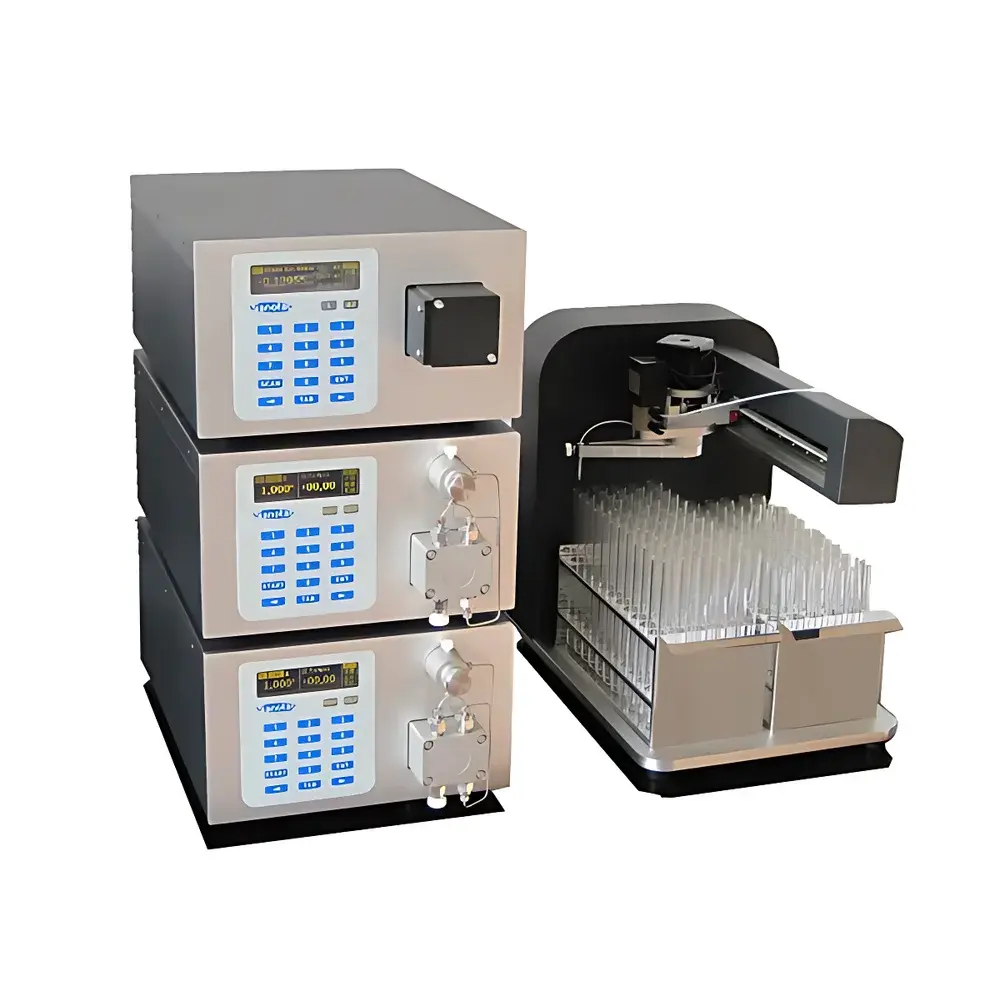
Sanotac Purifier-100 Medium-Pressure Preparative Liquid Chromatography System
| Brand | Sanotac |
|---|---|
| Origin | Shanghai, China |
| Manufacturer Type | OEM Manufacturer |
| Product Category | Domestic |
| Model | Purifier-100 |
| Application Level | Laboratory Grade |
| Instrument Type | Medium- to Low-Pressure Preparative LC System |
| Flow Rate Range | 0.01–100.00 mL/min |
| Flow Accuracy | ±1% |
| Flow Precision (RSD) | ≤0.5% |
| Maximum Pressure | 10 MPa |
| Wavelength Range | 190–800 nm |
| Wavelength Accuracy | ±1 nm |
| Wavelength Repeatability | 0.2 nm |
| Baseline Noise | ±0.5 × 10⁻⁵ AU (254 nm, TC = 1 s) |
| Data Acquisition Rate | 10 Hz |
| Gradient Types | Step, Linear, Real-Time Modifiable |
| Minimum Gradient Increment | 1% |
| Pressure Pulsation | ≤0.2 MPa |
| UV Detector Light Source | Dual Deuterium & Tungsten Lamps (Imported) |
| Absorbance Range | 0–2 AU |
| Fraction Collector | Automated, 2 × 60 positions (Φ15 mm × 150 mm vials, optional configurations available) |
| Collection Modes | Time-based, Peak-triggered, Threshold-triggered, Sequential, Recirculating |
| Sample Injection Valve | Prep-Grade Manual Injector (10 mL loop standard) |
| Sample Introduction | Solid or Liquid Loading |
| Fluidic Materials Options | 316L Stainless Steel, PEEK, Pure Titanium, Hastelloy |
| Software Compliance | Fully 21 CFR Part 11 & CFDA GxP Compliant |
| System Bus | High-Speed Digital Communication Architecture |
| Power Supply | 220 V ±10%, 50 Hz |
Overview
The Sanotac Purifier-100 is a medium-pressure preparative liquid chromatography (PLC) system engineered for robust, reproducible, and scalable purification of small molecules, synthetic intermediates, natural product isolates, and biomolecules—including peptides and modified oligonucleotides—within laboratory-scale research environments. Operating on the fundamental principle of differential partitioning between a stationary phase and a mobile phase under controlled pressure (up to 10 MPa), the Purifier-100 bridges the performance gap between analytical HPLC and high-pressure preparative systems, delivering precise gradient elution, low-flow stability, and high-fidelity detection without requiring ultra-high-pressure infrastructure. Its modular architecture supports seamless integration of pump modules, dual-lamp UV-Vis detection, automated fraction collection, and intelligent software control—all calibrated for method transfer from analytical to preparative workflows. Designed for laboratories prioritizing regulatory readiness, operational longevity, and method flexibility, the system adheres to core chromatographic principles while enabling direct translation of scouting methods into purification protocols.
Key Features
- High-stability dual-plunger reciprocating pump with cam-profile flow compensation, minimizing pulsation (<0.2 MPa) and ensuring baseline stability (±0.5 × 10⁻⁵ AU at 254 nm, 1 s time constant).
- Full-spectrum UV-Vis detector (190–800 nm) with imported deuterium and tungsten lamps, automatic lamp switching, and dual-wavelength simultaneous monitoring for compound identification and co-elution assessment.
- Automated fraction collector supporting 120-tube capacity (standard Φ15 × 150 mm format), configurable for time-, peak-, threshold-, sequential-, or recirculating collection modes.
- Chemically resistant fluidic path options—including 316L stainless steel, PEEK, pure titanium, and Hastelloy—enabling compatibility with aggressive solvents (e.g., TFA, HFIP), acidic/basic mobile phases, and salt-containing buffers.
- Pump head auto-cleaning function mitigates buffer crystallization and cross-contamination risks; rapid lamp and flow cell replacement reduces instrument downtime.
- Multi-point flow calibration across the full range (0.01–100.00 mL/min) ensures volumetric accuracy (±1%) and repeatability (RSD ≤0.5%), critical for mass recovery quantification and method validation.
- Real-time gradient and flow rate modification during runs facilitates method optimization without system shutdown or re-injection.
Sample Compatibility & Compliance
The Purifier-100 accommodates sample loads ranging from milligrams to multi-gram quantities using columns with internal diameters up to 50 mm—supporting both flash-style silica columns and high-resolution reversed-phase or HILIC media. It is compatible with commercially available SPE cartridges and third-party preparative columns across major vendors (e.g., Waters, Phenomenex, YMC, Agilent). From a regulatory standpoint, the system meets essential requirements for GLP- and GMP-aligned laboratories: electronic audit trails, role-based user authentication, electronic signatures, and immutable method/data archiving are fully implemented in Sanochrom software per FDA 21 CFR Part 11 and CFDA GxP guidelines. All hardware components comply with IEC 61010-1 safety standards, and fluidic material certifications (e.g., USP Class VI for PEEK, ASTM F899 for titanium) are available upon request.
Software & Data Management
Control and data acquisition are managed through Sanochrom Chromatography Workstation—a Windows-native application (compatible with Windows 7/8/10) featuring intuitive graphical interface, drag-and-drop method building, real-time chromatogram overlay, and integrated peak integration with customizable baselines and retention time locking. Project-level database architecture links instrument methods, raw chromatograms, processed results, and report templates within a single hierarchical structure. Raw data files are stored in vendor-neutral formats (e.g., .cdf-compatible), and all user actions—including parameter changes, injection events, and fraction triggers—are timestamped and logged with operator ID. The software supports IQ/OQ documentation packages and includes built-in tools for system suitability testing (SST), including resolution, tailing factor, and %RSD calculations per USP and EP 2.2.46.
Applications
- Purification of reaction mixtures in medicinal chemistry and process R&D, particularly for isolating chiral intermediates or regioisomers via normal-phase or reversed-phase gradients.
- Isolation of bioactive constituents from plant extracts, fungal cultures, or marine sources—enabling dereplication and structure–activity relationship (SAR) studies.
- Desalting and buffer exchange of synthetic peptides prior to lyophilization or biological assay.
- Preparative separation of oligonucleotide synthesis impurities (n−1, n−2 failure sequences) using ion-pairing RP-LC.
- Method development for downstream scale-up, leveraging identical column chemistries and gradient profiles used in analytical screening.
FAQ
Does the Purifier-100 support method transfer from analytical HPLC systems?
Yes—the system accepts standard .mtd and .seq files from common analytical platforms and allows linear scaling of flow rates, gradient times, and injection volumes based on column dimension ratios.
Can the UV detector operate in dual-wavelength mode simultaneously?
Yes—users may define two independent wavelengths (e.g., 214 nm and 254 nm) for concurrent monitoring of peptide bonds and aromatic moieties, with independent gain and filter settings.
Is the system compatible with non-aqueous mobile phases such as pure THF or chloroform?
With appropriate fluidic material selection (e.g., Hastelloy pump heads and PEEK tubing), the Purifier-100 supports full organic solvent operation, including halogenated and highly viscous eluents.
How is data integrity ensured during long-duration purification runs?
All detector signals, pump parameters, and fraction events are logged continuously at 10 Hz to local encrypted storage; backup synchronization to network drives follows configurable retention policies compliant with ALCOA+ principles.
What column dimensions and packing materials are validated for use with this system?
Validation data exist for columns ranging from 10 × 250 mm to 50 × 500 mm packed with C18, C8, phenyl-hexyl, amino, cyano, and diol phases—both silica- and polymer-based—under isocratic and gradient conditions up to 10 MPa.




