
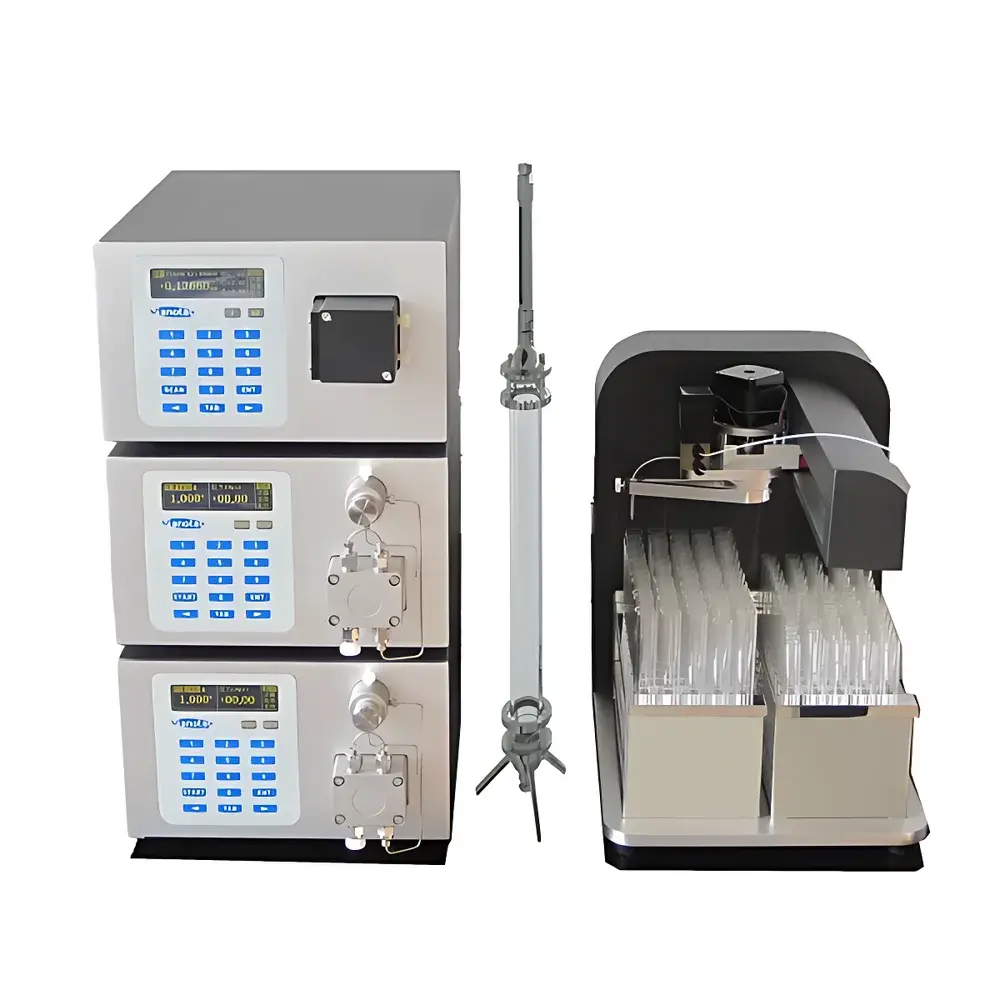
Sanotac Purifier 50 Medium-Pressure Preparative Liquid Chromatography System
| Brand | Sanotac |
|---|---|
| Origin | Shanghai, China |
| Manufacturer Type | OEM & In-House Producer |
| Product Category | Domestic |
| Model | Purifier 50 |
| Application Level | Laboratory-Scale |
| Instrument Type | Medium-Pressure Preparative HPLC |
| Flow Rate Range | 0.01–50.00 mL/min |
| Flow Accuracy | ±1% |
| Flow Precision (RSD) | ≤0.5% |
| Maximum Pressure | 30 MPa |
| Wavelength Range | 190–800 nm |
| Wavelength Accuracy | ±1 nm |
| Wavelength Repeatability | 0.2 nm |
| Baseline Noise | ±0.75×10⁻⁵ AU (254 nm, TC = 1 s) |
| Data Acquisition Frequency | 10 Hz |
Overview
The Sanotac Purifier 50 is a medium-pressure preparative liquid chromatography (PLC) system engineered for high-fidelity isolation and purification of bioactive compounds from complex natural matrices—particularly traditional Chinese medicinal herbs, botanical extracts, and synthetic organic intermediates. Unlike analytical-scale HPLC systems optimized for detection, the Purifier 50 implements robust fluidic architecture grounded in classical liquid chromatographic principles: separation occurs via differential partitioning of analytes between a stationary phase (e.g., C18, silica, or specialized natural product columns) and a mobile phase under controlled pressure-driven flow. Its operational envelope—up to 30 MPa (4350 psi), 50 mL/min flow, and dual-wavelength UV-Vis detection—positions it precisely between low-pressure flash chromatography and high-pressure preparative HPLC, offering optimal balance between resolution, throughput, scalability, and solvent economy for laboratory-scale purification workflows.
Key Features
- Microprocessor-controlled dual-piston parallel pump with real-time chamber pressure feedback, compensating for solvent compressibility and refill dynamics to ensure stable, pulse-free flow across the full range (0.01–50.00 mL/min).
- Flow pulsation suppression via cam-profile compensation technology, reducing baseline noise to ±0.75×10⁻⁵ AU at 254 nm (1 s time constant).
- Multi-point volumetric flow calibration across the entire dynamic range, delivering ≤0.5% RSD flow repeatability.
- Floating plunger design in 316L stainless-steel pump heads extends seal lifetime under sustained medium-pressure operation; PEEK pump head option available for aggressive solvents.
- 10 user-definable gradient and flow programs, supporting step, linear, and real-time modifiable gradients with 1% minimum increment resolution.
- Dual-wavelength UV-Vis detector featuring deuterium and tungsten lamps, enabling simultaneous monitoring at two wavelengths, time-programmed wavelength scanning, and stop-flow spectral acquisition for peak identity verification.
- Intelligent lamp and flow cell exchange mechanism—no tools required—maximizing instrument uptime and minimizing maintenance downtime.
Sample Compatibility & Compliance
The Purifier 50 accommodates diverse sample formats including crude herbal extracts (aqueous, ethanolic, methanolic), semi-purified fractions, synthetic reaction mixtures, fermentation broths, and peptide libraries. Its compatibility spans reversed-phase (C4, C8, C18), normal-phase (silica, amino), and specialized media (e.g., diol, phenyl-hexyl) for orthogonal separations. The system meets fundamental requirements for Good Laboratory Practice (GLP) and supports regulatory compliance through built-in audit trail functionality, electronic signature capability, and full traceability of method parameters, run logs, and collected fractions—all aligned with FDA 21 CFR Part 11 data integrity standards. While not certified for GMP manufacturing, its architecture and software documentation are suitable for method development, reference standard preparation, and preclinical compound supply in regulated research environments.
Software & Data Management
Controlled via Sanochrom™ Chromatography Workstation—a Windows 10–compatible application—the system provides full graphical interface control over pump, detector, and fraction collector. The software supports USB 2.0 and RS-232 connectivity, real-time multi-wavelength signal acquisition (up to four channels), and configurable collection triggers (time, threshold, slope, or combined logic). Delay volume compensation algorithms correct for system dwell volume, ensuring precise alignment between UV peak apex and fraction tube placement. All acquisition and collection metadata—including timestamp, pressure, flow, absorbance, and vial position—are stored in structured .csv and .chm formats, enabling seamless integration with LIMS or ELN platforms. Audit trails record operator ID, parameter changes, and run execution history with immutable timestamps.
Applications
The Purifier 50 is extensively deployed in natural product chemistry laboratories for targeted isolation of pharmacologically relevant compound classes from TCM matrices, including but not limited to: saponins (e.g., ginsenosides, astragalosides), flavonoids (quercetin glycosides, baicalein derivatives), isoflavones (genistein, daidzein), coumarins (scopoletin, imperatorin), chromones, alkaloids (berberine, matrine), phenolic acids (rosmarinic acid, chlorogenic acid), terpenoids (triptolide, artemisinin analogs), anthraquinones (emodin, rhein), and lignans (schisandrin B). It also serves synthetic chemistry groups for purifying novel heterocycles, chiral intermediates, and peptide conjugates prior to structural characterization (NMR, HRMS) or biological evaluation.
FAQ
What distinguishes medium-pressure PLC from analytical or high-pressure preparative HPLC?
Medium-pressure systems like the Purifier 50 operate at 0–30 MPa, bridging resolution and loading capacity: higher than flash chromatography (40 MPa), enabling gram-scale purification with sub-2% impurity carryover without requiring ultra-high-pressure infrastructure.
Can the system be used for protein purification?
While primarily designed for small-molecule natural products, optional large-bore columns (up to 30 mm ID) and biocompatible PEEK flow paths permit purification of peptides and small proteins (<25 kDa) using ion-exchange or size-exclusion media—though dedicated FPLC systems remain preferred for routine biomolecule work.
Is method transfer from analytical HPLC possible?
Yes—gradient scaling, flow rate adjustment, and column dimension conversion tools are embedded in Sanochrom software, allowing direct translation of analytical methods to preparative conditions while preserving selectivity and peak elution order.
What validation documentation is provided?
Each unit ships with Factory Acceptance Test (FAT) report, IQ/OQ protocols, and 21 CFR Part 11-compliant software validation package—including electronic signature configuration, audit trail enablement, and role-based access control setup guides.
How is fraction purity verified post-collection?
Integrated dual-wavelength tracking enables real-time purity assessment via peak shape symmetry and co-elution analysis; collected fractions can be re-injected on analytical HPLC or subjected to TLC/HPTLC for rapid identity and purity confirmation.





