
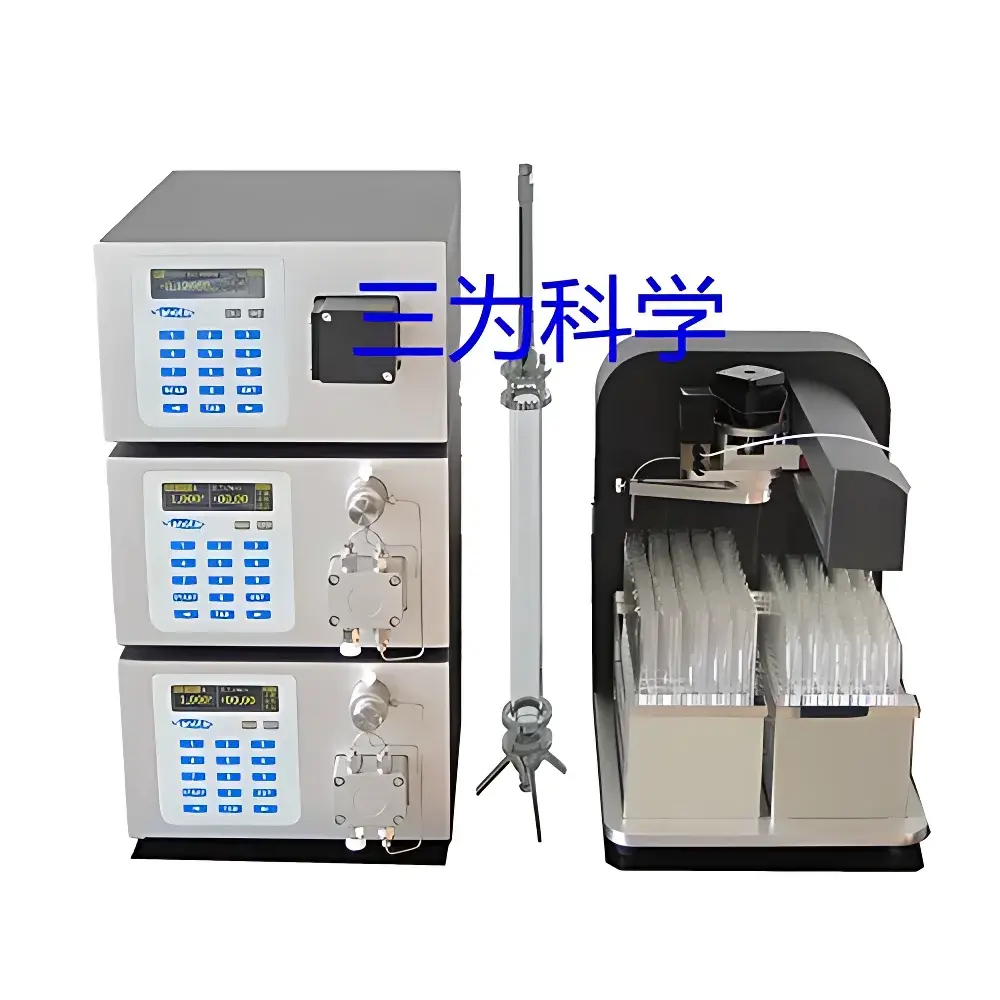
Sanotac Purifier ZG-50 High-Pressure Preparative Liquid Chromatography System
| Brand | Sanotac |
|---|---|
| Origin | Shanghai, China |
| Manufacturer Type | OEM Manufacturer |
| Regional Category | Domestic (China) |
| Model | ZG-50 |
| Price Range | USD 14,000 – 28,000 |
| Application Level | Laboratory-Scale |
| Instrument Type | High-Pressure Preparative LC System |
| Flow Rate Range | 0.01–50.00 mL/min |
| Flow Accuracy | ±1% |
| Flow Precision (RSD) | ≤0.5% |
| Maximum Pressure | 30 MPa |
| Wavelength Range | 190–800 nm |
| Wavelength Accuracy | ±1 nm |
| Wavelength Repeatability | 0.2 nm |
| Baseline Noise | ±0.75×10⁻⁵ AU (254 nm, TC = 1 s) |
| Data Acquisition Rate | 10 Hz |
Overview
The Sanotac Purifier ZG-50 is a modular, high-pressure preparative liquid chromatography (PLC) system engineered for reproducible, scalable isolation and purification of natural product compounds—particularly saponins—from complex botanical matrices such as traditional Chinese medicinal herbs. Operating on the principle of reversed-phase or normal-phase liquid chromatography under controlled pressure gradients, the ZG-50 delivers precise solvent delivery, real-time UV/Vis detection across a broad spectral range (190–800 nm), and automated fraction collection—enabling robust separation of structurally similar triterpenoid and steroidal saponins with high resolution and recovery yield. Designed for laboratory-scale purification workflows, it supports both analytical-to-preparative method transfer and direct isolation of milligram-to-gram quantities of bioactive constituents without requiring system reconfiguration.
Key Features
- High-stability dual-plunger pump with 316L stainless steel or optional PEEK pump heads, delivering low-pulse flow across 0.01–50.00 mL/min with ±1% accuracy and ≤0.5% RSD repeatability
- Full-spectrum UV/Vis detector featuring imported deuterium and tungsten lamps, enabling simultaneous dual-wavelength monitoring (e.g., 205 nm + 254 nm) for co-elution assessment and peak purity evaluation
- Automated fraction collector supporting 2 × 60 tubes (Φ15 mm × 150 mm), configurable for time-based, peak-triggered, threshold-based, sequential, or cyclic collection modes
- Modular gradient capability: programmable linear, stepwise, or custom-defined gradients with ≤1% minimum increment; real-time online modification of flow rate and gradient profile during run
- Integrated 10 mL preparative injection valve (standard), compatible with solid or liquid sample loading; optional larger-loop configurations available for increased loading capacity
- Maximum operating pressure of 30 MPa (4350 psi), suitable for sub-10 µm particle size columns and high-resolution separations under elevated backpressure conditions
Sample Compatibility & Compliance
The ZG-50 is routinely deployed in the isolation of saponin aglycones and glycosides—including ruscogenin, ginsenosides (Rb1, Rg1, Rh2, etc.), astragalosides I–IV, platycodin D, jujubosides A/B, and cycloastragenol—from plant extracts such as Panax ginseng, Astragalus membranaceus, Platycodon grandiflorus, and Paris polyphylla. Its fluidic architecture accommodates standard 10–30 mm ID preparative columns and is mechanically and chemically compatible with medium-pressure systems from GE Healthcare (Explore), Biotage, ISCO, and Büchi—allowing seamless column interchange and method portability. All hardware and software components comply with ISO 9001 quality management standards; the system’s operational documentation and electronic records adhere to GLP principles and support audit readiness for regulatory submissions under CFDA GxP and FDA 21 CFR Part 11 requirements.
Software & Data Management
Controlled via Sanochrom™ Chromatography Workstation—a Windows 7/8/10–based application—the ZG-50 integrates pump, detector, and fraction collector into a unified graphical interface. The software supports method development, sequence definition, real-time chromatogram visualization, peak integration using tangent skim or valley-to-valley algorithms, and customizable report generation. Electronic signatures, user access levels (admin/operator/auditor), audit trails with timestamped event logging (including parameter changes, start/stop actions, and collection triggers), and encrypted data storage ensure full traceability and compliance with 21 CFR Part 11 Annex 11 expectations. Raw data files are stored in vendor-neutral formats (e.g., .cdf), facilitating third-party analysis and long-term archival.
Applications
The ZG-50 is validated for purification of diverse phytochemical classes beyond saponins, including flavonoids, alkaloids, terpenoids, anthraquinones, coumarins, lignans, and phenolic acids. Its high-pressure capability enables efficient separation of closely eluting isomers—such as 20(S)- vs. 20(R)-ginsenoside epimers—or positional glycosylation variants (e.g., ginsenoside Rb2 vs. Rb3). In natural product drug discovery pipelines, the system serves critical roles in: (i) dereplication-guided isolation; (ii) preparation of reference standards for QC/QA labs; (iii) generation of purified fractions for NMR structural elucidation; and (iv) scale-up of lead compound batches for pharmacological screening. Its compatibility with both C18 and silica-based stationary phases further extends utility to synthetic organic intermediates and peptide purification workflows.
FAQ
What column formats and dimensions are supported by the ZG-50?
Standard compatibility includes 10–30 mm internal diameter preparative columns packed with 5–25 µm particles; users may employ stainless steel, PEEK, or glass-jacketed columns rated for ≤30 MPa.
Can the system perform multi-wavelength detection during a single run?
Yes—the dual-lamp UV/Vis detector allows concurrent monitoring at two user-defined wavelengths (e.g., 205 nm for aglycone detection and 254 nm for glycosidic bond absorption), improving peak identification confidence.
Is method transfer possible from analytical HPLC to this preparative system?
Yes, via linear flow rate scaling and column volume normalization; Sanochrom software includes built-in method translation tools to assist in retention time and gradient adjustment.
Does the system meet regulatory requirements for pharmaceutical development?
The ZG-50 meets core elements of FDA 21 CFR Part 11 and CFDA GxP for electronic records and signatures when deployed with configured audit trail, role-based access, and secure data export protocols.
What maintenance intervals are recommended for pump seals and detector lamps?
Pump seal replacement is advised every 6–12 months depending on solvent aggressiveness and usage frequency; deuterium lamp lifetime is typically ≥1000 hours, tungsten lamp ≥2000 hours—both monitored via software diagnostics.
Related Products





