
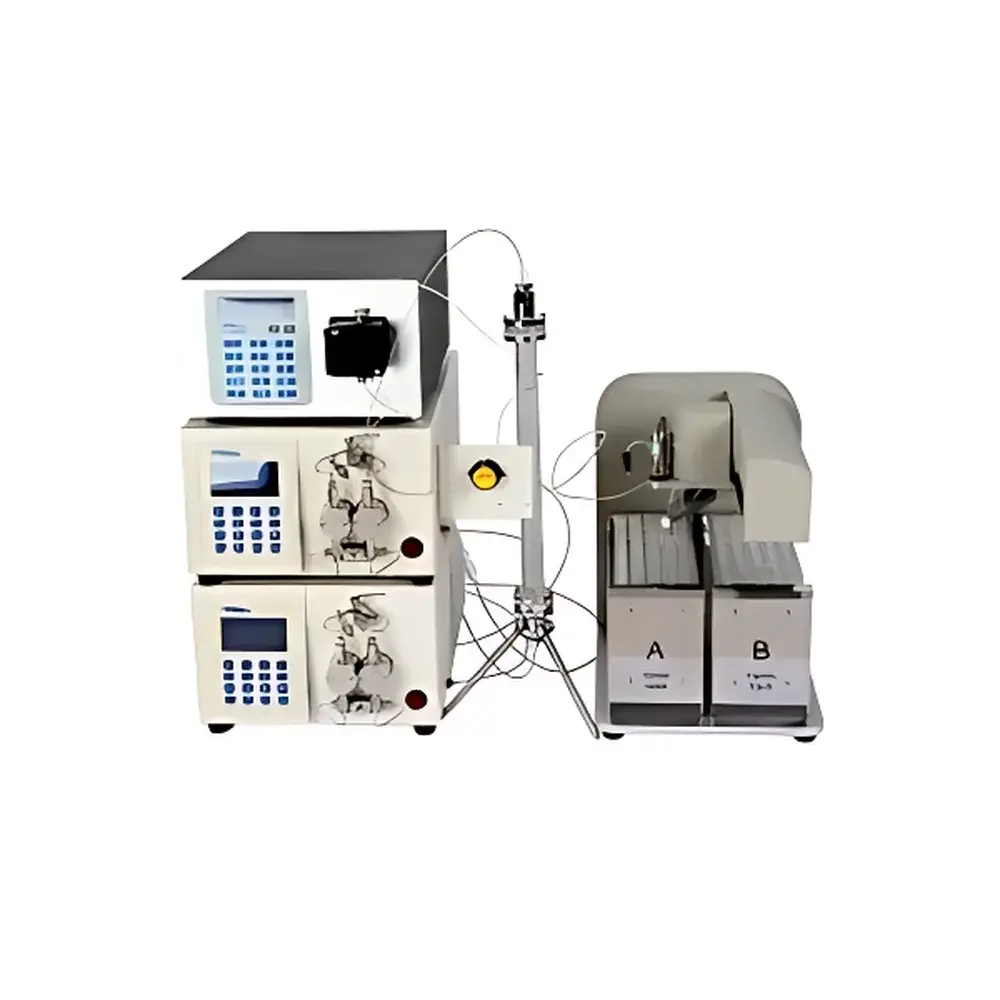
Sanotac Q0502 Low-Pressure Liquid Chromatography (LPLC) System
| Brand | Sanotac |
|---|---|
| Origin | Shanghai, China |
| Manufacturer Type | Direct Manufacturer |
| Product Category | Domestic |
| Model | Q0502 |
| Application Level | Laboratory Grade |
| Instrument Type | Medium-Low Pressure Preparative Liquid Chromatography |
| Flow Rate Range | 0–50 mL/min |
| Flow Accuracy | ±1% |
| Flow Precision (RSD) | ≤1% |
| Maximum Operating Pressure | 6 MPa |
| Wavelength Range | 190–800 nm |
| Wavelength Accuracy | ±1 nm |
| Wavelength Repeatability | ±0.1 nm |
| Baseline Noise | ≤1×10⁻⁵ AU |
| Data Acquisition Frequency | 10 Hz |
Overview
The Sanotac Q0502 Low-Pressure Liquid Chromatography (LPLC) System is an engineered medium-pressure preparative chromatography platform designed for robust, reproducible separation and purification of organic small molecules, natural product extracts, synthetic intermediates, and moderately stable biomolecules under controlled isocratic or gradient elution conditions. Operating within a pressure range up to 6 MPa (≈60 bar), the system bridges the performance gap between traditional gravity-fed column chromatography and high-pressure preparative HPLC—offering superior resolution, scalability, and method transferability without requiring ultra-high-pressure infrastructure. Its core architecture implements dual-piston reciprocating pump technology with real-time chamber pressure feedback, solvent compressibility compensation, and dynamic pulse dampening via proprietary flow curve compensation algorithms—ensuring consistent delivery across the full 0.1–50 mL/min flow range. This enables precise retention time alignment, reliable fraction collection, and compliance-ready method execution in regulated laboratory environments.
Key Features
- Microprocessor-controlled dual-piston parallel pump head with active pressure feedback loop for enhanced flow stability and reduced pulsation (≤0.1 MPa)
- Multi-point flow calibration curves applied across the entire operational range to maintain ±1% flow accuracy and ≤1% RSD flow precision
- Floating plunger design minimizing seal wear and extending high-pressure seal service life under repeated cycling
- Programmable gradient capability: linear, stepwise, or user-defined profiles with online modification support
- Dual-wavelength UV-Vis detector featuring imported deuterium and tungsten lamps, auto-switching logic, and intelligent lamp management for extended uptime
- Three acquisition modes—dual-wavelength monitoring, wavelength-time programming, and stop-flow spectral scanning—to minimize baseline drift and maximize signal-to-noise ratio (baseline noise ≤1×10⁻⁵ AU at 254 nm)
- Modular flow cell options: semi-preparative (10 µL) and preparative (80 µL) pathlength cells compatible with standard 1/4″ or 1/8″ ID columns
- Integrated automated fraction collector with dual 60-position racks (15 mm × 150 mm tubes), supporting sequential, cyclic, and threshold-triggered collection modes
Sample Compatibility & Compliance
The Q0502 accommodates diverse sample formats—including solid loading (via 10 mL fixed-loop or optional variable-loop injectors) and direct liquid injection—enabling purification of compounds ranging from 40 mg to 50 g per run. Column compatibility spans stainless steel, PEEK, and glass-bodied preparative columns (ID 10–50 mm), supporting reversed-phase (C18, C8), normal-phase (silica), ion-exchange, and size-exclusion media. The system meets fundamental requirements for GLP-compliant operation: audit-trail-enabled software logging (via optional CFR Part 11 add-on), electronic signature support, and instrument parameter locking. While not certified for GMP manufacturing, it aligns with ASTM D7213 (standard practice for preparative LC method development) and ISO 17025 traceability frameworks when paired with calibrated reference standards and documented SOPs.
Software & Data Management
Control and data acquisition are managed through a Windows-based PC workstation connected via RS-232 or USB interface. The native software provides full instrument control—including pump gradient programming, detector wavelength scheduling, fraction collector triggering logic, and real-time chromatogram visualization. Raw data files (.chd) are stored in vendor-neutral ASCII format for third-party integration (e.g., Chromeleon, OpenLab CDS). All method parameters, run logs, and audit events—including user login timestamps, parameter changes, and collection triggers—are timestamped and exportable as CSV or PDF reports. Optional 21 CFR Part 11 compliance packages include role-based access control, electronic signatures, and immutable audit trails compliant with FDA-regulated QC/QA workflows.
Applications
- Purification of pharmaceutical active ingredients and process-related impurities during early-stage API development
- Isolation of bioactive constituents from plant extracts, marine organisms, and fermentation broths
- Separation of regioisomers and diastereomers in synthetic organic chemistry campaigns
- Desalting and buffer exchange of peptides and small proteins prior to analytical characterization
- Method scouting and scale-up studies for subsequent transfer to analytical or semi-preparative HPLC systems
- Quality control of natural product reference standards and botanical extract batches
FAQ
What is the maximum column backpressure the Q0502 can sustain?
The system is rated for continuous operation up to 6 MPa (60 bar), with pressure sensors and safety interlocks preventing over-pressurization.
Can the detector perform simultaneous dual-wavelength quantitation?
Yes—the UV-Vis module supports concurrent monitoring at two user-defined wavelengths (e.g., 214 nm and 254 nm) with independent gain settings and real-time ratio calculation.
Is method transfer possible from analytical HPLC to this LPLC system?
Method transfer is feasible using linear velocity scaling and column volume normalization; however, gradient dwell volume differences require empirical re-optimization of delay times and slope profiles.
Does the system support pH-sensitive mobile phases?
PEEK fluidic paths (pump head, tubing, detector flow cell) ensure compatibility with aqueous buffers across pH 2–12; stainless steel components are limited to pH 3–10 to prevent corrosion.
What validation documentation is provided with the instrument?
Each unit ships with a Factory Acceptance Test (FAT) report, IQ/OQ templates aligned with ISO/IEC 17025, and NIST-traceable calibration certificates for flow and wavelength verification.





