
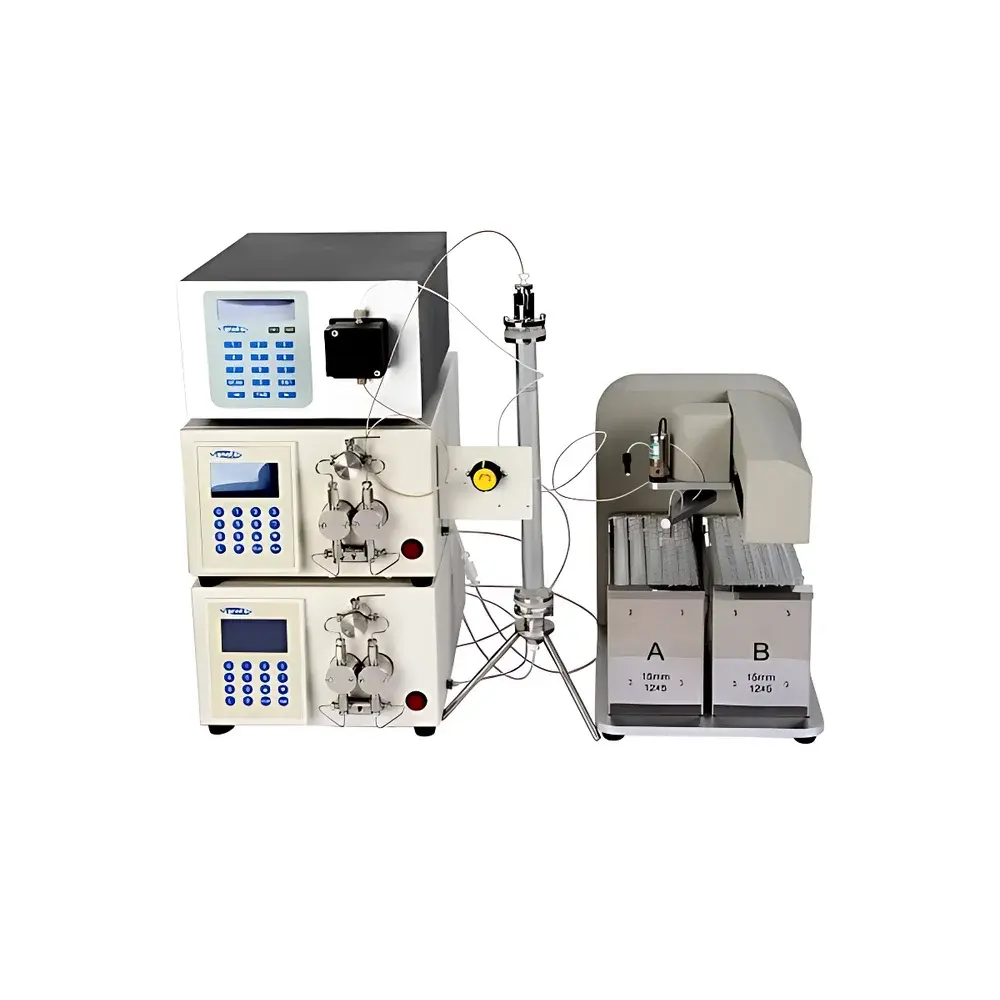
Sanotac Q0510 Medium-Pressure Preparative Liquid Chromatography (MPLC) System
| Brand | Sanotac |
|---|---|
| Origin | Shanghai, China |
| Manufacturer Type | Direct Manufacturer |
| Product Origin | Domestic (China) |
| Model | Q0510 |
| Application Level | Laboratory Grade |
| Instrument Type | Medium-Low Pressure Preparative LC |
| Flow Rate Range | 0–50 mL/min |
| Flow Accuracy | ±1% |
| Flow Precision (RSD) | ≤1% |
| Maximum Operating Pressure | 10 MPa |
| Wavelength Range | 190–800 nm |
| Wavelength Accuracy | ±1 nm |
| Wavelength Repeatability | ±0.1 nm |
| Baseline Noise | ≤1 × 10⁻⁵ AU |
| Data Acquisition Frequency | 10 Hz |
Overview
The Sanotac Q0510 Medium-Pressure Preparative Liquid Chromatography (MPLC) System is an engineered solution for scalable, reproducible purification of complex organic and natural product mixtures in academic, pharmaceutical, and biotechnology laboratories. Operating within a pressure range up to 10 MPa (1450 psi), the Q0510 bridges the performance gap between traditional flash chromatography and high-performance preparative HPLC—delivering enhanced resolution, method transferability, and robustness without requiring ultra-high-pressure infrastructure. Its core separation principle relies on liquid-phase partitioning under controlled gradient elution, utilizing reversed-phase, normal-phase, or ion-exchange columns (typically 10–40 mm ID, packed with silica, C18, or specialized stationary phases). The system integrates a dual-lamp UV-Vis detector (deuterium + tungsten) enabling simultaneous dual-wavelength monitoring across 190–800 nm—critical for tracking compounds with disparate absorption maxima (e.g., flavonoids and alkaloids in plant extracts) and minimizing co-elution misidentification.
Key Features
- High-stability dual-piston reciprocating pump with corrosion-resistant fluidic path (316L stainless steel and PEEK), delivering flow rates from 0.1 to 50.0 mL/min with ≤±1% accuracy and ≤1% RSD across the full range
- Programmable binary gradient system supporting linear, step, and custom-defined gradients; gradient composition adjustable in real time via PC software without system interruption
- Dual-wavelength UV-Vis detection with ±1 nm wavelength accuracy and ±0.1 nm repeatability; baseline noise <1 × 10⁻⁵ AU at 254 nm (1 sec response time), ensuring high-sensitivity fraction triggering
- Automated fraction collector with dual 60-position racks (15 mm × 150 mm tubes); supports sequential, looped, peak-threshold, and time-based collection modes
- Standard 10 mL fixed-loop manual injection valve (optional loops: 1, 5, 25, 50, 100 mL); compatible with both solid-phase loading (dry loading on silica) and direct liquid injection
- RS-232 and USB 2.0 interfaces for bidirectional communication; Windows-based control software compliant with audit trail requirements per 21 CFR Part 11 (user authentication, electronic signatures, change history)
Sample Compatibility & Compliance
The Q0510 accommodates diverse sample matrices—including crude natural extracts, reaction mixtures (post-Suzuki, amidation, or esterification), fermentation broths, and peptide hydrolysates—with load capacities ranging from 40 mg to 50 g per run (depending on column dimensions and resolution targets). It supports standard chromatographic consumables: disposable glass or polypropylene columns (15–100 mm ID), pre-packed cartridges (up to 300 g silica), and custom-packed stainless-steel columns. All wetted materials meet USP Class VI biocompatibility standards. The system adheres to ISO 9001 manufacturing protocols and is validated for GLP-compliant operation in QC environments. Method parameters (flow, gradient, collection thresholds) are fully exportable as CSV or XML for regulatory submission (e.g., ICH M4, FDA IND packages).
Software & Data Management
The embedded Sanotac ChromoControl™ workstation (Windows 7/10 compatible) provides intuitive method building, real-time chromatogram visualization, and automated peak integration using second-derivative algorithms. Raw data (.raw) files include full detector spectra (200–400 nm snapshots at 10 Hz), pressure/flow logs, and collection event timestamps. Software enforces role-based access control (administrator, analyst, reviewer), generates immutable audit trails for all parameter modifications, and exports PDF reports with digital signatures. Data integrity complies with ALCOA+ principles (Attributable, Legible, Contemporaneous, Original, Accurate, Complete, Consistent, Enduring, Available) and supports 21 CFR Part 11 compliance when deployed on validated IT infrastructure.
Applications
- Purification of bioactive natural products (e.g., terpenoids, glycosides, polyphenols) from botanical extracts prior to NMR or MS structural elucidation
- Isolation of synthetic intermediates and final APIs in medicinal chemistry workflows, especially where crystallization fails
- Desalting and buffer exchange of peptides and small proteins (≤10 kDa) using size-exclusion or ion-exchange MPLC
- Preparative separation of diastereomers and regioisomers in asymmetric synthesis validation
- Process development support for downstream scale-up to industrial SFC or preparative HPLC
FAQ
What column dimensions and packing materials are recommended for optimal Q0510 performance?
Standard use cases employ 20–30 mm ID glass or stainless-steel columns packed with 40–63 µm spherical silica (e.g., Merck Silica 60, YMC Pack Diol). For polar analytes, amino or cyano phases are viable; for biomolecules, polymer-based SEC resins (e.g., TSK-GEL G2000SWxl) operate effectively below 5 MPa.
Can the system be integrated into a LIMS or ELN environment?
Yes—via ASCII-based ASCII/CSV export and optional OPC UA server add-on (available upon request), enabling bidirectional data exchange with LabVantage, Benchling, or Veeva systems.
Is method transfer from analytical HPLC to Q0510 feasible?
Absolutely. Retention time scaling (using linear velocity normalization) and gradient dwell volume compensation allow reliable translation of UHPLC methods to MPLC conditions while preserving selectivity—validated per ASTM D7802 guidelines.
What maintenance intervals are recommended for long-term reliability?
Pump seals: every 6 months or 1000 h; UV lamp: 1000 h; inline filter cartridges: before each run; system leak testing: weekly per ISO 17025 Annex A. Full PQ documentation is included with shipment.






