
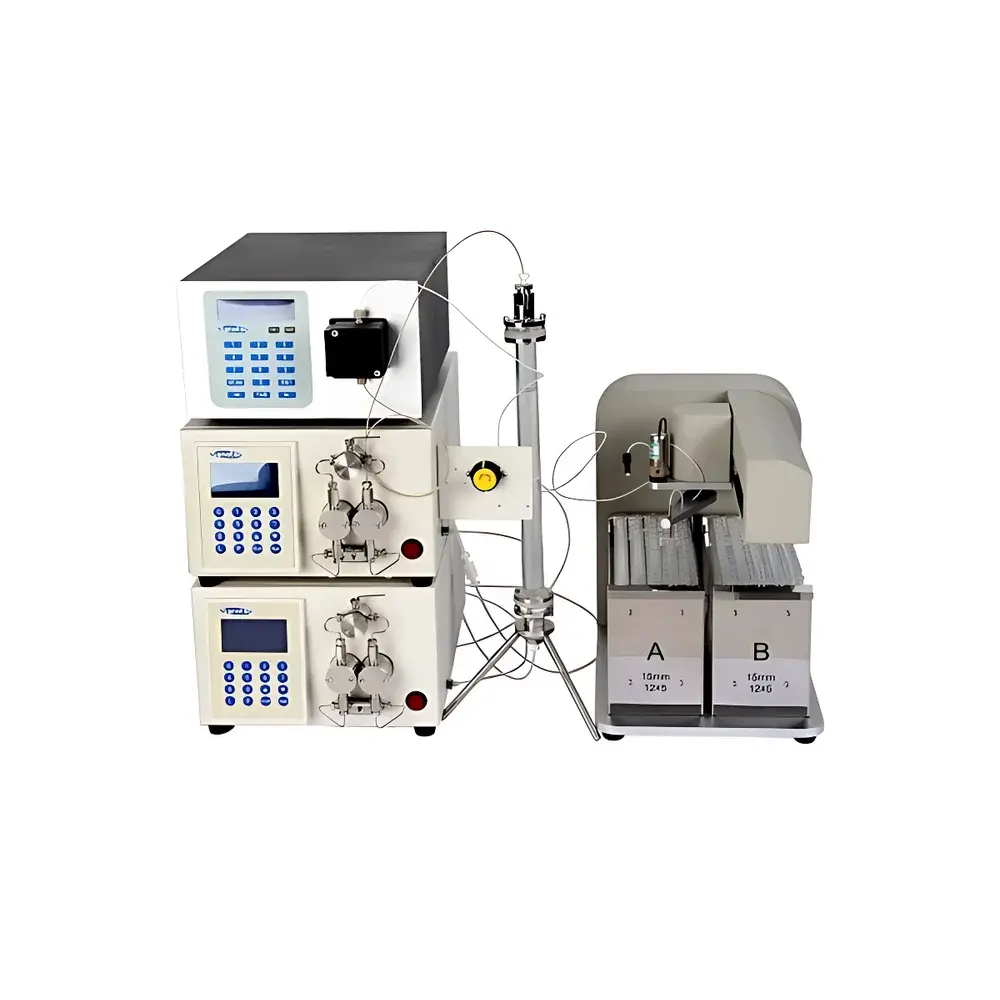
Sanotac Q2005 Flash Medium-Pressure Chromatography System
| Brand | Sanotac |
|---|---|
| Origin | Shanghai, China |
| Manufacturer Type | Direct Manufacturer |
| Product Category | Domestic |
| Model | Q2005 |
| Application Level | Laboratory Grade |
| Instrument Type | Medium-Low Pressure Preparative Liquid Chromatography |
| Flow Rate Range | 0–50 mL/min |
| Flow Accuracy | ±1% |
| Flow Precision | ±1% |
| Maximum Operating Pressure | 10 MPa |
| Wavelength Range | 190–800 nm |
| Wavelength Accuracy | ±1 nm |
| Wavelength Repeatability | ±0.1 nm |
| Baseline Noise | ≤1 × 10⁻⁵ AU |
| Data Acquisition Frequency | 10 Hz |
Overview
The Sanotac Q2005 Flash Medium-Pressure Chromatography System is an engineered solution for laboratory-scale purification and refinement of complex organic and natural product mixtures. Designed around medium-pressure liquid chromatography (MPLC) principles—operating at pressures up to 10 MPa—it bridges the performance gap between conventional gravity-driven flash chromatography and high-pressure preparative HPLC. The system employs dual-wavelength UV-Vis detection (190–800 nm) with a combined deuterium and tungsten lamp source, enabling simultaneous monitoring at two user-defined wavelengths for improved peak tracking and fraction discrimination. Its modular architecture supports both solid and liquid sample loading, with programmable gradient elution (step or linear), real-time gradient modification, and automated fraction collection—making it suitable for iterative method development and reproducible scale-up from analytical to early-preparative workloads.
Key Features
- High-precision dual-piston reciprocating pump with low pulsation (≤0.1 MPa) and corrosion-resistant fluid path materials, ensuring long-term stability under organic solvent exposure.
- UV-Vis detector with ±1 nm wavelength accuracy and ±0.1 nm repeatability; baseline noise ≤1 × 10⁻⁵ AU at 254 nm (10 mm pathlength cell), supporting reliable quantification across diverse compound classes.
- Automated fraction collector with dual 60-position racks (15 mm × 150 mm tubes), configurable in sequential, cyclic, or threshold-triggered modes based on absorbance or time.
- Integrated 10 mL stainless-steel loop injector (expandable via optional loops); accommodates sample loads ranging from 40 mg to 200 g depending on column dimensions and matrix complexity.
- Gradient programming flexibility: selectable step or linear profiles with minimum 1% incremental resolution; gradients editable during runtime via PC interface.
- RS-232 and USB connectivity compatible with Windows-based control software (XP/7), supporting method storage, audit trail logging, and export of raw chromatograms in standard formats (e.g., .csv, .txt).
Sample Compatibility & Compliance
The Q2005 system is routinely deployed for purification of thermally labile natural products (e.g., alkaloids, flavonoids, terpenoids), synthetic intermediates, peptide fragments, and small-molecule antibiotics. Its pressure and flow specifications align with ASTM D6988-17 (standard practice for preparative chromatographic purification) and support method transfer consistent with ICH Q5A(R2) and Q5C guidelines for biopharmaceutical impurity profiling. While not certified for GMP production environments, its software architecture includes timestamped event logs, user-access controls, and method versioning—facilitating GLP-compliant documentation in academic and contract research laboratories. All wetted parts comply with USP Class VI biocompatibility standards and resist common mobile phases including hexane/ethyl acetate, methanol/water, and acetonitrile/trifluoroacetic acid mixtures.
Software & Data Management
Control and data acquisition are managed through a dedicated Windows workstation application that provides full instrument parameterization—including flow rate ramping, gradient slope definition, detector wavelength assignment, and fraction trigger logic. Raw data files include retention time, absorbance values at both selected wavelengths, pressure trace, and pump status flags. The software supports post-run integration using tangent skim or Gaussian smoothing algorithms and permits manual baseline correction. Export functions adhere to FAIR data principles: chromatograms and calibration reports can be saved as ASCII-delimited text for third-party analysis (e.g., MATLAB, Python pandas), and method files are digitally signed to prevent unauthorized modification. Audit trails record operator ID, timestamp, parameter changes, and collection events—meeting foundational requirements for FDA 21 CFR Part 11 compliance when deployed with appropriate IT governance policies.
Applications
- Purification of plant extracts prior to NMR or MS structural elucidation.
- Isolation of reaction mixtures following Suzuki or Heck couplings where polar by-products co-elute with target compounds.
- Desalting and buffer exchange of synthetic peptides prior to lyophilization.
- Removal of residual catalysts (e.g., Pd, Ru) from transition-metal-catalyzed reactions using chelating stationary phases.
- Fractionation of microbial fermentation broths to isolate novel antimicrobial agents under anaerobic or pH-sensitive conditions.
- Method scouting for downstream HPLC or SFC optimization, leveraging consistent column packing and eluent compatibility.
FAQ
What column dimensions are compatible with the Q2005 system?
Standard columns range from 10 mm to 50 mm internal diameter and 100–500 mm length, supporting silica, C18, amino, cyano, and diol stationary phases rated for ≤10 MPa operation.
Can the system operate with non-UV-absorbing compounds?
Yes—fraction collection may be triggered by time windows or external signals (e.g., conductivity or ELSD output via analog input), though primary detection relies on UV-Vis absorbance.
Is remote monitoring supported?
The system does not include native Ethernet or cloud connectivity; however, the PC workstation may be accessed remotely via institutional VNC or RDP protocols subject to local network security policy.
How is maintenance documented?
Service logs—including seal replacement dates, lamp usage hours, and calibration verification records—can be manually entered into the software’s “Instrument History” module and exported as PDF reports.
Does the software support IQ/OQ documentation templates?
Sanotac provides a vendor-validated IQ/OQ protocol package upon request, aligned with ISO/IEC 17025:2017 Annex A.3 requirements for chromatographic equipment qualification.
Related Products






