
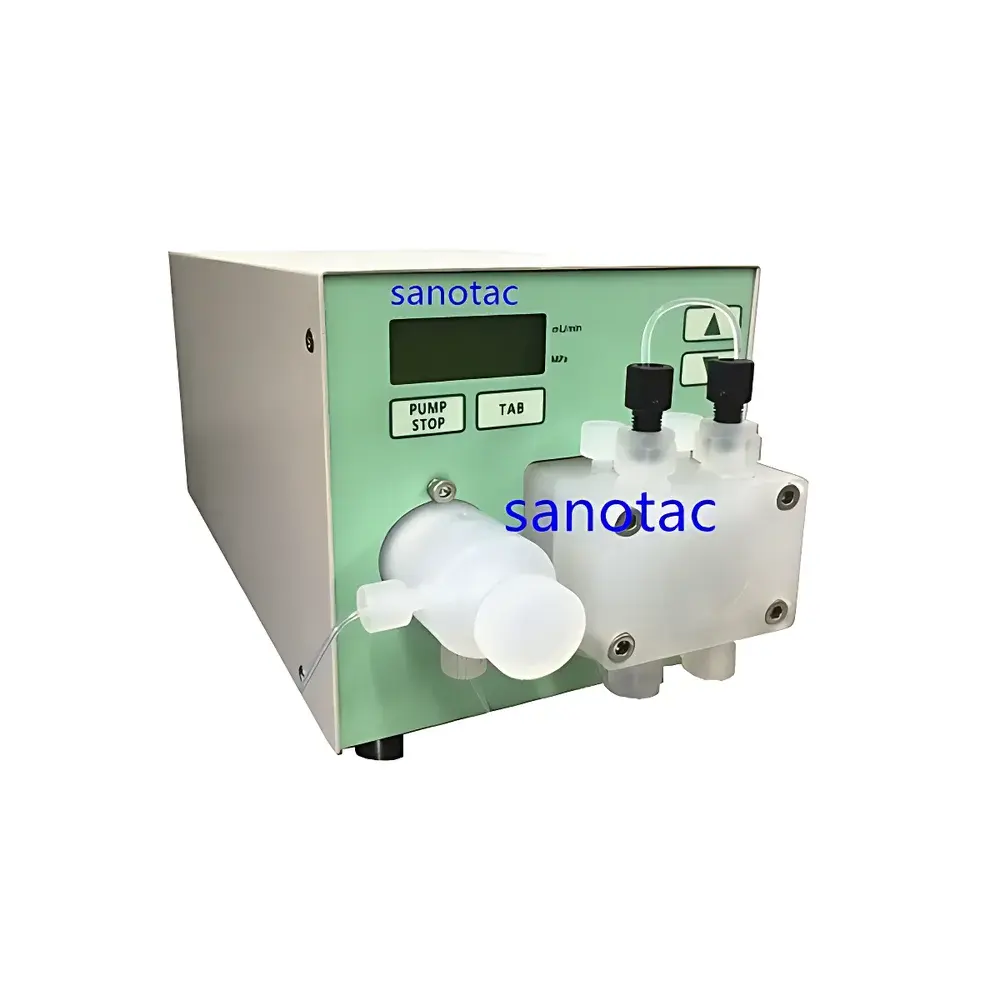
Sanotac QP0017 Micro PCTFE Constant-Flow Pump
| Brand | Sanotac |
|---|---|
| Origin | Shanghai, China |
| Manufacturer Type | Direct Manufacturer |
| Model | QP0017 |
| Flow Range | 0.001–9.999 mL/min |
| Flow Increment | 0.001 mL/min |
| Flow Accuracy | ±0.1% |
| Flow Precision (RSD) | ≤0.1% |
| Max Pressure | 2 MPa |
| Pressure Ripple | ≤0.1 MPa |
| Pump Head Volume | 10 mL |
| Fluidic Path Materials | PTFE, PCTFE, Sapphire, Ceramic |
| Tubing Connection | 1/16" Standard |
| Display | 256×64 Dot Matrix OLED |
| Control Modes | Front Panel + RS232/USB Computer Reverse Control (Open Protocol) |
| Power Supply | 85–264 VAC, 50 Hz |
| Dimensions | 260 × 110 × 110 mm³ |
| Drive Mechanism | Dual Parallel Plunger with Floating Plunger Design |
| Gradient Capability | Isocratic, Linear & Step Gradient Combination |
| Solvent Compression Compensation | Yes |
| Multi-Point Flow Calibration | Yes |
| Check Valves | Imported Swiss Sapphire-Ceramic |
| Sealing Architecture | Low-Wear Floating Plunger Seal System |
Overview
The Sanotac QP0017 Micro PCTFE Constant-Flow Pump is an engineered solution for precise, pulse-free liquid delivery in demanding laboratory and pilot-scale applications where chemical compatibility, long-term stability, and metrological traceability are critical. Designed around a dual-plunger, parallel-driven architecture with floating plunger mechanics, the pump operates on positive displacement principles—ensuring volumetric accuracy independent of fluid viscosity or backpressure within its specified operating envelope (up to 2 MPa). Its fluid path is constructed entirely from inert fluoropolymers—specifically PTFE and PCTFE—alongside sapphire and ceramic components, granting exceptional resistance to aggressive solvents, strong acids, halogenated reagents, and supercritical fluids. This material selection aligns with ASTM D471 and ISO 1817 standards for elastomer and polymer resistance testing, making the QP0017 suitable for use in regulated environments including catalyst evaluation, electrochemical flow cells, and continuous-flow synthesis platforms compliant with GLP documentation requirements.
Key Features
- Dual parallel plunger design with floating plunger mechanism—minimizes seal friction and extends service life of high-pressure sealing elements under sustained operation.
- Microprocessor-controlled solvent compression compensation—dynamically adjusts stroke volume based on fluid compressibility, ensuring consistent volumetric delivery across solvent families (e.g., acetonitrile vs. water vs. CO₂-expanded liquids).
- Multi-point flow calibration algorithm—enables user-defined correction at up to 10 discrete flow rates, improving linearity and reducing systematic error across the full 0.001–9.999 mL/min range.
- Low-pressure ripple performance (≤0.1 MPa)—achieved via cam-profile optimization and real-time electronic pulse suppression, critical for UV-Vis detection stability and reproducible reaction kinetics in flow chemistry.
- Open-protocol reverse control interface (RS232/USB)—supports integration with third-party chromatography data systems (CDS), LabVIEW, Python-based automation frameworks, and custom SCADA architectures without proprietary driver dependencies.
- Self-luminous 256×64 OLED display—operable under low-light conditions common in glovebox or fume hood installations; supports real-time monitoring of flow rate, pressure, gradient profile, and system status flags.
Sample Compatibility & Compliance
The QP0017 accommodates a broad spectrum of process fluids—including aqueous buffers, organic solvents (THF, DMF, chlorinated hydrocarbons), corrosive reagents (HF, oleum, bromine solutions), and supercritical CO₂—with no wetted metal surfaces. Its PCTFE pump head exhibits superior dimensional stability versus standard PTFE at elevated pressures and temperatures (up to 120 °C continuous), per ASTM F1671 test methodology for chemical permeation resistance. All wetted materials comply with USP Class VI biocompatibility requirements and meet FDA 21 CFR Part 11 readiness when paired with audit-trail-enabled host software. The pump’s mechanical design conforms to IEC 61000-6-2 (immunity) and IEC 61000-6-4 (emissions) for electromagnetic compatibility in shared laboratory infrastructure.
Software & Data Management
The QP0017 supports both standalone operation and networked deployment. Internal memory stores up to 10 user-defined methods—including flow ramping sequences, multi-step gradients, and timed valve actuation triggers—each timestamped and version-controlled. When connected to a host PC, the pump logs all operational parameters (flow, pressure, temperature if external sensor integrated, error codes) at 10 Hz resolution into CSV-formatted files compatible with MATLAB, OriginLab, and LIMS databases. Audit trails include operator ID (via optional RFID login), method execution history, calibration event timestamps, and firmware revision metadata—supporting 21 CFR Part 11 compliance when deployed with validated electronic signature workflows.
Applications
- HPLC/UHPLC auxiliary solvent delivery for mobile phase blending, post-column derivatization, or column washing protocols.
- Continuous-flow catalysis: metered addition of catalysts (e.g., Pd complexes), ligands, or stoichiometric reagents into microreactor trains.
- Electrochemical flow cell feeding—stable low-flow delivery (<1 mL/min) essential for controlled mass transport and Faradaic efficiency quantification.
- Supercritical fluid processing: CO₂ co-solvent pumping in extraction or particle formation systems requiring inert wetted paths.
- Materials science research: precise dosing of precursors in sol-gel synthesis, MOF crystallization, or battery electrolyte formulation.
- Process analytical technology (PAT) integration: as a calibrated fluidic actuator in automated feedback loops governed by inline NIR or Raman sensors.
FAQ
Is the QP0017 compatible with aggressive fluorinated solvents such as HFIP or TFEE?
Yes—the PCTFE and sapphire-wetted path provides documented resistance to fluorinated alcohols and ethers per ASTM D543 immersion testing protocols.
Can the pump be operated in gradient mode without external software?
Yes—onboard programming supports isocratic, linear, and step gradients using front-panel controls; complex composite gradients require computer-based method loading.
What maintenance intervals are recommended for the sapphire check valves?
Under typical lab use (≤8 h/day, non-abrasive solvents), inspection is advised every 6 months; replacement interval exceeds 12 months per ISO 13485 preventive maintenance guidelines.
Does the pump support analog input for external flow setpoint modulation?
No—analog setpoint control is not implemented; all parameter changes occur via digital command (ASCII protocol over RS232/USB) to ensure deterministic timing and repeatability.
How is flow accuracy verified during installation qualification (IQ)?
Sanotac provides NIST-traceable gravimetric calibration certificates; users may perform in-house verification using Class S1 analytical balances and certified volumetric flasks per USP guidelines.



