
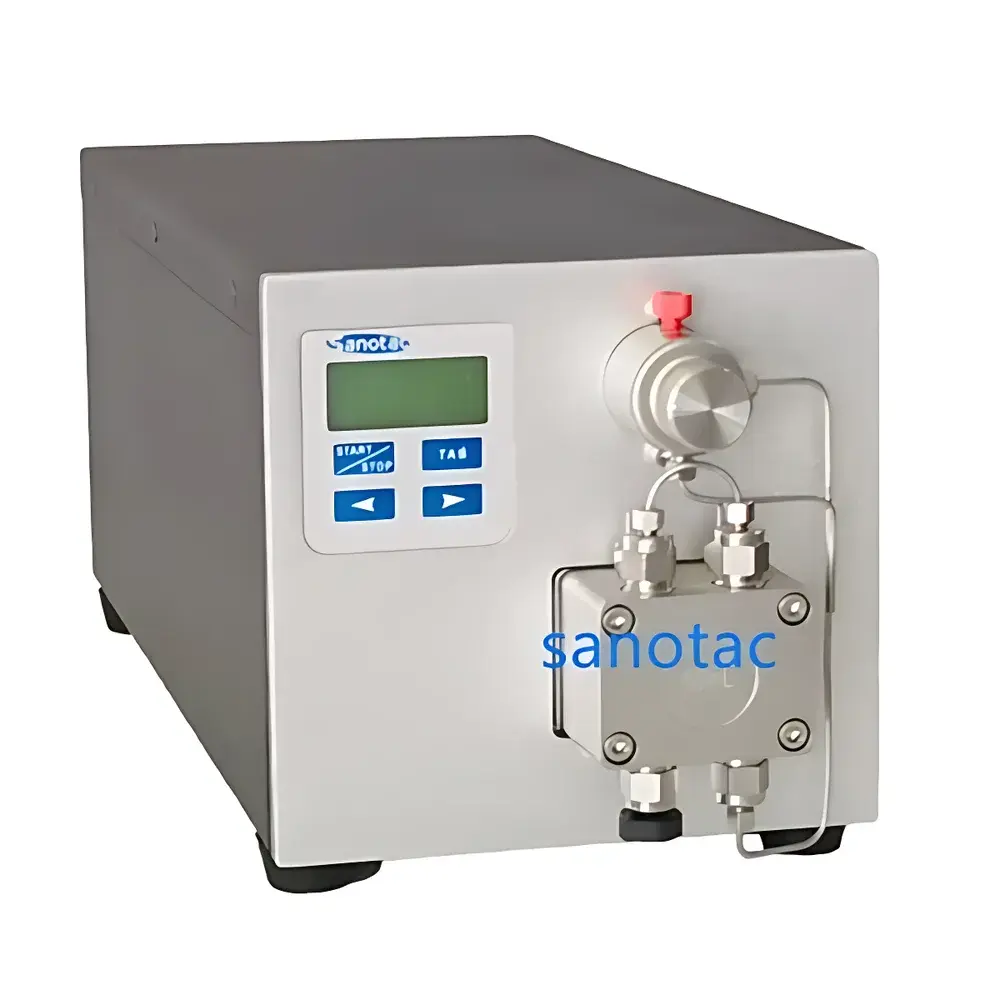
Sanotac S0140M High-Pressure Constant Flow Pump
| Brand | Sanotac |
|---|---|
| Origin | Shanghai, China |
| Manufacturer Type | Direct Manufacturer |
| Model | S0140M |
| Flow Range | 0.001–9.999 mL/min |
| Increment | 0.001 mL/min |
| Flow Accuracy | ±0.1% |
| Flow Precision (RSD) | ≤0.1% |
| Max Pressure | 40 MPa |
| Pressure Pulsation | ≤0.1 MPa |
| Pump Head Materials | 316L SS, Ruby, PTFE, Ceramic |
| Connection | 1/16" Standard Fittings |
| Display | 256×64 Dot Matrix LCD with Backlight |
| Communication | RS232, USB, RS485 |
| Power Supply | 85–264 VAC, 50 Hz |
| Dimensions | 370 × 145 × 152 mm³ |
Overview
The Sanotac S0140M High-Pressure Constant Flow Pump is an engineered precision fluid delivery system designed for demanding continuous-flow applications requiring stable volumetric displacement under elevated pressure conditions. Based on a dual-piston serial drive architecture with floating piston design, it operates on positive displacement principles to deliver highly reproducible flow rates across its full operational range—without reliance on feedback loops or external flow meters. Its core function is to maintain constant volumetric output independent of backpressure fluctuations up to 40 MPa, making it suitable for integration into pressurized reaction systems, supercritical fluid processing, catalytic evaluation rigs, and preparative chromatography platforms where pulse-free, metrologically traceable liquid delivery is essential.
Key Features
- Dual-piston serial configuration with floating piston mechanism ensures mechanical symmetry and minimizes dead volume, contributing to high volumetric fidelity and low compressibility error.
- Multi-point flow calibration capability enables user-defined correction across the entire 0.001–9.999 mL/min range, supporting traceable accuracy of ±0.1% and repeatability (RSD) ≤0.1%.
- Integrated cam-profile compensation and real-time electronic pulsation suppression reduce pressure ripple to ≤0.1 MPa—critical for maintaining laminar flow in microreactors and packed-bed reactors.
- Column seal washing function automatically flushes the rear side of the plunger after each stroke, mitigating abrasive wear on sealing components and extending service intervals.
- Configurable pressure limit setting and zero-point offset adjustment allow dynamic adaptation to thermal drift and system compliance, enhancing long-term operational stability.
- Modular communication interface supports RS232, USB, and RS485 ports with native Modbus RTU/ASCII protocol implementation—enabling seamless integration into industrial control environments including PLC, DCS, and SCADA architectures.
Sample Compatibility & Compliance
The S0140M accommodates a broad spectrum of process fluids—including organic solvents, aqueous acids/bases, supercritical CO₂ co-solvents, and viscous catalyst slurries—through chemically resistant wetted path materials: 316L stainless steel housing, ruby check valves, PTFE seals, and ceramic plungers. All fluidic interfaces conform to standard 1/16″ tubing connections per ASTM F2516 and ISO 8535-1 specifications. The pump’s mechanical design complies with CE directives (2014/30/EU EMC, 2014/35/EU LVD), and its firmware architecture supports audit-trail-ready operation when deployed in GLP/GMP-regulated environments—particularly when paired with optional remote monitoring software enabling timestamped parameter logging and user-access control per FDA 21 CFR Part 11 requirements.
Software & Data Management
The embedded control firmware provides native support for volumetric and gravimetric delivery modes, allowing users to switch between mL/min and g/min units based on density input or direct load-cell integration. Programmable flow profiles include constant, linear ramp, and multi-step gradient sequences—each storable as named methods with version-tagged parameters. Real-time graphical visualization includes synchronized flow vs. pressure trend plots and progress bar indicators during method execution. All operational data—including timestamps, setpoints, actual flow values, and pressure readings—are logged internally and exportable in CSV and PNG formats via USB mass storage mode. Factory reset, custom calibration table upload, and remote firmware update functions are accessible through the local interface or optional Ethernet/WiFi-enabled gateway module.
Applications
- Catalytic testing systems requiring precise stoichiometric reagent dosing under 40 MPa hydrogenation or hydroformylation conditions.
- Microfluidic and continuous-flow synthesis platforms where pulse amplitude directly impacts residence time distribution and product selectivity.
- Supercritical fluid extraction (SFE) and particle formation (RESS, SAS) processes demanding stable CO₂ or ethanol co-solvent delivery at near-critical densities.
- Preparative HPLC and flash chromatography systems requiring high-pressure gradient elution with sub-milliliter precision.
- Electrochemical flow cells and battery electrolyte infusion rigs requiring controlled, bubble-free injection into sealed electrochemical reactors.
- Automated reactor feeding modules integrated into PAT (Process Analytical Technology) frameworks compliant with ICH Q8/Q9 guidelines.
FAQ
What is the maximum allowable operating pressure for the S0140M pump head?
The rated maximum pressure is 40 MPa (5800 psi) at ambient temperature; derating is required above 40°C per material-specific thermal expansion limits.
Can the S0140M be used with corrosive media such as hydrofluoric acid or molten salts?
Standard 316L/PTFE/ruby configuration is not recommended for HF or halide-rich molten salts; optional Hastelloy C-276 or PEEK pump heads must be specified for such applications.
Does the pump support closed-loop gravimetric control via external load cell input?
Yes—via analog voltage input (0–10 V) mapped to flow setpoint, enabling real-time mass-based feedforward control when interfaced with third-party weighing systems.
Is firmware upgrade possible without returning the unit to the manufacturer?
Yes—field-upgradable via USB stick using signed binary packages distributed through Sanotac’s secure customer portal.
How is calibration traceability maintained for regulatory submissions?
Calibration coefficients are stored in non-volatile memory with write-protected checksums; calibration logs include operator ID, date/time stamp, reference standard ID, and deviation values—all exportable for audit review.



