
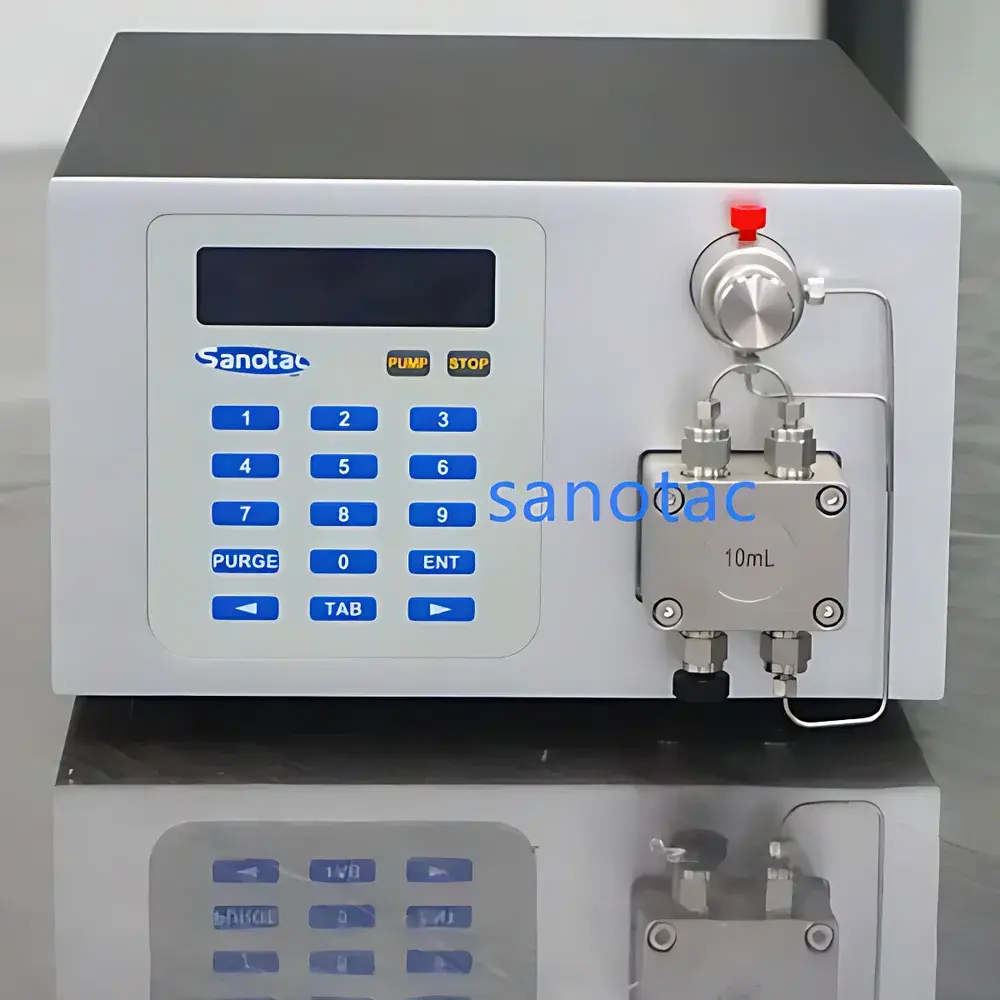
Sanotac V-Series High-Pressure Precision Metering Pump for Bubble-Sensitive Liquids (e.g., Hydrogen Peroxide)
| Brand | Sanotac |
|---|---|
| Origin | Shanghai, China |
| Manufacturer Type | Direct Manufacturer |
| Product Category | Domestic |
| Model | V-Series High-Pressure Metering Pump |
| Flow Rate | 0.01–50.00 mL/min |
| Pressure Rating | ≤ 10 MPa |
| Flow Accuracy | ±0.5% |
| Flow Repeatability | ≤0.1% |
| Pressure Pulsation | ≤0.2 MPa |
| Drive Mechanism | Dual Parallel Plungers with Floating Plunger Design |
| Increment Resolution | 0.01 mL/min |
| Wetted Materials | 316L Stainless Steel, Sapphire, PTFE, Ceramic |
| Tubing Connection | 1/16" Standard Fitting |
| Display | 256×64 Dot Matrix Backlit LCD |
| Communication | RS232 & USB (Standard), RS485/422 (Optional), Modbus RTU/ASCII, Modbus TCP, Profibus DP, Profinet |
| Remote Interface | Wired/Wireless Ethernet, Analog Input (0–5 V / 4–20 mA) |
| Power Supply | 85–264 VAC, 50 Hz |
| Dimensions | 370 × 240 × 152 mm |
Overview
The Sanotac V-Series High-Pressure Precision Metering Pump is an engineered solution for the accurate, pulse-minimized delivery of bubble-sensitive, low-surface-tension, and two-phase liquid streams—particularly hydrogen peroxide (H₂O₂), aqueous oxidants, catalyst slurries, supercritical CO₂ co-solvents, and reactive precursors used in microreactor systems and continuous flow chemistry. Unlike conventional diaphragm or peristaltic pumps, the V-Series employs a dual parallel plunger architecture with floating plunger dynamics and real-time cam-profile compensation to decouple mechanical inertia from fluid displacement. This design enables stable volumetric delivery under high backpressure (up to 10 MPa) while maintaining ≤0.2 MPa pressure pulsation—critical for avoiding nucleation-induced cavitation in H₂O₂ solutions and ensuring laminar, non-turbulent injection into catalytic beds or chromatographic columns. The pump operates on positive displacement principles with active compression compensation, dynamically adjusting for fluid compressibility at elevated pressures—a necessity when metering low-viscosity, compressible media such as subcritical or near-critical fluids.
Key Features
- Dual parallel plunger system with floating plunger design ensures balanced load distribution and minimizes seal wear across extended duty cycles.
- Multi-point flow calibration across the full range (0.01–50.00 mL/min) supports traceable accuracy of ±0.5% and repeatability ≤0.1%—validated per ISO 5725-2 for precision fluid delivery instrumentation.
- Integrated electronic pulsation suppression combines hardware-level cam curve optimization with software-based real-time flow feedback correction, reducing pressure ripple to ≤0.2 MPa even at maximum rated pressure.
- Column plunger post-wash function automatically flushes the plunger shaft seal interface after each run cycle, mitigating crystallization buildup and extending seal service life by up to 3× in aggressive oxidant applications.
- Comprehensive communication suite: RS232 and USB standard; RS485/422, Modbus TCP, Profibus DP, and Profinet optional—enabling native integration into SCADA, DCS, and PLC environments compliant with IEC 61131-3 control logic frameworks.
- Configurable analog input (0–5 V / 4–20 mA) allows external process signals—such as reactor temperature or pH—to modulate flow rate in closed-loop mode without host PC intervention.
Sample Compatibility & Compliance
The V-Series is validated for use with chemically aggressive, low-surface-tension, and gas-saturated liquids including aqueous H₂O₂ (up to 70%), organic peroxides, acidic etchants, metal-organic precursors, and supercritical fluid mixtures. All wetted components—including plungers, valves, and check seats—are constructed from 316L stainless steel, sapphire, PTFE, and technical ceramics to resist oxidation, pitting, and hydrolytic degradation. The pump meets CE electromagnetic compatibility (EMC) Directive 2014/30/EU and Low Voltage Directive 2014/35/EU. While not certified for hazardous area installation (ATEX/IECEx), its non-sparking construction and absence of internal ignition sources make it suitable for laboratory-scale fume hood–integrated reaction systems operating under GLP-compliant workflows. Data integrity features—including audit-trail-enabled parameter logging and method versioning—support alignment with FDA 21 CFR Part 11 requirements when paired with validated third-party LIMS or ELN platforms.
Software & Data Management
The optional Sanotac FlowControl Suite provides full remote operation via Windows/Linux clients or web-based dashboards over Ethernet. It supports time-stamped, synchronized acquisition of flow rate, outlet pressure, motor current, and temperature (via optional sensor input). All data are logged in CSV and HDF5 formats with embedded metadata (operator ID, method name, calibration timestamp). Gradient profiles—including linear, stepwise, and user-defined custom curves—can be programmed with up to 99 segments and executed with ≤100 ms timing resolution. Method libraries support version-controlled storage, digital signature verification, and role-based access control. Calibration routines allow user-defined point mapping against gravimetric or syringe-pump reference standards, with automatic generation of correction tables applied in real time during operation.
Applications
- Microreactor feed systems requiring stoichiometrically precise, pulse-free addition of unstable oxidants (e.g., H₂O₂) into exothermic catalytic loops.
- Fixed-bed catalytic evaluation rigs where consistent liquid hourly space velocity (LHSV) must be maintained under 8–10 MPa system backpressure.
- Supercritical fluid processing (e.g., scCO₂ + co-solvent delivery) demanding compressibility-compensated metering at densities >0.6 g/cm³.
- Preparative liquid chromatography and simulated moving bed (SMB) systems requiring gradient elution stability across multi-hour runs.
- Electrochemical flow cells and fuel cell membrane testing setups requiring inert, bubble-free electrolyte dosing at controlled mass flow rates.
- Lab-scale polymerization reactors using initiator/catalyst metering where flow coefficient drift must remain <0.05% over 72 h continuous operation.
FAQ
Is the V-Series pump compatible with hydrogen peroxide concentrations above 30%?
Yes—wetted materials (316L SS, sapphire, PTFE, ceramic) are chemically resistant to aqueous H₂O₂ up to 70% w/w at ambient temperatures. Continuous operation above 50% requires temperature-controlled environment (<30 °C) and periodic plunger seal inspection.
Can the pump be integrated into a Siemens S7-1500 PLC system?
Yes—via optional Profibus DP or Profinet modules; configuration files and GSDML device descriptors are provided for seamless TIA Portal integration.
Does the pump support dynamic flow adjustment during operation?
Yes—real-time flow setpoint modulation is supported via analog input (0–5 V / 4–20 mA) or Modbus register write commands with ≤200 ms response latency.
What maintenance intervals are recommended for continuous 24/7 operation?
Plunger seals require replacement every 6 months under continuous H₂O₂ service; valve assemblies every 12 months. Full factory recalibration is recommended annually or after any wetted-part replacement.
Is firmware update capability available remotely?
Yes—secure OTA (over-the-air) updates are supported via Ethernet with TLS 1.2 encrypted channel and digital signature validation.



