
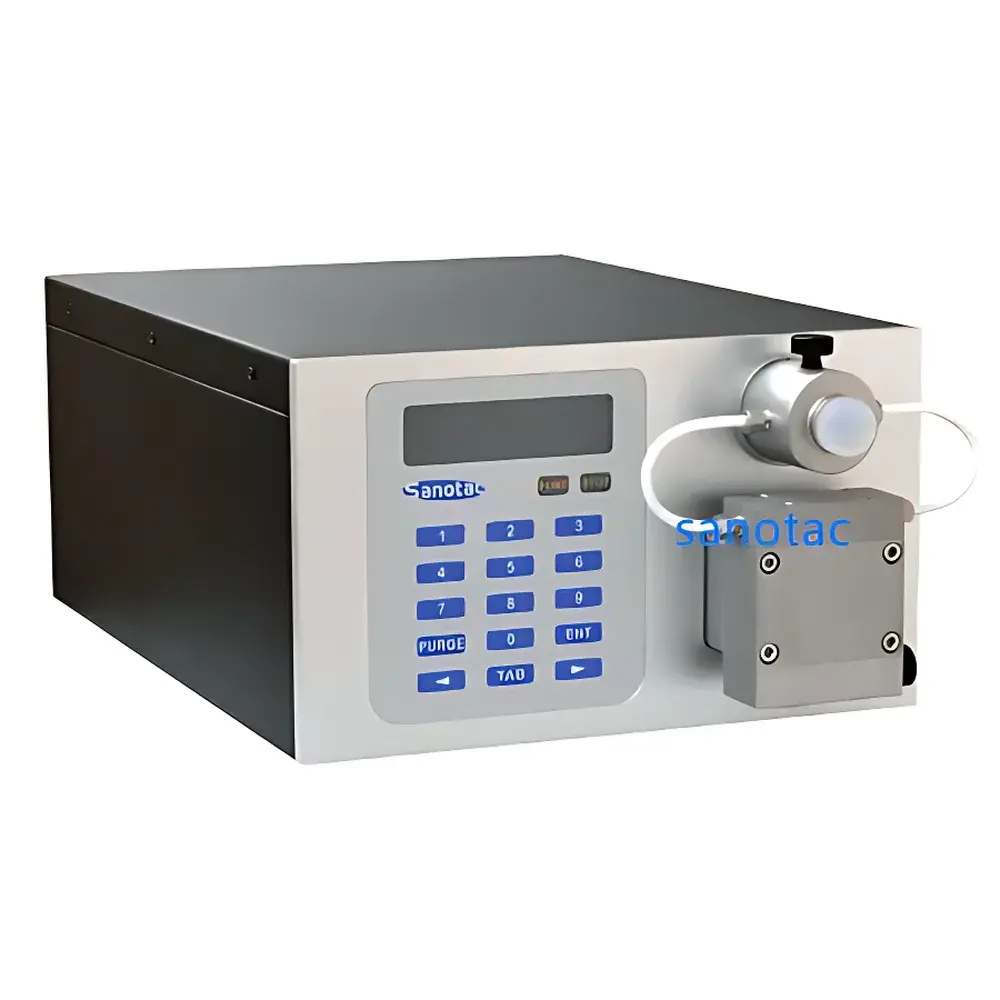
Sanotac SF0106A Fluoropolymer-Pathway High-Pressure Constant Flow Pump
| Brand | Sanotac |
|---|---|
| Origin | Shanghai, China |
| Manufacturer Type | Direct Manufacturer |
| Model | SF0106A |
| Flow Rate | 0.001–10.000 mL/min |
| Maximum Pressure | 6 MPa |
| Flow Accuracy | ±0.1% |
| Flow Precision (RSD) | ≤0.1% |
| Pressure Pulsation | ≤0.05 MPa |
| Wetted Materials | PCTFE, PTFE, Sapphire, Ceramic, Hastelloy C-276 |
| Pump Head | Stainless Steel with Embedded PCTFE |
| Drive Mechanism | Dual Parallel Plungers with Floating Plunger Design |
| Increment Resolution | 0.001 mL/min |
| Communication Interfaces | RS232, RS485, USB |
| Protocols | Modbus RTU/ASCII, Custom Protocol |
| Analog I/O | 0–5 V DC, 4–20 mA |
| Power Supply | 85–264 VAC, 50 Hz |
| Dimensions | 370 × 240 × 152 mm |
Overview
The Sanotac SF0106A Fluoropolymer-Pathway High-Pressure Constant Flow Pump is an engineered solution for precise, corrosion-resistant fluid delivery in aggressive chemical environments. Designed around a dual parallel plunger architecture with floating plunger dynamics, the pump operates on positive displacement principles to deliver highly reproducible volumetric flow under sustained backpressure up to 6 MPa. Its fluoropolymer-wetted path—comprising PCTFE pump heads, PTFE seals, sapphire check valves, ceramic plungers, and Hastelloy C-276 fluidic components—ensures compatibility with concentrated acids (e.g., HF, HNO₃, H₂SO₄), strong alkalis (e.g., NaOH/KOH >50%), halogenated solvents, supercritical CO₂, and reactive organometallics. Unlike conventional stainless-steel or titanium pumps, the SF0106A eliminates galvanic corrosion and leaching risks, making it suitable for catalytic evaluation, continuous-flow microreactor systems, and high-integrity process analytical technology (PAT) applications where material purity and long-term stability are non-negotiable.
Key Features
- Corrosion-Resistant Fluid Path: All wetted surfaces constructed from chemically inert fluoropolymers (PCTFE, PTFE), sapphire, ceramic, and Hastelloy C-276—validated per ASTM D543 and ISO 15193 for resistance to aggressive media.
- High-Fidelity Flow Control: 0.001 mL/min minimum increment resolution; ±0.1% flow accuracy and ≤0.1% RSD over full range (0.001–10.000 mL/min), achieved via multi-point user-calibratable flow correction and real-time cam-profile compensation.
- Low-Pressure Pulsation Architecture: Integrated electronic pulsation suppression combined with optimized cam geometry reduces pressure ripple to ≤0.05 MPa—critical for stable residence time control in microfluidic reactors and chromatographic coupling.
- Intelligent Pressure Management: Programmable pressure limit protection, zero-point offset correction, and column/stage backpressure monitoring ensure safe operation during thermal expansion or blockage events.
- Column & Plunger Maintenance System: Automatic post-stroke plunger rinsing cycle minimizes seal wear and extends service life beyond 10,000 hours under continuous operation at rated pressure.
- Modular Integration Readiness: Native support for analog (0–5 V, 4–20 mA), digital (TTL), and serial (RS232/RS485/USB) interfaces enables direct integration into PLC-controlled reaction trains, SCADA supervisory systems, and DCS architectures.
Sample Compatibility & Compliance
The SF0106A is routinely deployed in GLP-compliant catalytic testing labs (per OECD 117, ASTM D7213), pharmaceutical continuous manufacturing lines (aligned with FDA Guidance for Industry on Continuous Manufacturing), and academic energy research facilities evaluating electrocatalyst slurries or molten salt feedstocks. Its fluoropolymer fluid path meets USP Class VI biocompatibility requirements for non-leachable particulates and extractables. The pump’s mechanical design conforms to IEC 61000-6-2 (EMC immunity) and IEC 61010-1 (safety for laboratory equipment). Full audit trail logging—including parameter changes, calibration events, and fault codes—is supported via SanoFlu software under 21 CFR Part 11-compliant configurations when paired with electronic signatures and role-based access controls.
Software & Data Management
SanoFlu Fluid Control Management Software provides deterministic, script-driven pump operation across three operational paradigms: volumetric delivery (mL/min), gravimetric delivery (g/min using optional load-cell feedback), and hybrid programmed gradients (e.g., linear ramp + hold + exponential decay). Real-time plotting of flow vs. pressure traces supports dynamic system characterization, while timestamped CSV export enables post-hoc correlation with reactor temperature, pH, or spectroscopic data streams. Method libraries store up to 128 programmable profiles with versioned metadata; each profile includes configurable safety interlocks (e.g., “halt if pressure exceeds 5.8 MPa for >2 s”). Remote operation is enabled via TCP/IP-enabled gateways or optional OPC UA server modules compliant with ISA-95 Level 2 interoperability standards.
Applications
- Continuous-flow hydrogenation, oxidation, and nitration reactions in microreactors and plate-type reactors
- Catalyst screening platforms requiring precise co-feeding of corrosive precatalysts (e.g., TiCl₄, AlCl₃) and ligand solutions
- Supercritical fluid processing (scCO₂, scNH₃) for extraction, impregnation, and particle engineering
- Electrochemical flow cells with acidic/alkaline electrolytes (e.g., PEM electrolyzer feed systems)
- In-line polymerization initiation where monomer purity and stoichiometric consistency dictate molecular weight distribution
- Gravimetric dosing loops integrated with loss-in-weight (LIW) feeders for exothermic batch reactors
FAQ
What materials are in contact with the fluid path?
All wetted components consist of PCTFE (pump head body), PTFE (seals/gaskets), sapphire (inlet/outlet check valves), ceramic (plunger rods), and Hastelloy C-276 (manifolds and fittings). No stainless steel is exposed to process fluid.
Can the pump be calibrated by the end user?
Yes—SanoFlu software supports multi-point volumetric calibration using certified gravimetric or syringe-pump reference standards. Calibration coefficients are stored per method and persist through power cycles.
Is the pump compatible with explosion-proof environments?
The base unit is rated for general laboratory use (IP20). For hazardous area deployment, ATEX/IECEx-certified enclosures and intrinsically safe signal isolators must be externally integrated per local regulatory requirements.
Does it support gradient elution like HPLC pumps?
While not designed for chromatographic separation, the SF0106A supports programmable flow gradients (linear, step, custom) with synchronized pressure monitoring—ideal for reaction optimization and kinetic profiling.
What maintenance intervals are recommended?
Plunger seals require replacement every 6,000–8,000 operating hours under typical 4 MPa/5 mL/min conditions. Full preventive maintenance—including cam inspection and motor encoder verification—is advised annually or after 10,000 hours, whichever occurs first.



