
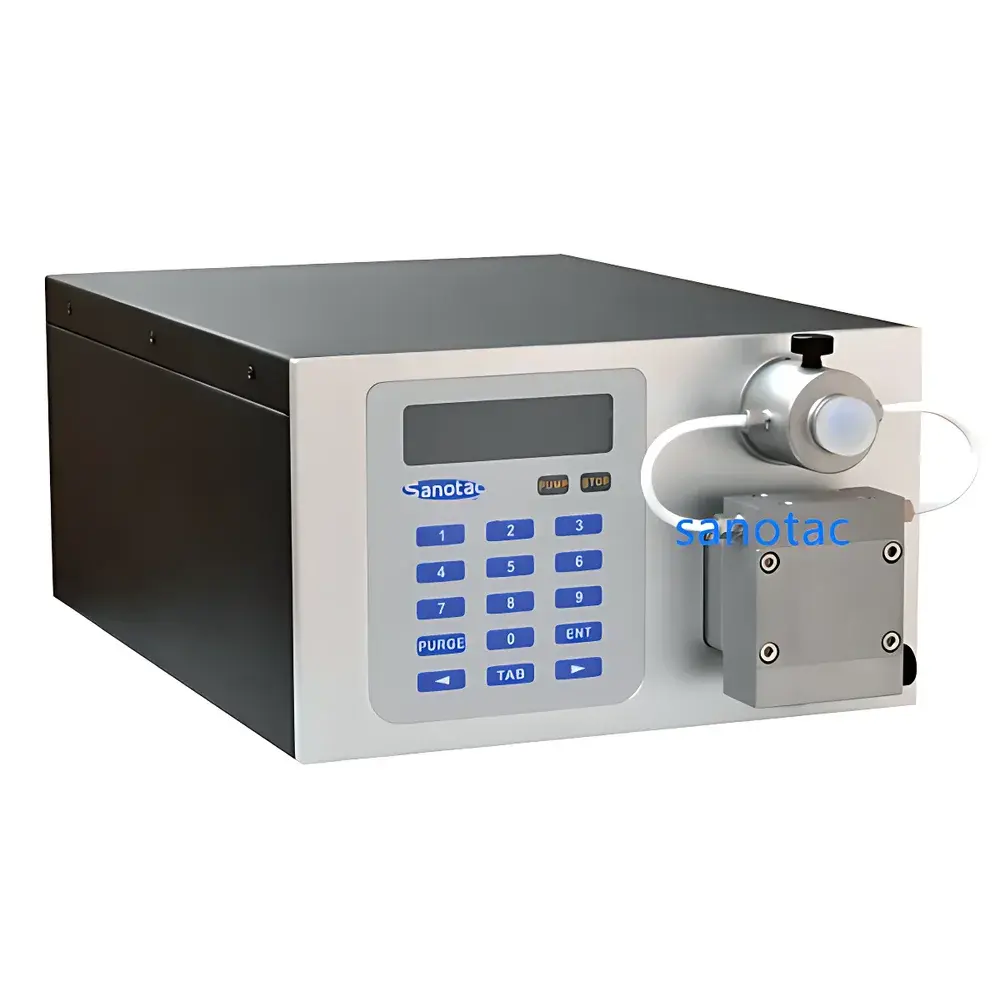
Sanotac SF1005-C High-Pressure Fluoropolymer Metering Pump for Anhydrous Hydrogen Fluoride (AHF) and Hydrofluoric Acid (HF)
| Brand | Sanotac |
|---|---|
| Model | SF1005-C |
| Drive Type | Electric |
| Max. Pressure | 5 MPa |
| Flow Range | 0.01–100.00 mL/min |
| Flow Increment | 0.01 mL/min |
| Flow Accuracy | ±0.5% |
| Flow Repeatability | ≤0.1% |
| Pressure Pulsation | ≤0.05 MPa |
| Wetted Materials | PCTFE, PTFE, Specialized Ceramic |
| Communication | RS-232 (standard), USB (standard), RS-485/422 (optional), Modbus RTU & ASCII protocols |
| Power Supply | 85–264 VAC, 50 Hz |
| Dimensions | 370 × 240 × 152 mm |
Overview
The Sanotac SF1005-C is a high-integrity, chemically inert metering pump engineered specifically for the precise, pulse-free delivery of highly aggressive fluids—including anhydrous hydrogen fluoride (AHF), aqueous hydrofluoric acid (HF), fuming nitric acid, oleum, and other strong oxidizers or corrosives—under sustained high pressure up to 5 MPa. Unlike conventional stainless-steel or alloy-based metering pumps, the SF1005-C eliminates all metallic contact with process fluid through a fully fluoropolymer-wetted flow path: pump heads are constructed from stainless steel housings with internally embedded PCTFE (polychlorotrifluoroethylene) liners; fluidic components—including plungers, seals, valves, and tubing interfaces—are fabricated from virgin PTFE and high-purity technical ceramics. This architecture ensures long-term dimensional stability, minimal leaching, and resistance to stress corrosion cracking under continuous exposure. The pump operates on a dual-plunger parallel displacement principle with floating plunger design and cam-profiled motion compensation, enabling inherently low pressure pulsation (<0.05 MPa) and high volumetric fidelity across its full 0.01–100.00 mL/min range.
Key Features
- Non-metallic wetted path: PCTFE pump head liner, PTFE valve assemblies, ceramic plungers and seats—certified for continuous service with HF, AHF, ClF₃, BrF₃, and molten alkali halides
- High-pressure capability: Rated for continuous operation at ≤5 MPa (725 psi), with programmable upper/lower pressure limits and real-time overpressure shutdown
- Ultra-low pulsation: Achieved via optimized cam kinematics and active electronic flow pulse suppression—critical for microreactor feed stability and catalyst dosing reproducibility
- Dual-mode delivery: Switchable volumetric (mL/min) and gravimetric (g/min) output modes, with user-defined density lookup tables for temperature-compensated mass flow control
- Multi-protocol digital interface: Standard RS-232 and USB; optional RS-485/422; native support for Modbus RTU and ASCII command sets—enabling seamless integration into PLC-controlled reaction systems and DCS environments
- Onboard data logging: Real-time acquisition and local storage of pressure vs. time and flow vs. time curves in CSV/Excel-compatible format, with timestamped event markers for audit trail compliance
- Configurable gradient programming: Two operational profiles—constant-flow mode and multi-step linear/nonlinear gradient mode—with up to 32 segments per program
- Integrated column cleaning cycle: Automated solvent flush sequence triggered by runtime or manual command to prevent crystallization and valve fouling in HF service
- Scalable control architecture: Supports 1:N master-slave configuration (up to 1:32) for synchronized multi-pump operation in parallel reactor arrays or multi-feed catalytic evaluation rigs
Sample Compatibility & Compliance
The SF1005-C is validated for use with Class 3A and 3B corrosive media per NACE MR0175/ISO 15156, and meets material compatibility requirements outlined in ASTM D1693 (environmental stress cracking resistance of plastics) and IEC 60529 (IP20 enclosure rating). Its fluoropolymer-ceramic flow path complies with USP for extractables profiling in pharmaceutical intermediate synthesis and satisfies the chemical resistance criteria defined in ISO 15190:2019 for laboratory safety equipment handling hazardous reagents. For GxP-regulated applications—including catalyst screening under GLP conditions or API precursor synthesis under cGMP—the pump’s firmware supports 21 CFR Part 11-compliant electronic signatures, role-based access control, and immutable audit logs when operated with the SanoFlu Fluid Control Management System.
Software & Data Management
The SanoFlu Fluid Control Management System (v3.2+) provides full remote supervision and configuration via Windows-based desktop application or web-enabled thin client. It enables real-time visualization of dual-channel analog inputs (0–5 VDC or 4–20 mA), including integration with loss-in-weight (LIW) feed systems for closed-loop gravimetric control. All parameter changes—including flow setpoints, pressure thresholds, gradient profiles, and calibration coefficients—are logged with operator ID, timestamp, and pre-/post-change values. Export functions support .xlsx, .csv, and .tdms formats for traceability in regulatory submissions. Firmware updates are delivered via signed binary packages with SHA-256 hash verification to ensure integrity and version control.
Applications
- Catalytic evaluation: Precise co-feeding of HF/AHF with hydrocarbons in fixed-bed or slurry-phase alkylation reactors
- Microchemical synthesis: Stable reagent introduction into chip-based or capillary microreactors operating at elevated pressures
- Electrolyte formulation: Metered addition of anhydrous HF to LiPF₆ solutions for lithium-ion battery electrolyte R&D
- Fluorochemical production: Controlled dosing in continuous fluorination reactors (e.g., Swarts, Balz-Schiemann)
- Corrosion testing: Delivery of standardized HF-containing test media to autoclaves per ASTM G31 and NACE TM0169
- Supercritical fluid processing: Co-solvent injection in scCO₂ or scH₂O systems where metal contamination must be avoided
- Flow chemistry platforms: Integration with back-pressure regulators, inline IR/UV sensors, and automated fraction collectors
FAQ
Is the SF1005-C suitable for anhydrous hydrogen fluoride (AHF) vapor phase service?
No. The SF1005-C is designed exclusively for liquid-phase pumping. AHF vapor requires specialized diaphragm or bellows-sealed compressors rated for Class 2.3 toxic gas service.
Can the pump be calibrated in-house using standard gravimetric methods?
Yes. The system provides nine factory-default calibration points (0.01, 0.1, 1, 10, 20, 40, 60, 80, 100 mL/min) and allows users to define custom correction factors across the full flow range via the SanoFlu software interface.
Does the pump meet explosion-proof requirements for Zone 1 hazardous areas?
The base unit is rated IP20 and non-sparking per EN 60079-0, but does not carry ATEX or IECEx certification. Explosion-proof enclosures or purge systems must be provided externally per site-specific hazard assessments.
What is the maximum allowable temperature for PTFE/PCTFE components in continuous HF service?
Continuous service limit is 120 °C for PTFE and 150 °C for PCTFE. Operation above these temperatures requires ceramic-only flow path configurations, available as OEM-engineered variants.
How is flow accuracy verified during IQ/OQ qualification?
Accuracy validation follows ASTM E2798-21 (Standard Practice for Calibration of Liquid Chromatography Pumps), using certified glass volumetric flasks, analytical balances (≥0.1 mg resolution), and temperature-controlled collection vessels. Full OQ documentation templates are supplied with each unit.



