
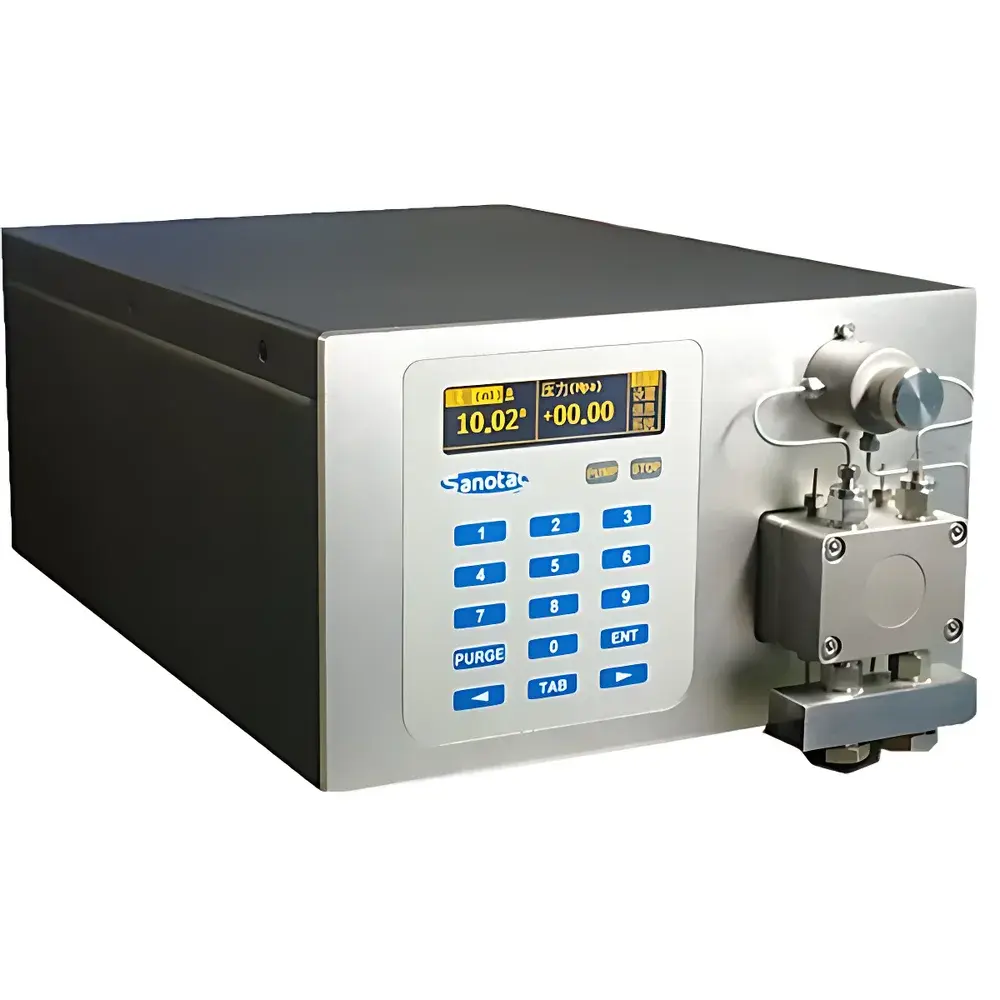
Sanotac SP-0530 High-Pressure Plunger Pump for Petrochemical Research
| Brand | Sanotac |
|---|---|
| Origin | Shanghai, China |
| Manufacturer Type | Direct Manufacturer |
| Model | SP-0530 |
| Flow Rate | 0.01–50.00 mL/min (adjustable in 0.01 mL/min increments) |
| Maximum Pressure | 30 MPa |
| Flow Accuracy | ±0.5% |
| Flow Precision (RSD) | ≤0.1% |
| Pressure Pulsation | ≤0.2 MPa |
| Wetted Materials | 316L Stainless Steel, Sapphire, PTFE, Ceramic |
| Connection | 1/16" Standard Fitting |
| Display | 256×64 Dot Matrix Backlit LCD |
| Communication | RS232 & USB (standard), RS485/RS422 (optional) |
| Protocols | Sanotac Proprietary & Modbus RTU/ASCII |
| Power Supply | 85–264 VAC, 50 Hz |
| Dimensions | 370 × 240 × 152 mm |
Overview
The Sanotac SP-0530 High-Pressure Plunger Pump is an engineered constant-flow precision delivery system designed for demanding research and process development applications in petrochemical laboratories, catalytic evaluation units, microreactor systems, and supercritical fluid processing. Operating on a dual-plunger parallel architecture with floating plunger design, the pump delivers stable, pulse-minimized flow under sustained high-pressure conditions—up to 30 MPa (4350 psi)—while maintaining volumetric accuracy of ±0.5% and repeatability (RSD) better than 0.1%. Its core principle relies on positive displacement via precision-machined ceramic and sapphire components, coupled with cam-profile compensation and real-time electronic pulse suppression to mitigate mechanical oscillations inherent in reciprocating plunger mechanisms. This enables consistent reagent dosing, catalyst injection, or solvent delivery where pressure stability, flow fidelity, and material compatibility are critical—particularly in continuous-flow chemistry, hydrothermal synthesis, and high-pressure hydrogenation studies.
Key Features
- Dual-plunger parallel configuration with floating plunger design for enhanced mechanical longevity and reduced wear-induced drift
- Multi-point flow calibration across full range (0.01–50.00 mL/min), enabling trace-level accuracy at low flow and robust performance at upper range
- Integrated flow pulse suppression combining optimized cam curve geometry and active electronic feedback control, limiting pressure pulsation to ≤0.2 MPa
- Column and seal protection logic: programmable pressure limit setting, zero-point offset correction, and environmental interference compensation
- Automatic post-stroke plunger cleaning cycle to minimize abrasive residue accumulation and extend seal service life
- Optional mass-based closed-loop control interface for integration with reactor inlet load cells—supporting gravimetric feed rate regulation
- Modular communication architecture supporting RS232, USB (standard), and RS485/RS422 (optional), compliant with Modbus RTU/ASCII and proprietary Sanotac protocol
Sample Compatibility & Compliance
The SP-0530 accommodates aggressive process fluids common in petrochemical R&D—including halogenated solvents, acidic/basic aqueous media, supercritical CO₂, H₂S-containing streams, and viscous organometallic solutions—through its chemically inert wetted path. Standard construction utilizes 316L stainless steel housings, sapphire check valves, PTFE seals, and ceramic plungers; optional configurations include Hastelloy C-276, titanium Grade 2, PEEK, and PCTFE for extreme corrosion resistance. The pump meets general-purpose laboratory equipment safety requirements per IEC 61010-1 and supports audit-ready operation in GLP-compliant environments through configurable data logging, timestamped event records, and parameter change tracking. While not certified for hazardous area use (e.g., ATEX/IECEx), it is routinely deployed in Class 1, Division 2 laboratory enclosures when integrated into larger reaction systems.
Software & Data Management
The SP-0530 operates with embedded firmware supporting multiple delivery modes: constant flow, linear ramp, multi-step gradient, and user-defined time-programmed profiles. Real-time visualization includes dynamic flow vs. pressure trend plots and progress bar indicators during method execution. All operational data—including setpoints, actual flow, system pressure, error codes, and timestamps—are logged internally and exportable in CSV or XLSX format with graphical overlays. Methods are stored in non-volatile memory with password-protected access and version-controlled naming. Calibration parameters can be customized per fluid density and compressibility, allowing compensation for thermal expansion and liquid compressibility effects—critical for accurate delivery of low-compressibility solvents (e.g., water, glycerol) or compressible supercritical phases. Remote monitoring and control are enabled via optional Ethernet/WiFi gateway modules compatible with standard SCADA, DCS, and PLC platforms using OPC UA or Modbus TCP.
Applications
- Catalytic testing rigs: precise co-feeding of gaseous reactants (via liquid carrier) and liquid catalysts into fixed-bed or slurry reactors
- Microreactor and continuous-flow synthesis: metered introduction of reagents under elevated pressure and temperature
- Supercritical fluid chromatography (SFC) and extraction: stable CO₂ or CO₂/co-solvent delivery at 10–30 MPa
- Hydrogenation and hydrotreating studies: controlled H₂-donor solvent (e.g., formic acid, cyclohexadiene) injection into autoclaves
- Foaming and extrusion R&D: metered addition of blowing agents into polymer melt streams under high backpressure
- Electrochemical flow cells: regulated electrolyte circulation with minimal pressure fluctuation to avoid membrane deformation
- Layer-by-layer deposition systems: repeatable nanoliter-to-milliliter dosing for thin-film fabrication
FAQ
What materials are in contact with the fluid path?
The standard wetted materials consist of 316L stainless steel pump head, sapphire ball check valves, PTFE seals, and ceramic plungers. Optional configurations include Hastelloy C-276, titanium Grade 2, PEEK, and PCTFE for specialized chemical resistance.
Is the pump suitable for supercritical CO₂ applications?
Yes—the SP-0530 is widely used in SFC and supercritical extraction systems operating up to 30 MPa. For optimal performance with CO₂, users should select the PCTFE or titanium variant and ensure proper pre-cooling and density compensation in software.
Can it be integrated into a PLC-controlled reaction system?
Yes—via RS485 Modbus RTU or optional Ethernet module with Modbus TCP support, enabling seamless integration into Siemens S7, Rockwell ControlLogix, or Beckhoff TwinCAT environments.
Does the pump support gravimetric feedback control?
Yes—through optional analog input (0–10 V or 4–20 mA) for real-time mass flow correction when paired with a calibrated load cell at the reactor inlet.
What maintenance intervals are recommended for continuous operation?
Under typical lab use (8 h/day, <20 MPa), seal replacement is recommended every 6–12 months; full recalibration every 6 months; and plunger inspection annually. Extended service life is achieved with regular plunger cleaning cycles and avoidance of particulate-laden solvents.



