
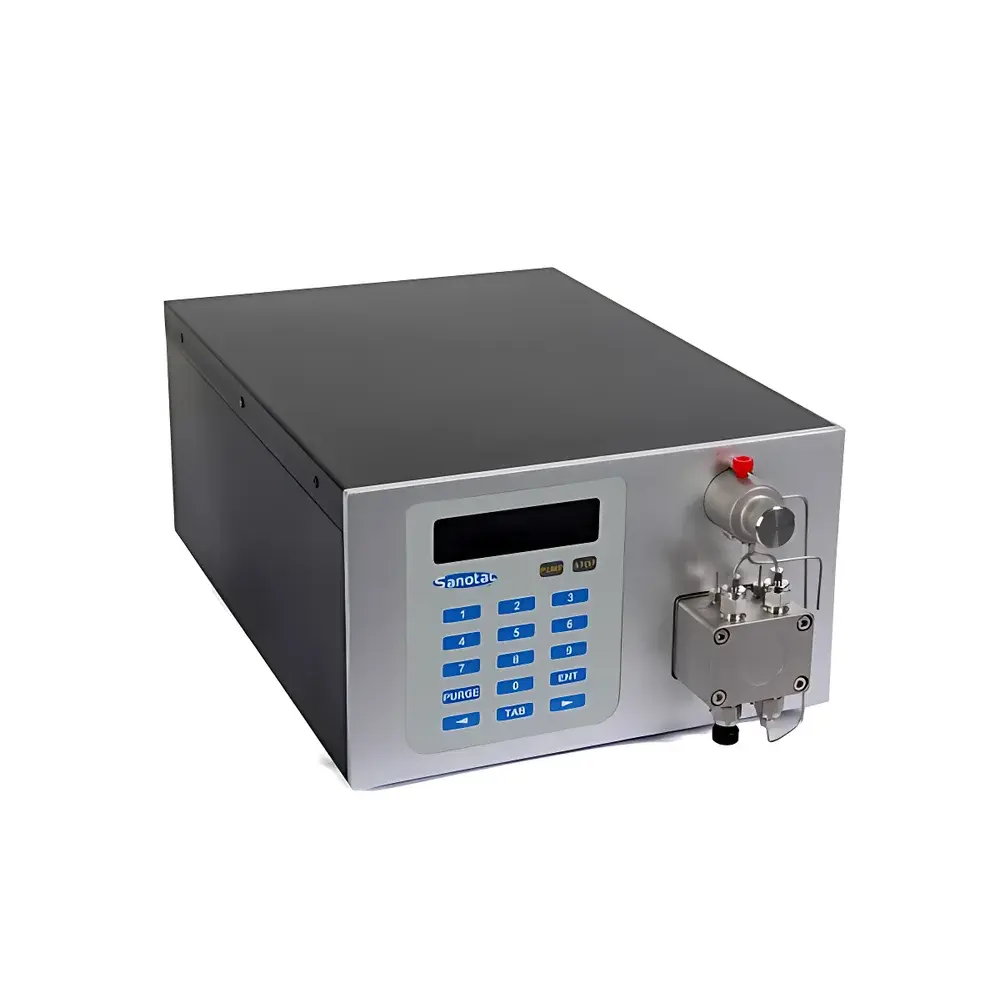
Sanotac SP Series Constant Flow Precision Piston Pump
| Brand | Sanotac |
|---|---|
| Origin | Shanghai, China |
| Manufacturer Type | Direct Manufacturer |
| Country of Origin | China |
| Model | SP Series |
| Price Range | USD 2,800 – 7,000 (FOB) |
| Flow Rate Range | 0.001–10,000 mL/min |
| Maximum Pressure | 42 MPa |
| Repeatability | ≤ ±0.5% |
| Flow Accuracy | ≤ ±1.0% |
| Power Consumption | 150–750 W |
| Input Voltage | 220 V ±10%, 50 Hz ±2 Hz |
| Dimensions (L×W×H) | 370 × 240 × 152 mm |
| Weight | 15–40 kg |
| Wetted Materials | 316L SS, PEEK, PTFE, Titanium, Sapphire, Carbon-Fiber-Reinforced PTFE, Fluoroelastomer |
| Compatible Fluid Viscosity | 0.3–5 cP |
| Tubing Connection | Inlet Φ3×0.5 mm / Outlet Φ1/16″ or Φ1/8″×0.5 mm (standard) |
Overview
The Sanotac SP Series Constant Flow Precision Piston Pump is an engineered solution for high-accuracy, continuous liquid delivery in analytical, preparative, and process-critical laboratory environments. Based on positive displacement principle with dual-acting or single-acting reciprocating piston architecture, the pump delivers stable, pulse-dampened flow across a wide dynamic range—from ultra-low nanoliter-per-minute dosing to high-throughput 10 L/min delivery—without reliance on feedback loops or external flow sensors. Its core innovation lies in the proprietary non-circular gear transmission system, which converts uniform rotational motion from a microstepping motor into precisely modulated linear piston displacement. This mechanical waveform synthesis eliminates electronic flow correction artifacts, enabling intrinsic flow linearity and long-term stability under variable backpressure. Designed for integration into HPLC, SFC, reaction screening platforms, microfluidic synthesis modules, and continuous manufacturing systems, the SP Series complies with fundamental fluid handling requirements for GLP-compliant method development and GMP-aligned process validation.
Key Features
- Non-circular gear-driven piston actuation ensures inherent flow linearity, eliminating the need for active pulsation dampening or real-time flow recalibration.
- Integrated pressure transducer with programmable over-pressure (up to 42 MPa) and under-pressure protection safeguards both pump integrity and downstream instrumentation.
- Automatic volumetric compensation algorithm dynamically adjusts stroke timing to maintain flow accuracy during high-pressure operation, counteracting fluid compressibility effects in solvents such as acetonitrile or CO₂-rich mobile phases.
- RS-232/RS-485 serial interface supports multi-pump synchronization, remote parameter configuration, and audit-trail-enabled command logging—fully compatible with LabVIEW, MATLAB, and third-party SCADA systems.
- Modular wetted-path construction: configurable pump heads in 316L stainless steel, PEEK, PTFE, or titanium; optional sapphire check valves and carbon-fiber-reinforced PTFE seals for aggressive solvents and elevated temperature operation.
- Floating piston design reduces radial loading on seals, extending service life by up to 3× compared to fixed-bore architectures—particularly critical in extended unattended runs (>72 h).
Sample Compatibility & Compliance
The SP Series accommodates Newtonian liquids with viscosities between 0.3 and 5 cP—including water, methanol, acetonitrile, hexane, and low-viscosity silicone oils—at ambient temperatures (5–40 °C). Non-wetted components conform to RoHS Directive 2011/65/EU. All firmware and communication protocols support time-stamped event logging required for FDA 21 CFR Part 11 compliance when deployed with validated electronic record systems. Mechanical design adheres to ISO 8573-1:2010 (compressed air purity) for pneumatic auxiliary options and meets IEC 61000-6-3 EMC emission standards. CE marking applies to models rated ≤30 MPa; higher-pressure variants (42 MPa) are supplied with ASME B31.3-compliant pressure boundary documentation for user risk assessment.
Software & Data Management
Local control is executed via a 4.3-inch TFT touchscreen with intuitive menu navigation supporting multi-language UI (English, German, Japanese, Chinese). All operational parameters—including flow setpoint, pressure limit, ramp rate, hold time, and alarm thresholds—are stored in non-volatile memory with write-cycle logging. The serial protocol implements ASCII-based command syntax (e.g., “FLO 5.234” for flow setpoint in mL/min), enabling seamless integration into custom Python or C# automation scripts. Optional Sanotac PumpControl Suite (v3.2+) provides graphical real-time monitoring, batch export in CSV/Excel format, trend analysis with ±0.01 mL/min resolution, and automated calibration report generation traceable to NIST-traceable flow standards.
Applications
- HPLC and UHPLC gradient delivery systems requiring sub-1% RSD flow stability across 0.001–10 mL/min at pressures up to 42 MPa.
- Preparative chromatography systems (10–1000 mL/min) where solvent blending accuracy directly impacts fraction purity and yield.
- Continuous-flow chemical synthesis reactors demanding precise stoichiometric reagent metering under backpressures >20 MPa.
- Material science applications including nanoparticle dispersion delivery, inkjet printhead calibration, and MEMS device testing.
- Environmental analysis workflows involving automated EPA Method 8081/8270 sample introduction into GC-MS or ICP-MS interfaces.
FAQ
What is the minimum programmable flow increment?
The SP Series supports 0.001 mL/min resolution across its lowest-range models (e.g., AP-0010); higher-flow variants maintain 0.01 mL/min resolution.
Can the pump handle viscous or particulate-laden fluids?
It is designed exclusively for low-viscosity (<5 cP), particle-free Newtonian liquids. Suspensions, slurries, or high-viscosity solvents require pre-filtration through ≥0.45 µm membranes and are not covered under warranty.
Is remote firmware update supported?
Yes—via USB-C port using Sanotac Firmware Updater Tool (v2.1+), with SHA-256 signature verification and rollback capability.
How is flow calibration performed?
Factory calibration uses gravimetric measurement against NIST-traceable mass standards (±0.05% uncertainty); users may perform field verification using certified glass volumetric flasks and analytical balances per ASTM D1193.
What safety certifications apply to the 42 MPa models?
These units are supplied with full ASME Section VIII Div. 1 design documentation, burst pressure test reports (3× MAWP), and third-party witnessed hydrostatic certification per EN 13445-3 Annex C.



