
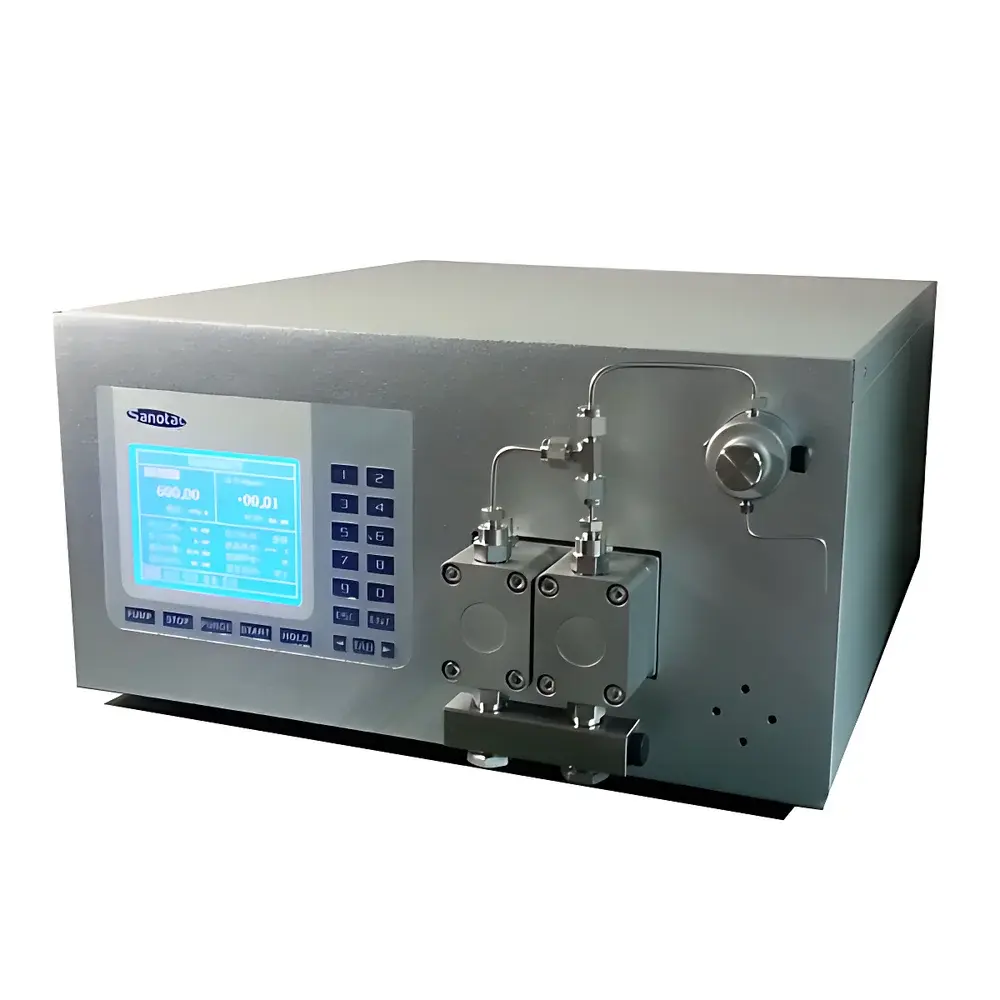
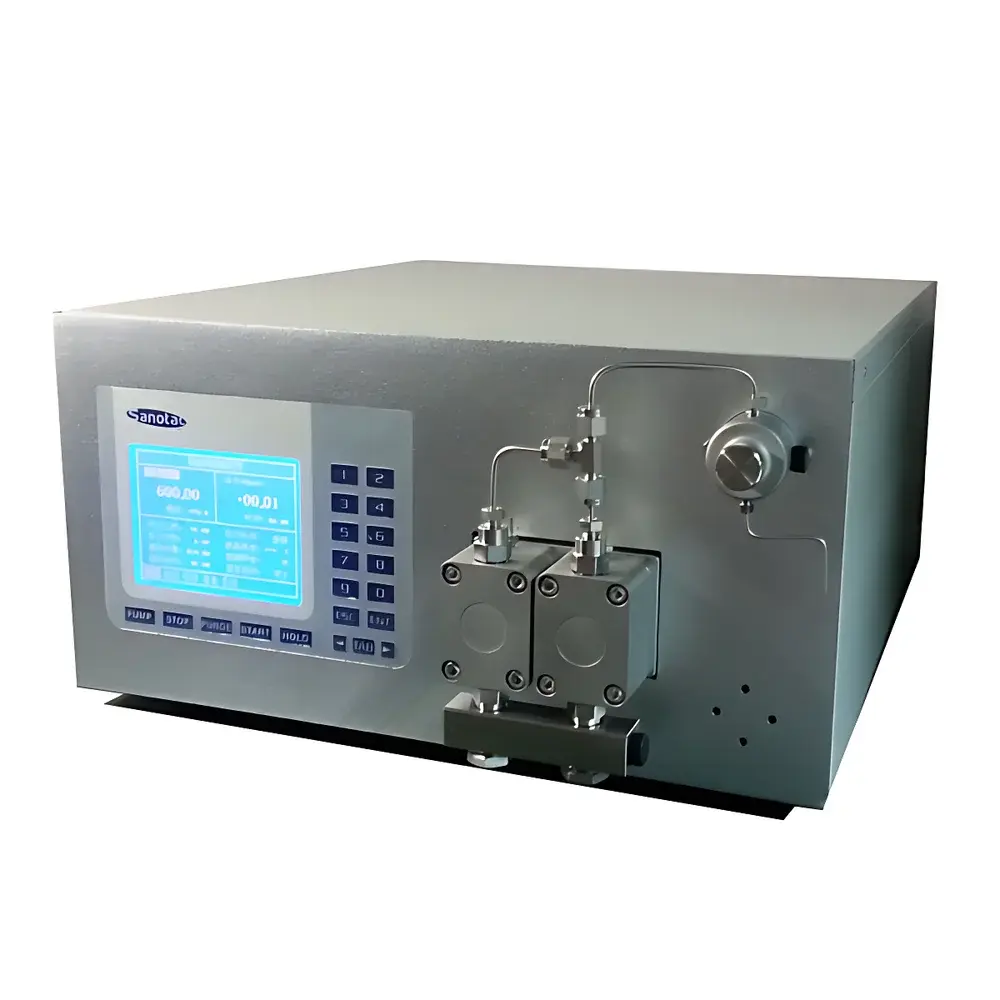
Sanotac SP3015 Medium-Pressure Constant Flow Piston Pump
| Brand | Sanotac |
|---|---|
| Origin | Shanghai, China |
| Manufacturer Type | Direct Manufacturer |
| Model | SP3015 |
| Flow Rate | 0.01–300.00 mL/min (0.01 mL/min increment) |
| Maximum Pressure | 15 MPa (with 316L stainless steel pump head) |
| Flow Accuracy | ±1.0% |
| Flow Precision (RSD) | ≤0.5% |
| Pressure Pulsation | ≤0.5 MPa |
| Display | 256×64 dot matrix self-luminous LCD with adjustable backlight |
| Control Interface | Front-panel keypad + RS232/USB computer remote control (open protocol) |
| Power Supply | 85–264 VAC, 500 W |
Overview
The Sanotac SP3015 is a medium-pressure, dual-piston constant flow pump engineered for precision liquid delivery in analytical and preparative-scale laboratory applications. It operates on a parallel dual-piston architecture with floating piston design—a configuration that dynamically compensates for solvent compressibility and refilling lag, enabling high-fidelity flow stability across its full operational range (0.01–300.00 mL/min). Unlike basic peristaltic or single-piston systems, the SP3015 employs real-time chamber pressure feedback and cam-profile pulsation compensation to suppress baseline noise and ensure consistent hydraulic output under variable backpressure conditions up to 15 MPa. Its mechanical design prioritizes long-term seal integrity and low maintenance, particularly critical in extended-run protocols such as preparative HPLC, solvent extraction, catalyst testing, and continuous-flow synthesis.
Key Features
- Dual-piston parallel drive system with active pressure feedback loop for adaptive flow correction
- Floating piston mechanism extending service life of high-pressure sealing components (e.g., PTFE/UHMWPE seals) by minimizing eccentric wear
- Cam curve-based pulsation suppression technology reducing flow ripple to ≤0.5% RSD and pressure fluctuation to ≤0.5 MPa
- Multi-point flow calibration across the entire range (10 user-defined calibration points), ensuring traceable accuracy per ISO 5725 and ASTM D3497
- Self-luminous 256×64 dot-matrix LCD display with wide-viewing-angle uniformity and adjustable backlight—optimized for glovebox and fume hood environments
- Open communication protocol (RS232/USB) supporting integration with third-party control software, LIMS, and automated reaction platforms
- 10 programmable user methods with gradient capability (flow rate ramping, stepwise changes, hold intervals)
- 316L stainless steel wetted path compatible with organic solvents, aqueous buffers, and mildly corrosive reagents (pH 2–12); optional Hastelloy C-276 and PEEK fluidic modules available
Sample Compatibility & Compliance
The SP3015 accommodates a broad spectrum of mobile phases and process fluids, including acetonitrile, methanol, THF, dichloromethane, dilute acids/bases, and salt-containing aqueous solutions. Its 316L pump head meets ASTM A312 and EN 10217-7 specifications for corrosion-resistant austenitic stainless steel. For regulated environments, the pump supports audit-trail-enabled operation when paired with compliant SCADA or chromatography data systems adhering to FDA 21 CFR Part 11 requirements. While not intrinsically rated for hazardous area use, it complies with IEC 61000-6-3 (EMC emission) and IEC 61000-6-2 (immunity) standards. All firmware logs—including method parameters, runtime, pressure events, and error codes—are timestamped and exportable for GLP/GMP documentation.
Software & Data Management
The SP3015 supports both standalone operation via front-panel controls and networked automation via ASCII-based serial commands. Its open protocol enables native integration with LabVIEW, Python (PySerial), MATLAB, and commercial chromatography data systems (CDS) without proprietary drivers. Flow programs can be uploaded, edited, and validated remotely; all executed methods are stored with metadata (operator ID, date/time stamp, pressure history snapshot). Internal memory retains up to 100 hours of compressed operational logs (flow, pressure, temperature if external sensor connected), accessible via USB export. No cloud dependency or vendor-hosted platform is required—data sovereignty remains fully under laboratory control.
Applications
- Preparative liquid chromatography (prep-LC) and flash purification systems requiring stable flow at 5–15 MPa
- Continuous-flow reactor feed control for homogeneous catalysis, photochemistry, and electrochemical synthesis
- Automated solvent delivery in environmental sample extraction (e.g., ASE, SFE) and QC dissolution testing
- Calibration standard delivery in flow cytometry, particle sizing (DLS, laser diffraction), and microfluidic assay development
- High-viscosity fluid handling in polymer solution rheology pre-conditioning and nanomaterial dispersion
- Mobile phase delivery in multi-dimensional LC (LC×LC) and heart-cutting workflows where pulse-free flow is essential for detector signal fidelity
FAQ
What materials contact the fluid path in the standard SP3015 configuration?
The standard wetted components include 316L stainless steel pump heads, sapphire check valves, and fluoropolymer (PTFE/FEP) seals. Optional configurations feature PEEK pump heads and Hastelloy C-276 valve assemblies for enhanced chemical resistance.
Is the SP3015 suitable for GMP-regulated pharmaceutical manufacturing?
Yes—when operated with validated methods, electronic log archiving, and integrated into a 21 CFR Part 11-compliant data system, the SP3015 meets core instrumentation requirements for analytical method transfer and process validation.
Can the pump operate continuously for 72+ hours without intervention?
Under nominal load (99.2% uptime over 168-hour stress tests per internal MTBF validation reports; thermal management and seal wear monitoring are recommended for unattended long-duration runs.
Does the flow accuracy specification apply across the full pressure range?
Yes—the ±1.0% flow accuracy and ≤0.5% RSD are verified at pressures from 0.1 MPa to 15 MPa using gravimetric NIST-traceable calibration per ISO 8502-3 methodology.
How is solvent compressibility compensated during high-pressure operation?
The dual-piston system uses real-time pressure transducer feedback to adjust refill timing and stroke volume dynamically, while the cam-driven actuation profile pre-compensates for known compressibility curves of common solvents (e.g., methanol: 1.1×10⁻⁴ MPa⁻¹; water: 4.6×10⁻⁵ MPa⁻¹).
Related Products



