
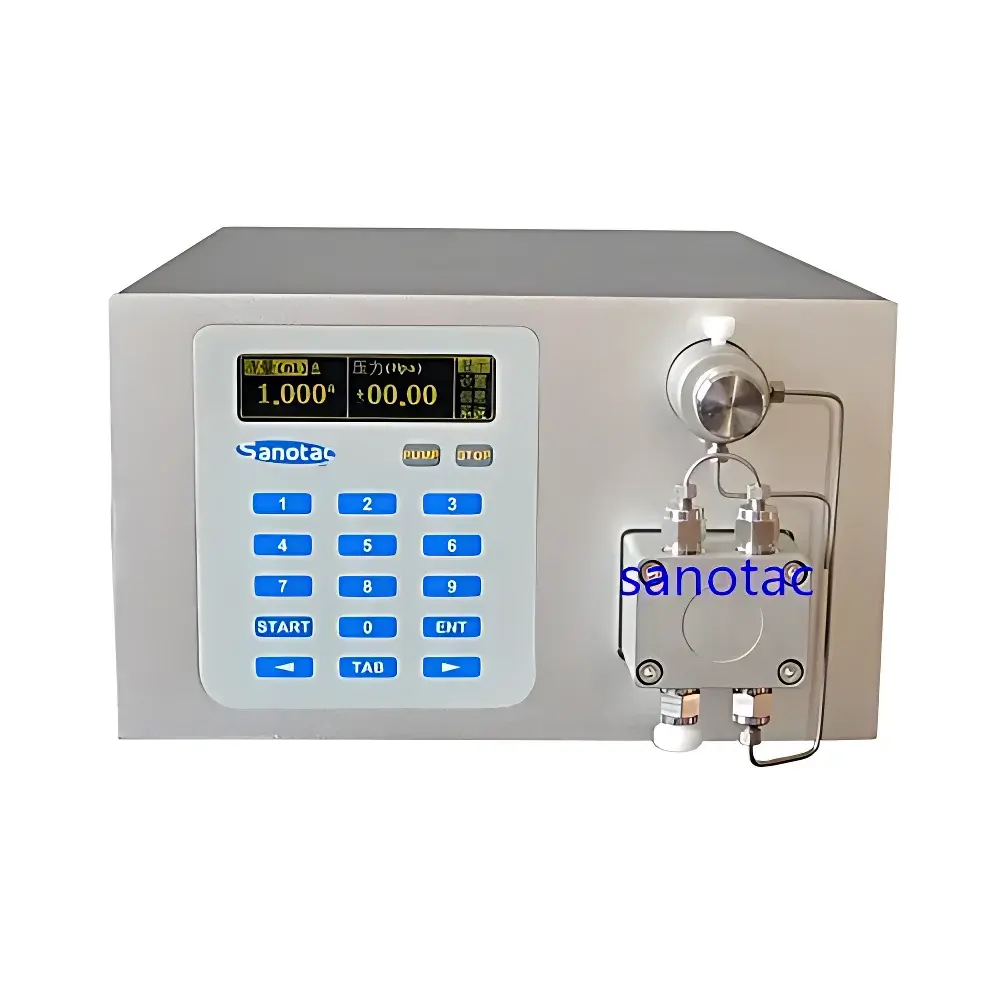
Sanotac SPH0530 Hastelloy High-Pressure Constant Flow Pump (50 mL, 30 MPa)
| Brand | Sanotac |
|---|---|
| Origin | Shanghai, China |
| Manufacturer Type | Direct Manufacturer |
| Model | Sanotac SPH0530 |
| Flow Range | 0.01–50.00 mL/min |
| Flow Increment | 0.01 mL/min |
| Flow Accuracy | ±0.5% |
| Flow Precision (RSD) | ≤0.1% |
| Maximum Pressure | 30 MPa |
| Pressure Pulsation | ≤0.2 MPa |
| Pump Head Volume | 50 mL |
| Fluidic Path Materials | Hastelloy, Sapphire, PTFE, Ceramic |
| Tubing Connection | 1/16″ Hastelloy tubing |
| Display | 256×64 dot matrix self-luminous LCD |
| Control Interface | Front-panel keypad + RS232/USB computer remote control (open protocol) |
| Power Supply | 85–264 VAC, 50 Hz |
| Dimensions | 370 × 240 × 152 mm |
Overview
The Sanotac SPH0530 is a high-performance, dual-piston, series-connected constant flow pump engineered for demanding high-pressure fluid delivery in analytical, process development, and research-scale applications. Designed around Couette-flow displacement principles with floating piston architecture, it delivers precise, pulse-dampened solvent or reagent delivery across a wide dynamic range — from trace-level micro-injection (0.01 mL/min) to preparative-scale throughput (50.00 mL/min), all at sustained pressures up to 30 MPa. Its core function is volumetric metering under closed-loop pressure feedback, making it suitable for integration into HPLC/UHPLC systems, supercritical fluid chromatography (SFC), catalytic reaction modules, continuous-flow reactors, and high-pressure dosing platforms in energy materials and petrochemical R&D.
Key Features
- Hastelloy C-276 fluidic path construction — including pump head, check valves, and 1/16″ tubing connections — provides exceptional resistance to chloride-induced pitting, stress corrosion cracking, and aggressive acids (e.g., HCl, H₂SO₄, HF) commonly encountered in refinery feedstock processing, coal liquefaction, and dye synthesis.
- Dual-servo-driven parallel pump heads with real-time solvent compressibility compensation ensure consistent volumetric displacement across viscosity and temperature gradients — critical for gradient elution stability in multi-solvent HPLC methods.
- Multi-point flow calibration algorithm enables linear, stepwise, and custom non-linear gradient profiles — supporting method development flexibility compliant with ICH Q2(R2) validation requirements for chromatographic systems.
- Cam-profile optimization combined with active electronic pulsation suppression reduces pressure ripple to ≤0.2 MPa (RMS), minimizing column backpressure fluctuations and improving retention time reproducibility (RSD ≤0.1% over 24 h).
- Floating piston design minimizes lateral load on high-pressure seals; paired with imported Swiss sapphire/PTFE check valves and ceramic plungers, it extends mean time between failures (MTBF) beyond 15,000 operational hours under continuous 25 MPa duty cycles.
- Open-protocol RS232/USB interface supports bidirectional communication with third-party chromatography data systems (CDS), including Thermo Chromeleon, Waters Empower, and Agilent OpenLab — fully compatible with 21 CFR Part 11 audit trail and electronic signature requirements when deployed in validated GMP environments.
Sample Compatibility & Compliance
The SPH0530 accommodates a broad spectrum of process fluids: aqueous buffers, organic solvents (acetonitrile, methanol, THF), supercritical CO₂, corrosive catalyst slurries (e.g., Ni/Mo sulfides), and viscous ionic liquids. Its Hastelloy-wetted components meet ASTM B575 and ASME B31.3 material certification standards for high-pressure service. The pump’s mechanical design complies with CE Machinery Directive 2006/42/EC and EMC Directive 2014/30/EU. When operated within specified parameters (≤30 MPa, 5–40 °C ambient), it supports GLP-compliant operation per OECD Series 110–125 guidelines for chemical testing and reactor feed integrity verification.
Software & Data Management
The embedded firmware includes ten programmable method slots for flow rate ramps, gradient composition tables, and pressure hold sequences — editable via front-panel navigation or external workstation. All parameter changes are timestamped and logged in non-volatile memory. Remote control utilizes ASCII-based command sets (documented in the publicly available communication protocol manual), enabling integration with Python-controlled automation scripts, LabVIEW VIs, or MATLAB instrument toolboxes. Data export supports CSV-formatted runtime logs (flow, pressure, error codes) with UTC timestamps — suitable for ALCOA+ data integrity frameworks.
Applications
- HPLC/UHPLC mobile phase delivery in pharmaceutical QC labs requiring USP system suitability compliance.
- Continuous co-injection of catalysts and monomers in tubular polymerization reactors.
- Supercritical fluid extraction (SFE) and impregnation systems operating at 20–30 MPa CO₂ pressures.
- In situ dosing of hydrogen sulfide or ammonia into high-temperature/pressure autoclaves for hydrodesulfurization (HDS) studies.
- Electrolyte metering in flow battery R&D where fluorinated solvents and LiPF₆ solutions demand inert wetted surfaces.
- Calibration traceability for gravimetric flow standards per ISO 4064-2:2014 Class 0.2 accuracy class.
FAQ
What materials are in direct contact with the fluid path?
Hastelloy C-276 (pump head, inlet/outlet manifolds, tubing ferrules), sapphire ball seats, PTFE valve seals, and ceramic plunger surfaces.
Is the pump compatible with FDA-regulated manufacturing environments?
Yes — when configured with audit-trail-enabled CDS software and operated within validated SOPs, it meets 21 CFR Part 11 requirements for electronic records and signatures.
Can the SPH0530 be used for gradient elution in reversed-phase HPLC?
Yes — its programmable gradient engine supports binary and ternary solvent mixing via external low-pressure mixing modules; gradient delay volume is minimized by direct high-pressure blending capability.
What maintenance intervals are recommended for continuous 25 MPa operation?
Plunger seals: replace every 6 months or 2,000 hours; check valves: inspect every 3 months; full calibration verification: biannually per ISO/IEC 17025 internal quality procedures.
Does the pump support analog input for external flow setpoint modulation?
No — control is digital-only via front panel or serial/USB interface; analog 0–10 V or 4–20 mA inputs are not supported in this model.



