
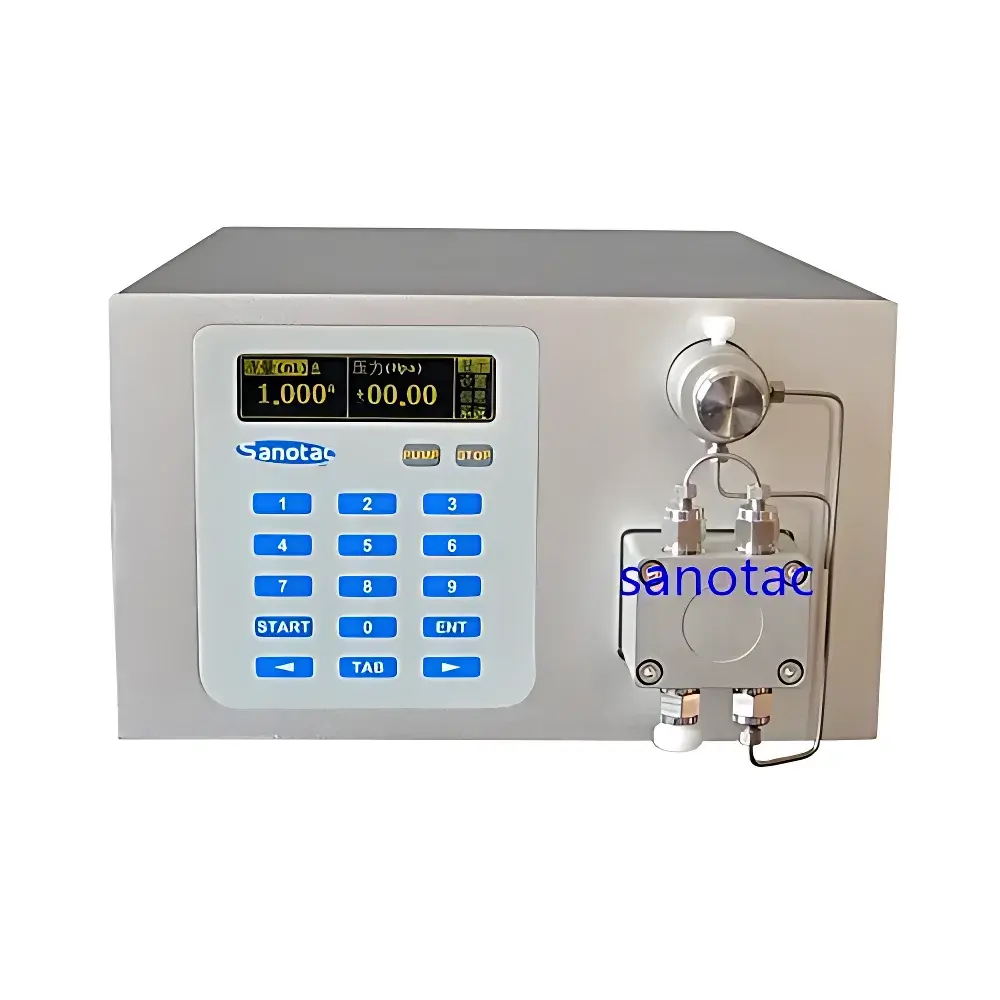
Sanotac ST0010 High-Pressure Constant Flow Pump for Permeability Measurement Systems
| Brand | Sanotac |
|---|---|
| Model | ST0010 |
| Flow Range | 0.001–9.999 mL/min |
| Flow Increment | 0.001 mL/min |
| Flow Accuracy | ±0.1% |
| Flow Precision (RSD) | ≤0.1% |
| Max Pressure | 42 MPa |
| Pressure Pulsation | ≤0.1 MPa |
| Pump Head Material | 316L Stainless Steel, Sapphire, PTFE, Ceramic |
| Tubing Connection | 1/16" Standard Fittings |
| Display | 256×64 Dot Matrix Backlit LCD |
| Control Interface | Front Panel Keypad + RS232/USB Computer Remote Control (Open Protocol) |
| Power Supply | 85–264 VAC, 50 Hz |
| Dimensions | 370 × 240 × 152 mm |
Overview
The Sanotac ST0010 High-Pressure Constant Flow Pump is an engineered solution designed specifically for precision fluid delivery in rock permeability measurement systems and other high-integrity laboratory applications requiring stable, pulse-free flow under elevated pressure. Based on dual-piston serial architecture with floating plunger design, the pump operates on positive displacement principles to deliver reproducible volumetric flow across a wide dynamic range—from nanoliter-per-minute microflow regimes to milliliter-per-minute operational conditions—while maintaining pressure stability up to 42 MPa (6,090 psi). Its core function is to supply consistent, calibrated mobile phase flow to core flooding apparatuses, triaxial permeameters, and multiphase flow simulators used in reservoir engineering, geomechanics, and porous media characterization. The ST0010 integrates solvent compressibility compensation and multi-point flow calibration algorithms to correct for fluid-dependent volumetric deviations, ensuring traceable flow performance compliant with ISO 5725 (accuracy and precision of measurement methods) and ASTM D5084 (hydraulic conductivity testing).
Key Features
- Dual-piston serial pumping mechanism with floating plunger design minimizes seal wear and extends service life under continuous high-pressure operation.
- Microprocessor-controlled flow regulation with real-time solvent compressibility compensation enables accurate delivery across diverse fluid viscosities and compressibilities (e.g., brine, CO₂-saturated water, supercritical fluids).
- Low-pressure pulsation (<0.1 MPa) achieved via optimized cam-profile motion control and active electronic pulse suppression—critical for minimizing baseline noise in differential pressure transducers during low-permeability core analysis.
- Chemically resistant fluid path constructed from 316L stainless steel, sapphire check valves, ceramic plungers, and PTFE seals ensures compatibility with aggressive solvents, acidic/alkaline brines, and H₂S-containing reservoir fluids.
- Open-protocol RS232/USB interface supports bidirectional communication with third-party data acquisition systems, chromatography data systems (CDS), and custom LabVIEW or Python-based control environments.
- Preloaded with ten user-defined method programs supporting gradient profiling (isocratic, linear, step), flow ramping, and timed pressure hold sequences—essential for simulating reservoir injection scenarios and transient permeability tests.
Sample Compatibility & Compliance
The ST0010 accommodates a broad spectrum of test fluids relevant to subsurface flow characterization, including aqueous electrolyte solutions (NaCl, CaCl₂, KCl), hydrocarbon mixtures (n-decane, kerosene), supercritical CO₂, polymer flooding agents (HPAM), and nanofluid suspensions. All wetted materials meet USP Class VI biocompatibility standards where applicable and are compatible with cleaning protocols per ASTM E2652 (cleaning validation for process equipment). The pump’s mechanical design conforms to IEC 61000-6-2 (electromagnetic immunity) and IEC 61000-6-4 (emission limits), and its operational documentation supports GLP-compliant audit trails when integrated with validated software platforms. It is routinely deployed in laboratories accredited to ISO/IEC 17025 for petrophysical testing.
Software & Data Management
The ST0010 supports both standalone operation via its backlit graphical LCD interface and computer-controlled automation through an openly documented ASCII command protocol. This enables seamless integration into LIMS and ELN ecosystems, as well as compliance-ready data capture under FDA 21 CFR Part 11 requirements when paired with qualified CDS software (e.g., Waters Empower, Thermo Chromeleon). Audit trail generation—including operator ID, timestamped parameter changes, method execution logs, and error codes—is fully configurable. Firmware updates are performed via USB without hardware modification, preserving calibration integrity and minimizing downtime.
Applications
- Steady-state and unsteady-state permeability measurements on intact rock cores (sandstone, shale, carbonate) under confining stress conditions.
- Enhanced oil recovery (EOR) screening using surfactant, polymer, or nanoparticle-laden injectants.
- CO₂-brine-rock interaction studies in carbon sequestration research.
- Filter cake formation and drilling fluid invasion analysis in wellbore stability modeling.
- Calibration of differential pressure sensors and flow meters in high-pressure test loops.
- Support instrumentation for ASTM D6988 (permeability of geotextiles) and ISO 11277 (soil hydraulic conductivity) adapted to elevated pressure ranges.
FAQ
What is the maximum operating pressure of the ST0010, and how is pressure stability maintained?
The ST0010 is rated for continuous operation up to 42 MPa. Pressure stability is ensured by dual-piston synchronization, cam-profile optimization, and real-time feedback from internal pressure transducers that trigger adaptive flow correction.
Can the ST0010 be used with corrosive or abrasive fluids?
Yes—the fluid path uses 316L stainless steel, sapphire check valves, and ceramic-plunger assemblies, making it suitable for acidic brines, H₂S-containing fluids, and silica nanoparticle suspensions when operated within specified viscosity and particulate size limits.
Is flow calibration traceable to national standards?
Flow accuracy (±0.1%) and repeatability (≤0.1% RSD) are verified using gravimetric methods traceable to NIST SRM-certified mass standards and ISO 4064-2 procedures for liquid meter calibration.
Does the pump support gradient elution for multi-fluid injection protocols?
Yes—its onboard gradient engine allows programmable blending of up to two independent fluid streams with linear, stepwise, or custom-shaped profiles, enabling simulated reservoir fluid front migration studies.
How is maintenance access and seal replacement handled?
The floating plunger assembly permits tool-free seal inspection and replacement; all consumables—including check valves and pump seals—are field-replaceable using standard hex tools, with mean time between failures (MTBF) exceeding 12,000 hours under typical lab use conditions.



