
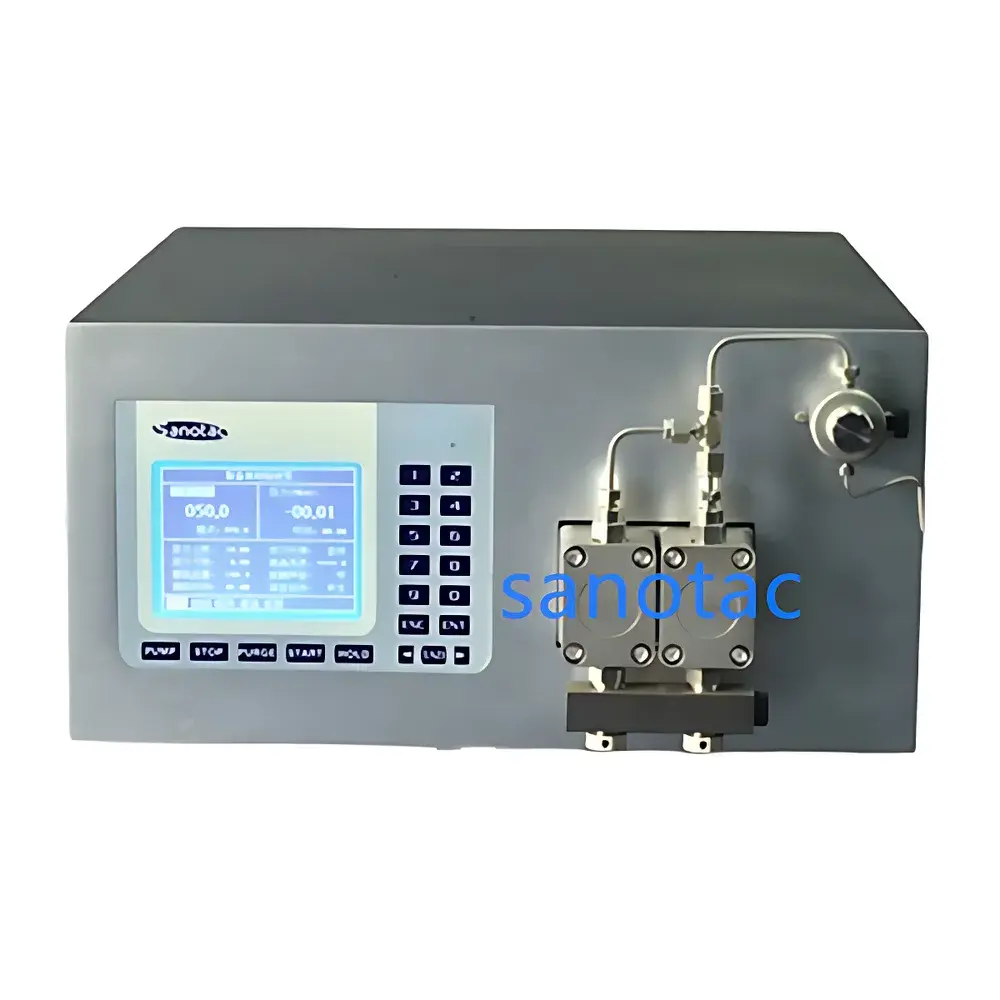
Sanotac SV1110 High-Viscosity Constant Flow Pump with 316L & PTFE Fluid Path
| Brand | Sanotac |
|---|---|
| Model | SV1110 |
| Flow Rate | 0.1–1000 mL/min |
| Max Pressure | 10 MPa |
| Viscosity Range | 0–200 cP |
| Accuracy | ±0.5% |
| Repeatability | ≤0.5% |
| Flow Increment | 0.1 mL/min |
| Wetted Materials | 316L Stainless Steel, PTFE, PEEK, Ceramic |
| Interface | USB, RS232, RS485, Modbus RTU/TCP, Analog/Digital I/O |
| Display | 256×64 backlit LCD |
| Power | 100–240 VAC, 50/60 Hz |
| Dimensions | 550 × 420 × 222 mm |
Overview
The Sanotac SV1110 is a high-precision, high-viscosity constant flow pump engineered for demanding laboratory and pilot-scale process applications requiring stable, pulse-free delivery of viscous and chemically aggressive fluids. It operates on a dual-piston serial displacement principle with floating piston design—optimized to minimize internal shear and maintain volumetric accuracy across variable backpressures. Unlike peristaltic or diaphragm pumps, the SV1110 employs positive displacement via precision-machined 316L stainless steel and PTFE-wetted components, enabling reliable operation up to 10 MPa (1450 psi) while accommodating viscosities up to 200 cP at its maximum rated flow (1000 mL/min). Its architecture supports continuous operation in corrosive, high-solids, or temperature-sensitive environments common in catalytic evaluation, microreactor feeding, supercritical fluid delivery, and polymer processing—where flow stability, chemical compatibility, and long-term reproducibility are critical.
Key Features
- Dual-piston serial configuration with floating piston mechanism ensures minimal flow pulsation (<0.5 MPa pressure ripple) and eliminates dead volume accumulation.
- Multi-point flow calibration algorithm compensates for nonlinearity across the full 0.1–1000 mL/min range, delivering ±0.5% flow accuracy and ≤0.5% repeatability under ISO 5725-2 traceable conditions.
- Programmable overpressure protection with three restart modes: automatic shutdown, manual reset, or low-pressure recovery—preventing column damage or seal extrusion during blockage events.
- Integrated plunger post-cleaning cycle reduces abrasive wear on PTFE seals and extends service life by up to 3× compared to conventional reciprocating designs.
- Modular communication architecture supports industrial protocols including Modbus RTU/TCP, EtherNet/IP, CANopen, and Profinet—enabling seamless integration into SCADA, DCS, and PLC-controlled reaction systems.
- Front-panel and software-based timing control allows precise start/stop sequencing, multi-step gradient profiles, and programmable dwell intervals—essential for catalyst injection, co-feed experiments, and sequential reagent addition.
Sample Compatibility & Compliance
The SV1110 accommodates a broad spectrum of process fluids—from low-viscosity solvents (methanol, ethyl acetate) to highly viscous, thermally sensitive, or strongly corrosive media such as concentrated sulfuric acid, silicone oils, photoresists, and molten polymer precursors. All wetted surfaces consist of ASTM A276-certified 316L stainless steel, virgin PTFE (ASTM D4894), PEEK (ISO 10993-5 compliant), and alumina ceramic—ensuring resistance to oxidation, halogen attack, and hydrolysis. The pump meets CE machinery directive 2006/42/EC, EMC directive 2014/30/EU, and RoHS 2011/65/EU requirements. For regulated environments, firmware supports audit-trail-enabled calibration logging and user-access-level controls aligned with FDA 21 CFR Part 11 principles when used with SanoFlu software.
Software & Data Management
SanoFlu Fluid Control Management System provides full remote configuration, real-time monitoring, and method-driven operation. Users may define complex flow programs—including ramped, stepped, or sinusoidal profiles—and switch between volumetric (mL/min) and gravimetric (g/min) output units based on density input. The software records time-stamped flow and pressure data at configurable intervals (100 ms–10 s), generating CSV-exportable tables and dynamic XY plots (e.g., flow vs. pressure curves). Calibration routines support both single-point verification and full-range linearization; all parameters—including zero-offset compensation and pressure-dependent gain correction—are stored with timestamped revision history. SanoFlu integrates with LabVIEW, MATLAB, and Python APIs via TCP/IP socket interface for custom automation frameworks.
Applications
- Catalytic testing rigs: Precise co-feeding of catalyst slurries and reactant streams into fixed-bed or slurry-phase reactors.
- Microchannel and chip-based reactors: Stable metering of viscous monomers or nanoparticle dispersions without clogging.
- Supercritical fluid processing: Controlled CO₂ or ethanol delivery in extraction and impregnation systems operating above 7.4 MPa.
- Chemical vapor deposition (CVD) precursor delivery: Pulseless transport of high-boiling organometallics for thin-film synthesis.
- Advanced material synthesis: Metering of epoxy resins, polyurethane prepolymers, and battery electrolyte formulations in R&D extruders and mixers.
- Fuel cell membrane casting: Uniform dispensing of Nafion® solutions onto substrates with minimal edge pooling or streaking.
FAQ
What viscosity range is supported at the maximum 1000 mL/min flow rate?
At 1000 mL/min, the SV1110 is rated for fluids up to 200 cP. For higher viscosities, consult the derated flow chart: e.g., 400 cP max at 600 mL/min; 700 cP at 300 mL/min.
Can the pump handle abrasive suspensions or particulates?
Yes—when equipped with ceramic check valves and hardened 316L plungers, it tolerates particles ≤25 µm in diameter at concentrations <5 wt%. Optional inline filtration (5 µm SS mesh) is recommended for slurries.
Is the firmware validated for GMP/GLP environments?
While the base firmware does not carry formal GMP validation, SanoFlu software includes 21 CFR Part 11-compliant features (electronic signatures, audit trails, role-based access) and can be qualified per IQ/OQ protocols upon request.
How is flow accuracy verified during installation?
A NIST-traceable gravimetric calibration kit (sold separately) enables on-site verification using certified balance and timed collection. Factory calibration certificates include uncertainty budgets per ISO/IEC 17025.
Does the pump support analog setpoint control from an external PID loop?
Yes—0–5 V or 4–20 mA analog inputs allow closed-loop flow regulation directly from third-party controllers, with configurable scaling and deadband filtering.
Related Products



