
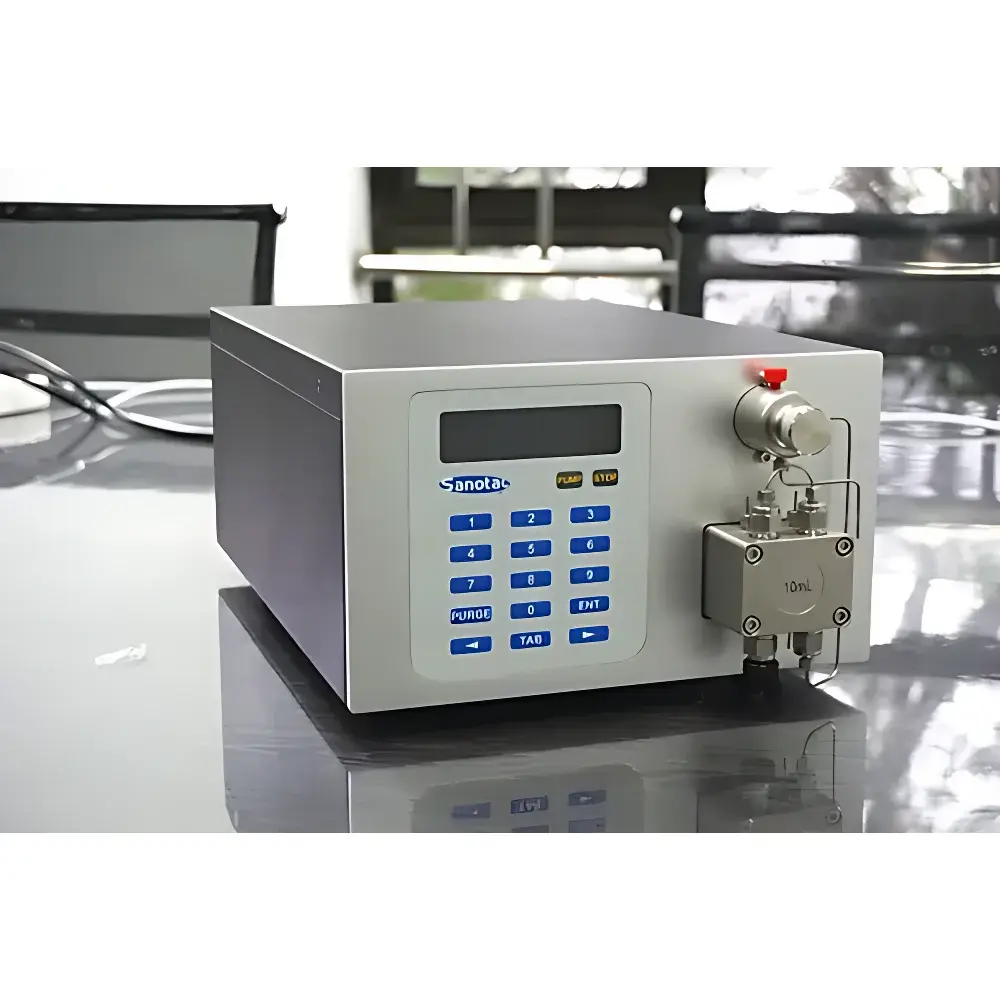
Sanotac SW0010 High-Pressure Constant Flow Pump with Hastelloy Pump Head
| Brand | Sanotac |
|---|---|
| Origin | Shanghai, China |
| Manufacturer Type | Manufacturer |
| Model | SW0010 |
| Flow Rate | 0.001–9.999 mL/min (adjustable in 0.001 mL/min increments) |
| Maximum Pressure | 42 MPa |
| Flow Accuracy | ±0.1% |
| Flow Precision (RSD) | ≤0.1% |
| Pressure Pulsation | ≤0.1 MPa |
| Pumping Mechanism | Dual-piston serial configuration with floating piston design |
| Wetted Materials | 316L stainless steel, sapphire, PTFE, ceramic |
| Communication Interfaces | RS232, RS485, RS422, USB |
| Display | 256×64 dot matrix backlit LCD |
| Power Supply | 85–264 VAC, 50 Hz |
| Dimensions | 370 × 240 × 152 mm |
Overview
The Sanotac SW0010 is an analytical-grade high-pressure constant flow pump engineered for precision fluid delivery in demanding laboratory and pilot-scale process environments. It operates on a dual-piston serial pumping principle with a floating piston architecture—designed to minimize mechanical wear on high-pressure seals and ensure long-term operational stability under sustained loads up to 42 MPa (6,090 psi). Its core function is the accurate, pulse-minimized delivery of viscous, corrosive, or reactive fluids across a wide dynamic flow range (0.001–9.999 mL/min), making it especially suitable for applications requiring strict mass balance control, such as continuous-flow synthesis, catalytic reaction monitoring, supercritical fluid processing, and high-performance liquid chromatography (HPLC) method development. The pump head is constructed from Hastelloy C-276—a nickel-molybdenum-chromium alloy offering exceptional resistance to pitting, stress corrosion cracking, and reducing acid environments—enabling reliable operation with aggressive solvents including hydrochloric acid, sulfuric acid, and halogenated organics.
Key Features
- Dual-piston serial configuration with real-time solvent compressibility compensation and multi-point flow calibration across the full operating range
- Floating piston design reduces seal friction and extends service life of high-pressure sealing components
- Low-pressure pulsation (<0.1 MPa) achieved via cam-profile optimization and active electronic pulse suppression
- Modular communication architecture supporting RS232/RS485/RS422 and USB interfaces with open-protocol computer control (Modbus RTU and ASCII)
- Integrated analog I/O (0–5 V DC and 4–20 mA) for seamless integration into PLC-based reactor control systems
- Backlit 256×64 dot-matrix LCD display with intuitive menu navigation and real-time visualization of flow rate, pressure, and system status
- Preloaded with 10 user-defined programs for automated gradient generation—including isocratic, linear, and step profiles—enabling reproducible method transfer between instruments
Sample Compatibility & Compliance
The SW0010 is compatible with a broad spectrum of chemically aggressive, high-viscosity, and thermally sensitive fluids commonly encountered in fine chemical synthesis, pharmaceutical process R&D, and materials science. Its Hastelloy C-276 pump head, sapphire check valves, and ceramic/PTFE/316L wetted path meet stringent material compatibility requirements per ASTM G46 and NACE MR0175/ISO 15156 for sour service environments. The instrument supports GLP-compliant operation through audit-trail-capable software integration and configurable event logging. While not certified to IEC 61000-6-2/6-4 or ATEX by default, explosion-proof variants are available upon request for Zone 1/21 hazardous area deployment. All firmware and control logic adhere to deterministic timing constraints required for synchronized multi-pump reactor feeding in accordance with ISO 17025-accredited laboratories.
Software & Data Management
The SW0010 supports bidirectional communication via open, documented command sets—allowing direct integration with third-party chromatography data systems (CDS), SCADA platforms, or custom Python/LabVIEW-based control suites. Real-time pressure and flow telemetry can be streamed at 10 Hz resolution for closed-loop feedback control. Local data logging includes timestamped flow/pressure curves, error codes, and calibration history. When operated within validated environments, the pump’s firmware supports 21 CFR Part 11-compliant electronic signatures and role-based access control when paired with compliant host software. Remote firmware updates are performed via secure USB or serial connection without hardware modification.
Applications
- Continuous-flow hydrogenation and cross-coupling reactions requiring precise stoichiometric reagent dosing
- High-pressure liquid-phase oxidation and polymerization studies under inert or supercritical conditions
- Method development for preparative HPLC and SFC where gradient fidelity and low pulsation are critical
- In-line reaction calorimetry and PAT (Process Analytical Technology) workflows with real-time feedstock modulation
- Calibration reference standards delivery in metrology labs performing volumetric flow verification per ISO 4064-2
- Microreactor array feeding in combinatorial catalyst screening platforms
FAQ
What materials are in contact with the fluid path?
The wetted components consist of Hastelloy C-276 (pump head and housing), sapphire ball check valves, ceramic plungers, PTFE seals, and 316L stainless steel tubing connectors.
Can this pump be integrated into a PLC-controlled reactor system?
Yes—it provides native 4–20 mA and 0–5 V analog inputs for external setpoint control, along with Modbus RTU over RS485 for discrete command execution and status polling.
Is flow calibration traceable to national standards?
Calibration procedures follow ISO/IEC 17025 guidelines; users may perform multi-point gravimetric verification using NIST-traceable balances and certified volumetric glassware.
Does the pump support gradient elution in chromatographic applications?
Yes—the onboard controller enables programmable isocratic, linear, and multi-step gradients with user-defined dwell volume compensation.
What is the maximum allowable viscosity for stable operation at rated pressure?
The pump maintains specified accuracy and pulsation performance for fluids up to 500 cP at 42 MPa; higher viscosities require reduced flow rates or pre-heating to maintain laminar flow conditions.



