
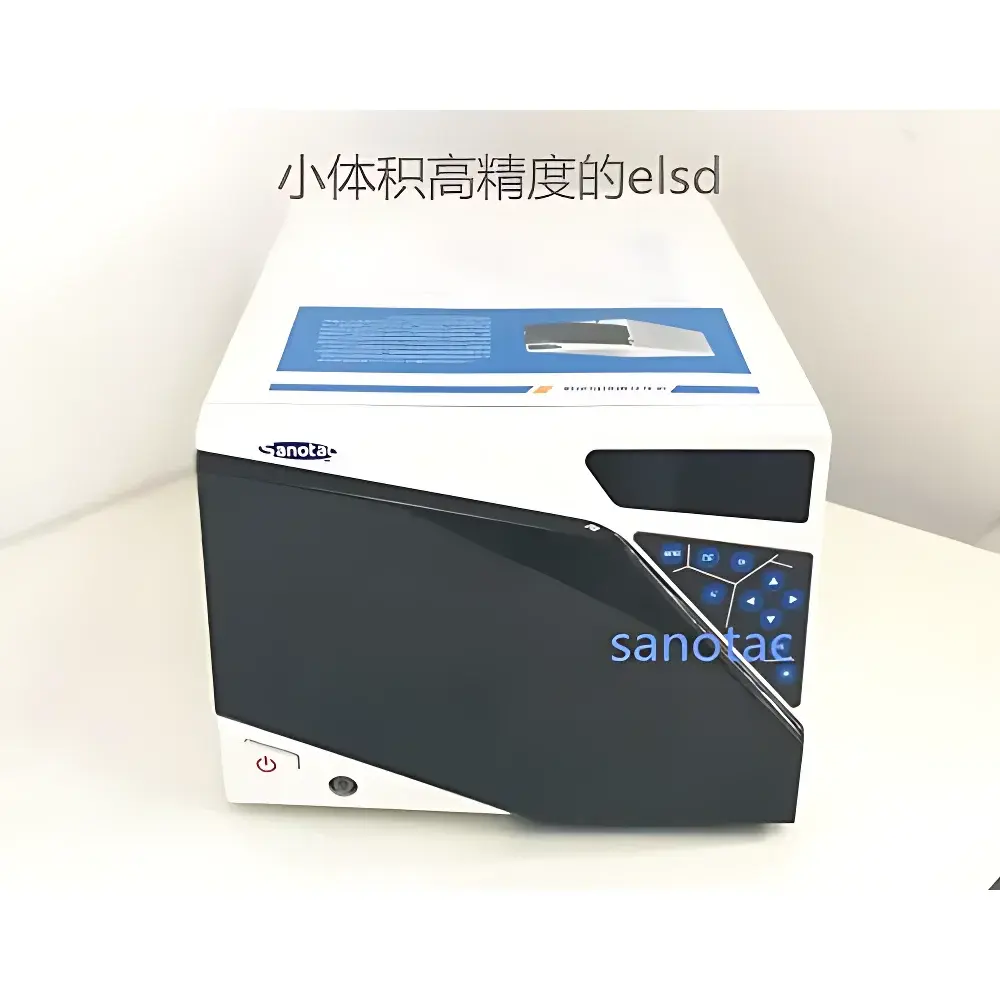
Sanotac T6000 Evaporative Light Scattering Detector (ELSD) for Online Active Ingredient Monitoring in Botanical Extracts
| Brand | Sanotac |
|---|---|
| Origin | Shanghai, China |
| Manufacturer Type | Original Equipment Manufacturer (OEM) |
| Product Category | Domestic |
| Model | T6000 |
| Instrument Type | Evaporative Light Scattering Detector (ELSD) |
| Wavelength | 650 nm |
| Detection Mode | Low-Temperature Evaporation |
| Light Source | Semiconductor Laser |
Overview
The Sanotac T6000 Evaporative Light Scattering Detector (ELSD) is a robust, benchtop-compatible mass-sensitive detector engineered for universal detection of non-volatile and semi-volatile analytes in liquid chromatography workflows. Unlike UV-Vis or fluorescence detectors, the T6000 operates on the principle of nebulization, solvent evaporation, and light scattering—making it particularly suited for compounds lacking chromophores, such as saponins, terpene lactones, flavonoid glycosides, and steroidal alkaloids commonly found in botanical extracts. Its core measurement cycle involves precise aerosol generation from the HPLC effluent, controlled thermal desolvation in a drift tube, and quantification of scattered laser light (650 nm, 30 mW semiconductor source) by a high-gain photomultiplier tube. This physical detection mechanism ensures consistent response across structurally diverse phytochemicals—including baicalein, ginkgolides, bilobalide, timosaponin, and peimine—regardless of UV absorbance characteristics. Designed for integration into QC/QA pipelines in herbal medicine manufacturing, natural product R&D, and nutraceutical process development, the T6000 delivers trace-level sensitivity with inherent compatibility to gradient elution and high-flow preparative systems.
Key Features
- Compact horizontal optical architecture with optimized internal thermal field design—minimizes footprint (260 × 190 × 460 mm) while ensuring thermal stability and operational safety
- Dual-stage temperature control: independent regulation of drift tube (ambient to 130 °C, ±1 °C accuracy) and nebulizer (ambient to 56 °C, 1 °C increment), enabling method-specific optimization for thermolabile botanical matrices
- Integrated rapid-cooling assist system for drift tube—reduces inter-method equilibration time by >60%, supporting high-throughput screening of multi-component extracts
- Front-access nebulizer capillary—facilitates real-time visual inspection and routine cleaning without disassembly or downtime
- Programmable gas delivery: mass-flow-controlled nitrogen or clean dry air (1–4 L/min, ≤1% accuracy), with pressure monitoring (0.01 bar resolution) and automatic standby activation to reduce gas consumption by ≥50%
- Analog output range: –1000 to +1000 mV with continuous gain adjustment (0.3–30×), auto-zero function, and digital output at 20 Hz sampling rate
- 16×2 backlit LCD interface with 10-key input; stores up to 10 methods (25 parameters each), with automatic recall and external event triggering (e.g., fraction collection, valve switching)
Sample Compatibility & Compliance
The T6000 detects any analyte with volatility lower than the mobile phase—enabling reliable quantification of non-chromophoric plant constituents including triterpenoid saponins (e.g., astragalosides), diterpene lactones (e.g., tanshinones), iridoid glycosides (e.g., aucubin), and polysaccharide fragments. It supports mobile phases containing volatile modifiers (e.g., acetonitrile, methanol, ammonium acetate, formic acid) and is fully compatible with reversed-phase, HILIC, and normal-phase LC separations. The detector meets key regulatory expectations for analytical instrumentation used in GMP-compliant environments: its embedded Sanotac Chromatography Software complies with FDA 21 CFR Part 11 requirements, featuring electronic signatures, role-based access control, immutable audit trails, and full data integrity logging. All hardware self-diagnostics (16-point instrument health check) and alarm protocols (gas pressure loss, temperature deviation, laser fault) are documented in system logs for GLP/GMP audit readiness.
Software & Data Management
The Sanotac Chromatography Software provides native ELSD signal acquisition, peak integration, calibration curve generation (linear/log-log), and report export (PDF, CSV, XML). It supports seamless bidirectional communication with third-party HPLC systems via RS-232, USB, or TCP/IP (HTTP), eliminating proprietary lock-in. Data files include complete metadata: method parameters, environmental conditions (gas flow, temperatures), hardware status flags, and user-defined annotations. Audit trail records capture timestamped events—including method edits, integration parameter changes, manual baseline corrections, and user logins—with hash-verified immutability. Raw signal data is stored in vendor-neutral formats compliant with ISO/IEC 17025 documentation standards, facilitating cross-platform reprocessing and long-term archival per ICH M5 guidelines.
Applications
- Quantitative release testing of Ginkgo biloba extract for ginkgolide A/B/C and bilobalide per USP and EP 2.2.29
- In-process monitoring of Fritillaria thunbergii extract batches for peimine and peiminine during industrial-scale purification
- Stability-indicating assay of Scutellaria baicalensis preparations under accelerated storage conditions (ICH Q1A)
- Method transfer validation between analytical and preparative HPLC systems for isolation of active fractions from Anemarrhena asphodeloides
- Multi-analyte profiling of complex herbal formulations (e.g., Traditional Chinese Medicine patent prescriptions) without derivatization
FAQ
Does the T6000 support gradient elution without baseline drift?
Yes—the low-noise photomultiplier (<0.03 mV), precise thermal control, and integrated baseline stabilization algorithm minimize gradient-induced signal artifacts.
Can it be used with high-flow preparative HPLC systems?
Yes—it accepts flow rates from 0.01 to 3 mL/min and integrates with medium-pressure (≤20 bar) and preparative-scale systems via optional flow-splitting modules.
Is nitrogen gas mandatory, or can compressed air be used?
Clean, oil-free, particle-filtered compressed air is acceptable for most botanical applications; nitrogen is recommended for ultra-low noise or high-sensitivity quantitation.
How is data integrity ensured during multi-user lab operations?
Through FDA 21 CFR Part 11–compliant software: electronic signatures, permission tiers, automated audit trails, and tamper-evident data packaging.
What maintenance intervals are recommended for routine operation?
Nebulizer capillary cleaning after every 50 injections; annual PM including laser power calibration, PMT gain verification, and gas flow sensor validation.






