
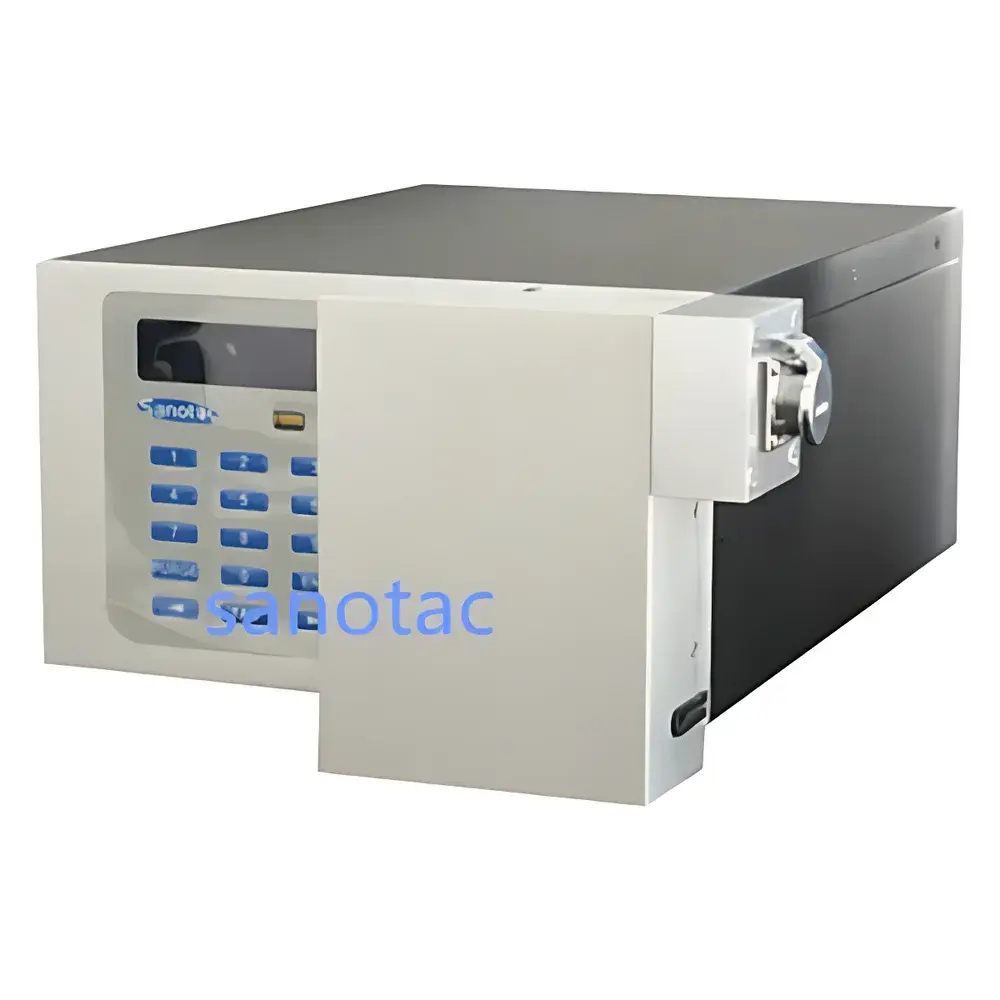
Sanotac TH2010 High-Temperature Hastelloy Constant Flow Pump with Integrated Temperature Control
| Brand | Sanotac |
|---|---|
| Origin | Shanghai, China |
| Manufacturer Type | Direct Manufacturer |
| Country of Origin | China |
| Model | TH2010 |
| Flow Rate | 200 mL/min |
| Maximum Pressure | 10 MPa |
| Temperature Range | Ambient to 100 °C |
| Temperature Accuracy | ±1 °C |
| Flow Accuracy | ±0.5% |
| Flow Precision (RSD) | ≤0.1% |
| Flow Resolution | 0.01 mL/min |
| Pumping Mechanism | Dual Parallel Piston with Floating Piston Design |
| Wetted Materials | Hastelloy, Sapphire, PTFE, PCTFE, Ceramic |
| Tubing Connection | 1/8" Standard |
| Display | 256×64 Dot Matrix Self-Illuminating LCD |
| Control Interface | Front Panel Keypad + Remote Computer Control (RS232/485/422, USB, Ethernet) |
| Communication Protocols | Modbus RTU/ASCII, Profibus DP, Profinet, OPC UA |
| Input/Output | Analog 0–10 V / 4–20 mA, Digital Start/Stop, Status Feedback |
| Power Supply | 85–264 VAC, 50 Hz |
Overview
The Sanotac TH2010 is a high-temperature, corrosion-resistant constant flow pump engineered for precise, stable fluid delivery under elevated thermal and pressure conditions. It operates on a dual parallel piston mechanism with floating piston design—a configuration that minimizes mechanical wear, reduces pulsation, and ensures long-term volumetric accuracy across extended duty cycles. Unlike conventional ambient-temperature syringe or peristaltic pumps, the TH2010 integrates active thermal management directly into the fluid path: temperature-controlled zones encompass inlet tubing, pump head cavity, and outlet manifold, ensuring uniform thermal equilibrium throughout the entire wetted volume. This eliminates cold-spot-induced viscosity drift, phase separation, or premature crystallization—critical concerns when handling molten salts, high-boiling-point solvents (e.g., NMP, DMSO), catalyst slurries, or thermally sensitive organometallic precursors. Its core architecture conforms to ISO 5725 (accuracy and precision of measurement methods) and supports traceable calibration in accordance with GLP-compliant workflows.
Key Features
- Integrated multi-zone temperature control (ambient to 100 °C) with ±1 °C stability across inlet, pump chamber, and outlet—enabled by microprocessor-driven PID regulation and embedded thermistor feedback loops
- Hastelloy C-276 fluidic path components—including pump head, valves, and check balls—providing exceptional resistance to chloride-induced stress corrosion cracking and oxidation at elevated temperatures
- Low-pulsation delivery (<0.2 MPa pressure ripple) achieved via cam-profile compensation and real-time electronic pulse suppression algorithms
- Dual-mode operation: volumetric metering (mL/min) and gravimetric feeding (g/min) with optional load-cell integration and client-side mass-flow calibration
- Configurable hardware architecture supporting both monolithic (all-in-one) and modular (pump head + remote controller + heater zone) deployments
- Comprehensive digital interface suite: RS232/485/422 serial, USB 2.0, and Ethernet (TCP/IP) ports; native support for Modbus RTU/ASCII, Profibus DP, Profinet, and OPC UA protocols
Sample Compatibility & Compliance
The TH2010 accommodates aggressive process media including concentrated acidic or alkaline solutions, halogenated hydrocarbons, molten polymer melts, and heterogeneous catalytic suspensions. Its wetted materials—Hastelloy C-276, sapphire, PTFE, PCTFE, and alumina ceramics—are selected per ASTM G46 and NACE MR0175/ISO 15156 standards for sour service compatibility. The pump meets CE marking requirements (2014/30/EU EMC Directive and 2014/35/EU Low Voltage Directive), and its control firmware implements audit-trail logging and user-access-level management in alignment with FDA 21 CFR Part 11 for electronic records and signatures. It is routinely deployed in ISO/IEC 17025-accredited laboratories performing method validation for continuous-flow synthesis, hydrothermal reaction engineering, and electrochemical fuel cell feedstock dosing.
Software & Data Management
Sanotac’s PumpControl Suite v3.2 provides cross-platform (Windows/Linux/macOS) configuration, real-time monitoring, and automated sequence scripting. The software enables dynamic pressure–flow curve visualization, multi-pump synchronization (1:N or M:N topologies), and export of time-stamped datasets in CSV, HDF5, or vendor-neutral ASAM MDF4 formats. All parameter changes—including temperature setpoints, flow profiles, and alarm thresholds—are logged with operator ID, timestamp, and pre/post values. For industrial integration, the TH2010 supports direct linkage to SCADA, DCS (e.g., Siemens PCS7, Yokogawa CENTUM VP), and PLC systems via native protocol stacks—eliminating gateway dependency and preserving sub-second command latency.
Applications
- Continuous-flow catalytic hydrogenation and cross-coupling reactions requiring stoichiometric reagent addition at 80–100 °C
- High-temperature slurry feeding in lab-scale Fischer–Tropsch or ammonia synthesis reactors
- Precise dosing of viscous electrolytes (e.g., LiTFSI in sulfolane) for solid-state battery electrode coating lines
- Controlled introduction of metal-organic precursors in CVD/ALD precursor delivery modules
- Automated reagent injection in ASTM D6304 (Karl Fischer titration) and USP conductivity-based water content analysis
- Stable melt-phase extrusion feed for rheological characterization of thermoplastic elastomers
FAQ
What is the maximum allowable fluid temperature at the pump head?
The TH2010 maintains full performance up to 100 °C at the pump cavity; however, sustained operation above 90 °C requires confirmation of fluid compatibility with PCTFE seals and verification of thermal expansion coefficients for connected stainless-steel or Swagelok tubing.
Can the TH2010 be integrated into an existing PLC-controlled reactor system?
Yes—it supports native Profibus DP and Profinet IRT communication with deterministic cycle times down to 1 ms, enabling synchronized start/stop, ramp profiling, and fault reporting without intermediary gateways.
Is flow calibration traceable to national metrology institutes?
Sanotac provides optional factory calibration certificates accredited to ISO/IEC 17025, with uncertainty budgets referenced to NIST-traceable gravimetric standards and certified reference fluids (e.g., Cannon–Fenske kinematic viscosity standards).
Does the pump support gradient elution or multi-solvent switching?
While the TH2010 is a single-fluid-path device, it can be paired with Sanotac’s SMC-8 valve manifold module (8-port, Hastelloy body, 100 °C rated) to enable programmable solvent selection and binary gradient generation under closed-loop temperature control.
How is maintenance performed on the piston seals under high-temperature operation?
The floating piston assembly uses self-lubricating ceramic-coated rods and replaceable Hastelloy-reinforced PCTFE seals; routine inspection intervals are extended to 2,000 operating hours at 80 °C, with seal replacement kits available as field-serviceable components.



