
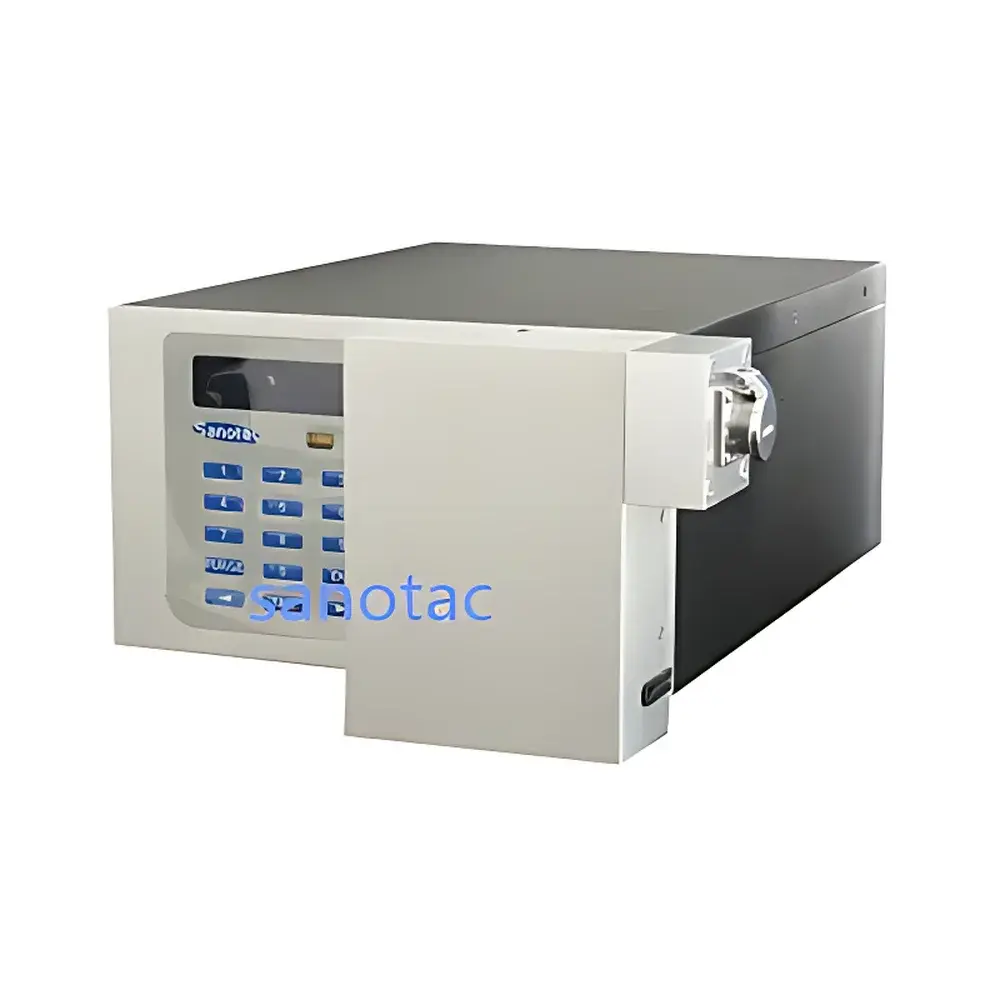
Sanotac TS-1020 High-Temperature High-Pressure Constant Flow Pump
| Brand | Sanotac |
|---|---|
| Origin | Shanghai, China |
| Manufacturer Type | Direct Manufacturer |
| Country of Origin | China |
| Model | TS-1020 |
| Flow Rate | 0.01–100.00 mL/min |
| Pressure Rating | ≤ 20 MPa |
| Temperature Control Range | Ambient to 100 °C |
| Temperature Accuracy | ±1 °C |
| Flow Accuracy | ±0.5% |
| Flow Precision (RSD) | ≤0.1% |
| Delivery Mode | Dual-piston parallel with floating piston design |
| Wetted Materials | 316L stainless steel, ruby, PTFE, ceramic |
| Connection | 1/8" standard tubing |
| Display | 256×64 dot matrix self-luminous LCD |
| Power Supply | 85–264 VAC, 50 Hz |
| Communication Interfaces | RS232/RS485/RS422, USB, wired/wireless Ethernet |
| Protocols | Modbus, Profibus DP, Profinet |
| Control Options | Front-panel keypad, analog input (0–5 V / 4–20 mA), digital I/O, remote PC control |
Overview
The Sanotac TS-1020 High-Temperature High-Pressure Constant Flow Pump is an engineered solution for precise, thermally stable fluid delivery in demanding laboratory and pilot-scale process environments. Designed around a dual-piston parallel architecture with floating piston technology, the pump delivers consistent volumetric flow under elevated thermal and hydraulic loads—critical for applications where reaction kinetics, phase behavior, or catalyst activation are temperature- and pressure-dependent. Unlike conventional ambient-rated HPLC pumps, the TS-1020 integrates active zone-specific thermal management across the inlet, pump head, and outlet zones, ensuring uniform fluid temperature throughout the entire wetted path. This eliminates thermal gradients that cause viscosity drift, vapor lock, or premature crystallization—common failure modes in high-temperature catalytic feed systems, supercritical fluid processing, and continuous-flow synthesis. Its maximum operating pressure of 20 MPa (2900 psi) and controllable temperature range from ambient to 100 °C position it as a core component for pressurized reactor feeding, controlled-dose catalyst injection, and high-viscosity polymer precursor metering.
Key Features
- Dual-piston parallel delivery system with floating piston design ensures low pulsation (<0.2 MPa) and long-term mechanical stability under sustained high-pressure operation.
- Zonal temperature control: independent thermal regulation of inlet, pump cavity, and outlet sections maintains isothermal fluid conditions—verified by embedded PT100 sensors with ±1 °C accuracy.
- Integrated thermal insulation architecture minimizes external heat loss and reduces power demand for steady-state operation.
- Modular configuration options: available in both integrated (all-in-one) and split-system layouts to accommodate space-constrained reactor skids or centralized utility rooms.
- Multi-mode flow calibration: supports both volumetric and gravimetric delivery modes, with client-side multi-point flow curve correction and cam-profile pulse compensation algorithms.
- Real-time dynamic monitoring: pressure vs. flow rate curves displayed live on the 256×64 self-luminous LCD; data exportable via serial or network interface.
Sample Compatibility & Compliance
The TS-1020’s fluidic path is constructed entirely from chemically inert, high-strength materials—including 316L stainless steel housings, ruby check valves, ceramic plungers, and PTFE-sealed joints—ensuring compatibility with aggressive solvents (e.g., concentrated acids, halogenated organics), high-boiling-point reagents (e.g., glycols, molten salts), and particulate-laden slurries up to 5 µm. All wetted components comply with ASTM F899 for wrought stainless steel and ISO 10993-5 for cytotoxicity screening. The pump’s electrical architecture meets IEC 61000-6-2 (immunity) and IEC 61000-6-4 (emissions) standards. For regulated environments, firmware supports audit-trail-enabled operation per FDA 21 CFR Part 11 requirements when integrated with validated SCADA/DCS platforms using Modbus TCP or Profinet.
Software & Data Management
The TS-1020 supports native integration into industrial automation ecosystems via multiple deterministic communication layers: RS485 (Modbus RTU), RS422 (Profibus DP), Ethernet (Profinet, Modbus TCP), and USB 2.0. It enables one-to-many or many-to-many control topologies, allowing centralized orchestration of multi-pump arrays in parallel reactor systems. Analog input (0–5 V / 4–20 mA) permits closed-loop feedback control from external temperature or pressure transmitters. All operational parameters—including setpoints, actual flow/pressure/temperature values, fault logs, and calibration history—are timestamped and stored onboard. Data export formats include CSV and XML; optional cloud gateway modules support MQTT-based telemetry to time-series databases (e.g., InfluxDB) for long-term performance trending and predictive maintenance analytics.
Applications
- Continuous-flow catalytic hydrogenation and oxidation reactions requiring precise stoichiometric reagent dosing at 80–100 °C and 10–20 MPa.
- Feed control in fixed-bed and slurry-phase reactors for Fischer–Tropsch synthesis, hydrodesulfurization, and ammonia decomposition studies.
- High-temperature polymerization initiators and crosslinker delivery in extrusion-coupled reaction systems.
- Supercritical CO₂ extraction pre-injection and co-solvent metering where thermal stability prevents phase separation upstream of the expansion valve.
- Electrolyte formulation and electrode slurry dispensing in battery R&D workflows under inert atmosphere gloveboxes.
- Calibration traceability for primary flow standards in metrology labs accredited to ISO/IEC 17025.
FAQ
What is the maximum allowable fluid temperature at the pump head?
The pump head is rated for continuous operation at fluid temperatures up to 100 °C, with thermal protection logic preventing exceedance beyond this limit.
Can the TS-1020 be used with abrasive or suspended-particle-containing fluids?
Yes—provided particles are ≤5 µm and non-fibrous; use of ceramic plungers and ruby valves extends service life under such conditions.
Is the flow calibration traceable to national standards?
Factory calibration is performed using NIST-traceable gravimetric standards; end-user multi-point correction preserves traceability when executed per documented SOP.
Does the pump support fail-safe shutdown during overpressure events?
Yes—integrated pressure transducer triggers immediate stop-and-hold action if pressure exceeds user-defined threshold, with event logging and relay output signaling.
How is temperature uniformity verified across the fluid path?
Three independently calibrated PT100 sensors monitor inlet, cavity, and outlet zones; deviation >1.5 °C between zones triggers automatic thermal rebalancing.



