
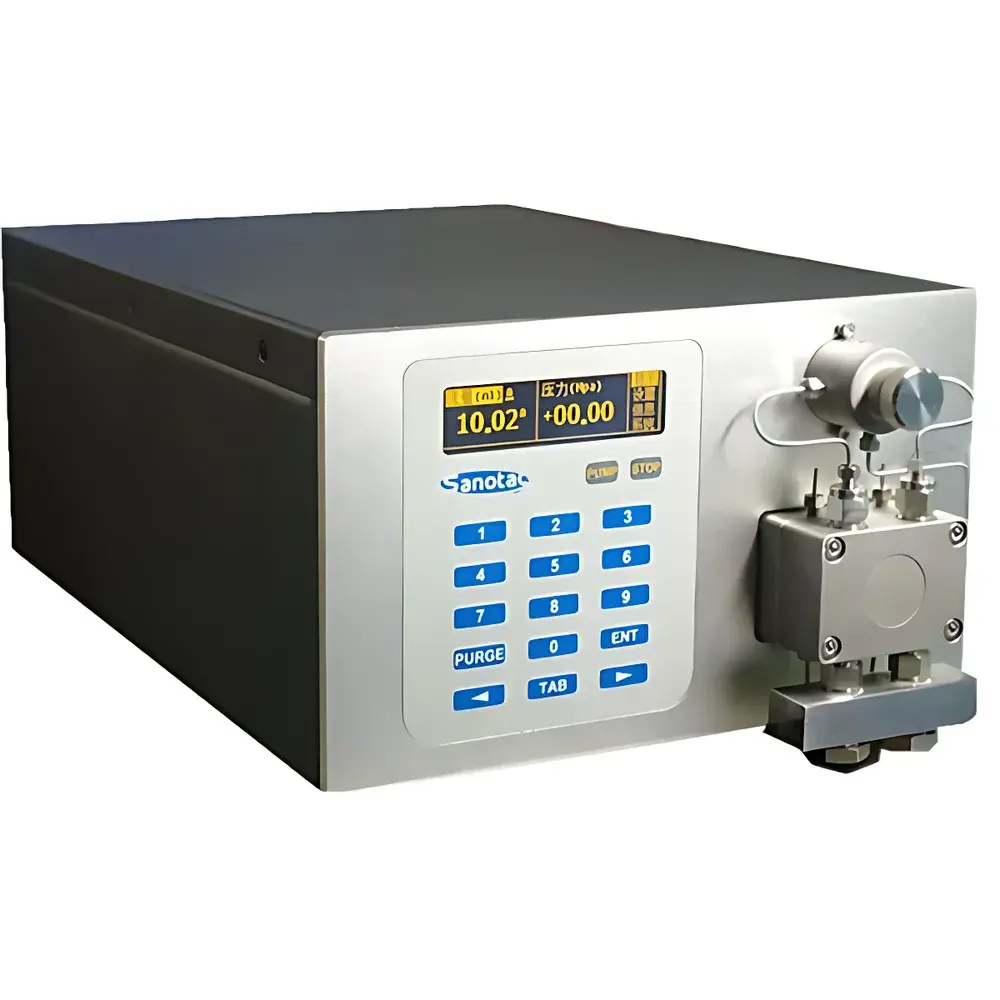
Sanotac TSP1030 High-Pressure Dual-Piston Constant Flow Pump
| Brand | Sanotac |
|---|---|
| Origin | Shanghai, China |
| Manufacturer Type | OEM Manufacturer |
| Product Category | Domestic |
| Model | TSP1030 |
| Price Range | USD 1,400 – 2,800 |
| Flow Range | 0.01–50.00 mL/min |
| Flow Increment | 0.01 mL/min |
| Flow Accuracy | ±0.5% |
| Flow Precision (RSD) | ≤0.1% |
| Maximum Pressure | 30 MPa |
| Pressure Pulsation | ≤0.2 MPa |
| Pump Head Volume | 100 mL |
| Fluid Path Materials | 316L Stainless Steel, Sapphire, PTFE, Ceramic |
| Tubing Connection | 1/16" Standard Fittings |
| Display | 256×64 Dot Matrix Backlit LCD |
| Control Modes | Front Panel Keypad + RS232/Ethernet Computer Remote Control (Open Protocol) |
| Power Supply | 85–264 VAC, 50 Hz |
| Dimensions (W×D×H) | 370×240×152 mm |
Overview
The Sanotac TSP1030 is a high-pressure, dual-piston constant flow pump engineered for precision fluid delivery in demanding analytical and process-scale laboratory environments. Based on positive displacement reciprocating piston technology with parallel dual-piston architecture and floating piston design, the TSP1030 delivers stable, pulse-minimized flow across a wide dynamic range — from ultra-low flow rates (0.01 mL/min) to high-throughput delivery (50.00 mL/min), all at pressures up to 30 MPa (4,350 psi). Its operational principle relies on synchronized cam-driven piston motion, solvent compressibility compensation algorithms, and real-time electronic pulse suppression — enabling consistent volumetric delivery essential for HPLC, SFC, catalytic reaction feeding, supercritical fluid processing, and continuous-flow synthesis systems. Unlike peristaltic or syringe-based pumps, the TSP1030 maintains metrological stability under variable backpressure and temperature gradients, making it suitable for GLP-compliant method development and long-duration unattended operation.
Key Features
- Dual-piston parallel architecture with floating piston mechanism — reduces seal wear and extends service life of high-pressure sealing components
- Microprocessor-controlled flow regulation with multi-point volumetric calibration curves — ensures accuracy of ±0.5% and repeatability ≤0.1% RSD across full flow range
- Integrated pressure pulsation mitigation via optimized cam profile design and real-time electronic flow feedback control — achieves pressure ripple ≤0.2 MPa
- Chemically inert fluid path constructed from 316L stainless steel, sapphire check valves, PTFE seals, and ceramic plungers — compatible with aggressive solvents, acids, bases, and supercritical CO₂
- Open communication protocol (RS232/Ethernet) supporting bidirectional remote control — fully interoperable with third-party chromatography data systems (CDS), LabVIEW, Python-based automation frameworks, and custom SCADA interfaces
- Front-panel programmability with 10 user-defined methods — supports gradient profiling (isocratic, linear, step, and composite gradients), flow ramping, and timed event sequencing
- Backlit 256×64 dot-matrix LCD display with intuitive menu navigation — provides real-time monitoring of flow rate, pressure, error codes, and system status
Sample Compatibility & Compliance
The TSP1030 accommodates a broad spectrum of liquid-phase chemistries, including aqueous buffers, organic solvents (acetonitrile, methanol, THF), corrosive reagents (HF,浓HCl), and supercritical fluids (CO₂, N₂O). Its wetted materials meet ASTM F2136-19 (biocompatibility of polymer components) and USP Class VI requirements for elastomeric seals. The pump’s mechanical design conforms to IEC 61010-1:2010 for electrical safety in laboratory equipment. While not certified for ATEX or IECEx hazardous area use, its sealed electronics and non-sparking actuation make it suitable for general-purpose chemical laboratories operating under ISO/IEC 17025-accredited quality management systems. All firmware logs support audit trail generation per FDA 21 CFR Part 11 when integrated with compliant CDS platforms.
Software & Data Management
The TSP1030 implements an open ASCII-based command set over RS232 or TCP/IP, enabling seamless integration into existing laboratory informatics infrastructure. It supports time-stamped event logging (start/stop, pressure fault, flow deviation >1%), which can be exported as CSV for traceability. When paired with validated chromatography software (e.g., Chromeleon, Empower, OpenLab), the pump contributes to full electronic record integrity — including user authentication, change control, and electronic signatures. Firmware updates are performed via USB or network interface, with version rollback capability and SHA-256 checksum verification to ensure firmware authenticity.
Applications
- HPLC and UHPLC mobile phase delivery (gradient and isocratic)
- Supercritical fluid chromatography (SFC) and extraction (SFE) systems
- Continuous-flow reactor feed control for homogeneous/heterogeneous catalysis studies
- Precise reagent dosing in electrochemical synthesis and battery electrolyte formulation
- High-pressure material extrusion (e.g., polymer foaming, aerogel precursor delivery)
- Calibration standard delivery in flow cytometry and microfluidic assay validation
- Method transfer between benchtop and pilot-scale process development units
FAQ
What is the maximum allowable inlet pressure for the TSP1030?
The pump is designed for atmospheric or slightly pressurized inlet conditions; maximum recommended inlet pressure is 0.5 MPa to prevent cavitation and valve malfunction.
Can the TSP1030 be used with viscous fluids above 500 cP?
Yes, provided flow rates are reduced proportionally and inlet line diameter is increased to minimize suction resistance; pre-filtration through ≤0.45 µm filters is mandatory.
Does the pump support gradient mixing internally?
No — the TSP1030 is a single-solvent high-pressure pump; gradient formation requires external low-pressure mixing modules or a second synchronized TSP1030 unit configured in binary mode.
Is firmware update documentation available to end users?
Yes — Sanotac provides publicly accessible release notes, HEX firmware files, and step-by-step update procedures via secure FTP upon registration.
How often should the sapphire check valves be inspected?
Under typical HPLC usage (≤25 MPa, aqueous/organic solvents), inspection is recommended every 6 months or after 2,000 hours of cumulative operation.



