
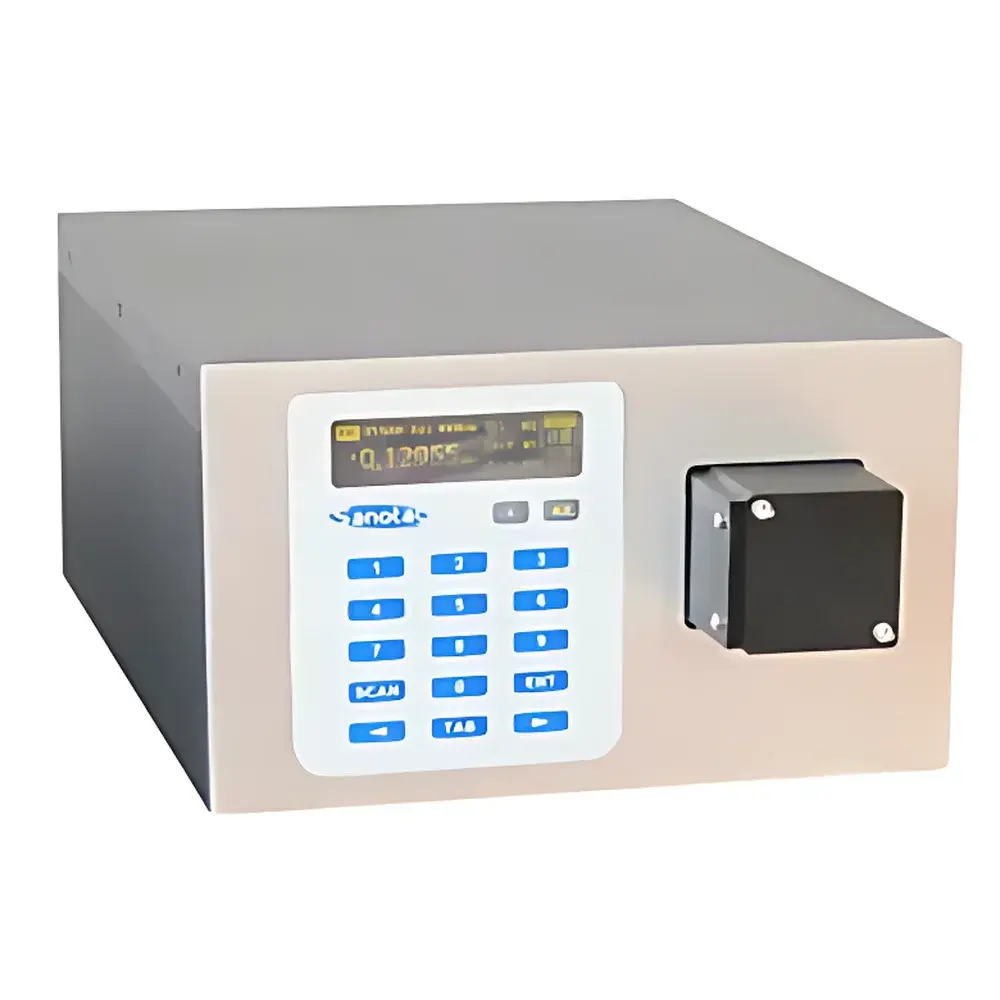
Sanotac UV-2001 Full-Range UV-Vis Detector
| Brand | Sanotac |
|---|---|
| Model | UV-2001 |
| Origin | Shanghai, China |
| Manufacturer Type | OEM Manufacturer |
| Instrument Type | UV-Vis Chromatographic Detector |
| Wavelength Range | 190–800 nm |
| Detection Mode | Simultaneous Dual-Wavelength Online Detection |
| Light Source | Deuterium Lamp + Tungsten-Halogen Lamp |
| Wavelength Accuracy | ±1 nm |
| Wavelength Repeatability | 0.2 nm |
| Flow Cell Pathlength | Adjustable from 1 to 5 mm |
| Flow Cell Inlet/Outlet | 1/16″ for Analytical & Semi-Preparative |
| Baseline Noise | ±0.5 × 10⁻⁵ AU (254 nm, Time Constant = 1 s) |
| Baseline Drift | 1.5 × 10⁻⁴ AU/h (254 nm) |
| Absorbance Range | ≥3 AU |
| Time Constants | 0.1 / 0.2 / 0.5 / 1.0 / 2.0 / 5.0 / 10.0 s |
| Digital Zero Adjustment | Full-Scale Auto-Zero |
| Display | 256 × 64-dot Self-Illuminating LCD with Adjustable Backlight |
| Control Interface | Front-Panel Keypad + RS-232 / USB Computer Remote Control (Open Protocol) |
| Power Supply | 85–264 VAC, 50/60 Hz, 150 W |
Overview
The Sanotac UV-2001 Full-Range UV-Vis Detector is an analytical-grade, dual-wavelength absorbance detector engineered for integration with high-performance liquid chromatography (HPLC), preparative HPLC, medium-pressure chromatography (MPLC), and protein purification systems. It operates on the principle of Beer–Lambert absorption spectroscopy, measuring analyte concentration through ultraviolet and visible light attenuation across a continuous spectral range from 190 nm to 800 nm. The dual-optical-path architecture—comprising a deuterium lamp for deep-UV performance (190–350 nm) and a tungsten-halogen lamp for visible-range stability (350–800 nm)—ensures seamless spectral coverage without manual lamp switching or calibration interruption. Designed for regulatory-compliant laboratories, the UV-2001 supports GLP/GMP workflows via hardware-level digital zeroing, stable baseline performance, and traceable wavelength accuracy (±1 nm) validated against NIST-traceable standards.
Key Features
- Dual-lamp optical system with automatic lamp selection and intensity balancing for uninterrupted 190–800 nm operation
- Simultaneous dual-wavelength detection capability enables real-time ratio monitoring (e.g., A260/A280 for nucleic acid/protein purity assessment)
- Adjustable flow cell pathlength (1–5 mm) optimized for both low-volume analytical columns (e.g., 2.1 mm ID) and high-flow preparative systems (up to 50 mL/min)
- Three programmable wavelength scanning modes: full-spectrum scan, fixed-wavelength tracking, and peak-absorbance auto-search
- Open RS-232 and USB communication protocol compliant with ASTM E1319 and ISO/IEC 17025 data exchange requirements
- Self-illuminating 256 × 64-dot LCD with wide-viewing-angle uniformity and adjustable backlight for ambient-light flexibility
- Hardware-based digital zero function with full-scale baseline reset—critical for long-duration gradient runs and method transfer validation
Sample Compatibility & Compliance
The UV-2001 accommodates a broad spectrum of UV-absorbing analytes including aromatic compounds, conjugated dienes, peptides, nucleotides, pharmaceutical intermediates, and natural product isolates. Its modular flow cell interface supports standard HPLC tubing (1/16″ OD) and preparative configurations (1/8″ OD), eliminating the need for external flow splitters during scale-up. All wetted surfaces are chemically resistant stainless steel and fused silica, compatible with common mobile phases (acetonitrile, methanol, aqueous buffers, 0.1% TFA). The detector meets electromagnetic compatibility (EMC) requirements per IEC 61326-1 and safety standards per IEC 61010-1. Its baseline stability (<1.5 × 10⁻⁴ AU/h drift at 254 nm) and noise floor (±0.5 × 10⁻⁵ AU) satisfy USP and EP 2.2.45 specifications for HPLC detector qualification.
Software & Data Management
The UV-2001 operates in standalone mode via front-panel keypad navigation or integrates into third-party chromatography data systems (CDS) such as Chromeleon, Empower, or OpenLab via its documented ASCII-based command set. All instrument parameters—including time constant, wavelength, gain, and zero offset—are remotely configurable and logged with timestamped audit trails. Data output conforms to AIA/ANDI format (Analytical Instrument Association/Analytical Data Interchange), ensuring interoperability with LIMS and electronic lab notebook (ELN) platforms. Firmware supports 10 user-defined methods with persistent storage, enabling rapid reconfiguration between QC release testing, stability studies, and R&D method development. Optional firmware upgrades provide FDA 21 CFR Part 11-compliant electronic signature support and role-based access control.
Applications
- Quantitative analysis of small-molecule APIs in HPLC method validation per ICH Q2(R2)
- Real-time monitoring of protein elution profiles during FPLC and AKTA-based purification
- Simultaneous detection of co-eluting impurities and degradation products using dual-wavelength ratio algorithms
- Nucleic acid quantification and purity assessment (A260/A280, A260/A230) in oligonucleotide synthesis QC
- Method transfer from analytical to semi-preparative scale without recalibration due to pathlength adjustability
- Online detection in centrifugal partition chromatography (CPC) and high-speed counter-current chromatography (HSCCC)
FAQ
What is the minimum detectable absorbance change under standard operating conditions?
The detector achieves a signal-to-noise ratio (S/N) ≥3 at 0.5 × 10⁻⁵ AU, corresponding to sub-nanogram detection limits for typical UV-absorbing compounds when coupled with 4.6 mm ID analytical columns.
Is the wavelength calibration traceable to international standards?
Yes—wavelength accuracy is verified using holmium oxide and didymium reference filters certified to NIST SRM 2034 and SRM 2035, with factory calibration reports provided upon request.
Can the UV-2001 be used with aggressive solvents such as THF or chloroform?
The standard flow cell is rated for all common HPLC solvents except halogenated hydrocarbons above 10% v/v; optional PEEK- or Hastelloy-bodied flow cells are available for extended chemical resistance.
Does the instrument support GMP audit trail functionality?
With optional firmware version 2.3+, the UV-2001 logs all parameter changes, method executions, and calibration events with operator ID, timestamp, and reason-for-change fields—fully compliant with Annex 11 and ALCOA+ data integrity principles.
How is baseline stability maintained during temperature fluctuations?
The optical bench incorporates passive thermal mass stabilization and active lamp current regulation, reducing thermal drift impact; baseline drift remains within specification over ambient ranges of 15–30 °C without external oven control.






