
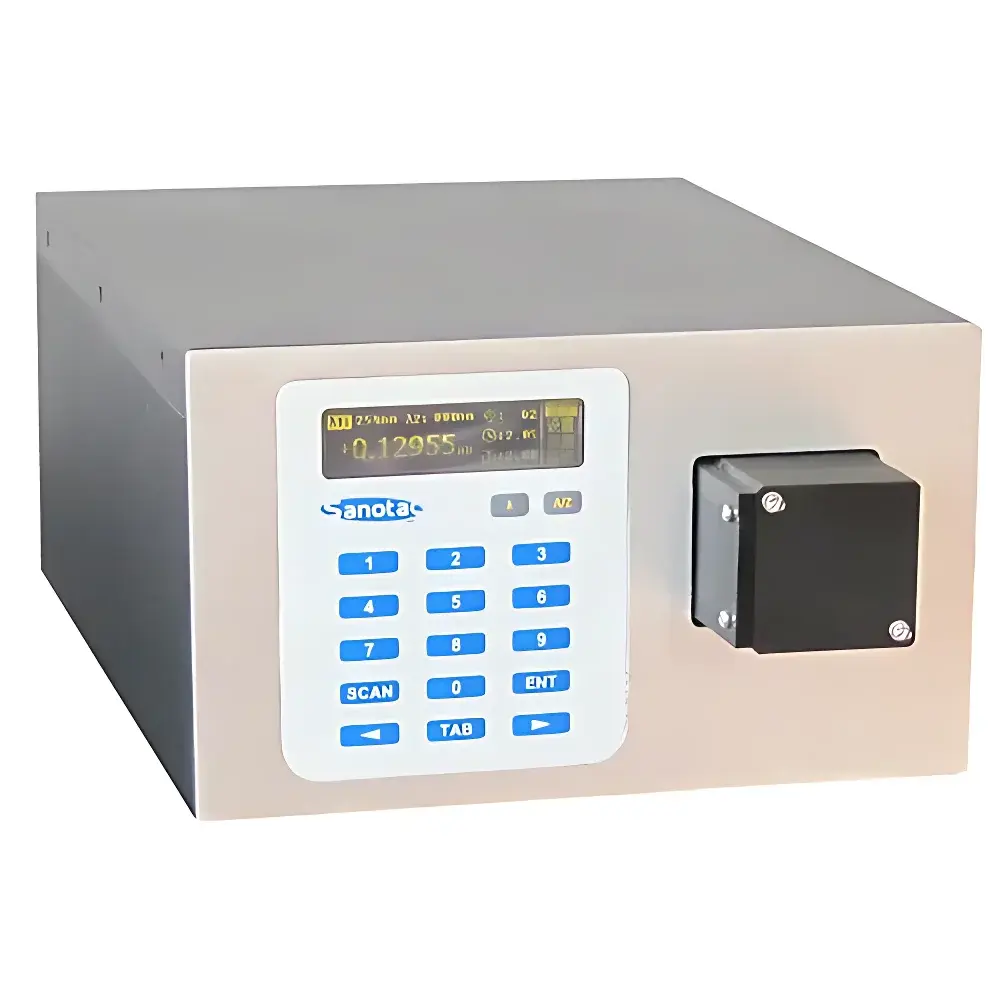
Sanotac UV1001 Dual-Wavelength UV-Vis Detector
| Brand | Sanotac |
|---|---|
| Origin | Shanghai, China |
| Manufacturer Type | Manufacturer |
| Product Category | Domestic |
| Model | UV1001 |
| Price Range | USD 1,400–2,800 (FOB) |
| Compatible Instrument | HPLC Systems |
| Instrument Type | UV-Vis Absorbance Detector |
| Wavelength Range | 190–700 nm |
| Detection Mode | Simultaneous Dual-Wavelength Online Detection |
| Light Source | Deuterium Lamp + Tungsten-Halogen Lamp |
| Wavelength Accuracy | ±1 nm |
| Wavelength Repeatability | 0.2 nm |
| Flow Cell Pathlength | Adjustable from 1 mm to 5 mm |
| Flow Cell Inlet/Outlet | 1/16" for Analytical & Semi-Prep |
| Baseline Noise | ±0.5 × 10⁻⁵ AU (254 nm, TC = 1 s) |
| Baseline Drift | 1.5 × 10⁻⁴ AU/h (254 nm) |
| Full-Scale Range | ≥3 AU |
| Time Constants | 0.1 / 0.2 / 0.5 / 1.0 / 2.0 / 5.0 / 10.0 s |
| Zero Adjustment | Digital Full-Scale Auto-Zero |
| Display | 256 × 64 Dot Matrix OLED, Self-Illuminating, Adjustable Backlight |
| Control Interface | Front Panel Keypad + RS-232 / USB Serial Communication (Open Protocol) |
| Power Supply | 85–264 VAC, 50/60 Hz, 150 W |
Overview
The Sanotac UV1001 Dual-Wavelength UV-Vis Detector is an analytical-grade absorbance detector engineered for high-performance liquid chromatography (HPLC) systems. It operates on the principle of ultraviolet–visible (UV-Vis) spectrophotometry, measuring analyte concentration via Beer–Lambert law-based absorbance at selected wavelengths across a broad spectral range (190–700 nm). Its dual-beam optical architecture—comprising a deuterium lamp for deep-UV output (190–350 nm) and a tungsten-halogen lamp for visible-range stability (350–700 nm)—ensures continuous spectral coverage without manual lamp switching. The detector supports simultaneous dual-wavelength acquisition, enabling real-time ratio monitoring (e.g., A260/A280 for protein/nucleic acid purity assessment), peak purity evaluation, and interference correction in complex matrices. Designed specifically for compatibility with standard analytical and semi-preparative HPLC platforms, the UV1001 delivers robust baseline stability, low electronic noise, and high photometric linearity—critical for quantitative compliance under GLP, GMP, and FDA 21 CFR Part 11 environments.
Key Features
- Dual-lamp optical system with automatic lamp selection and seamless spectral transition between 190–700 nm
- Simultaneous dual-wavelength detection mode with independent gain and time constant settings per channel
- Adjustable flow cell pathlength (1–5 mm) optimized for analytical sensitivity or preparative throughput without flow splitting
- High-precision stepper-motor-driven monochromator with ±1 nm wavelength accuracy and 0.2 nm repeatability
- Three operational scan modes: fixed-wavelength, wavelength-programmed gradient, and stop-flow spectral scanning
- Open RS-232/USB communication protocol supporting third-party chromatography data systems (CDS), including Chromeleon, Empower, and OpenLab
- Digital full-scale auto-zero function eliminating mechanical zero-drift and enhancing long-term measurement reproducibility
- OLED display (256 × 64 pixels) with uniform luminance, wide viewing angle, and user-configurable backlight intensity
Sample Compatibility & Compliance
The UV1001 accommodates a broad spectrum of UV-absorbing compounds—including aromatic hydrocarbons, conjugated dienes, peptides, nucleotides, pharmaceutical actives, and natural product isolates—without derivatization. Its modular flow cell design supports interchangeable cells: standard 1/16″ stainless steel fittings for analytical columns (ID ≤ 4.6 mm), and 1/8″ ports for semi-preparative and preparative applications (ID ≥ 10 mm). All wetted surfaces are chemically inert (316L SS, fused silica, PEEK), compatible with common HPLC mobile phases (aqueous buffers, acetonitrile, methanol, THF). The instrument meets key international performance benchmarks defined in ASTM E275, ISO 17025 (when operated within validated methods), and USP for chromatographic detectors. Its digital signal chain and audit-trail-capable firmware support regulatory submissions requiring traceable calibration history and user-access logs.
Software & Data Management
While the UV1001 operates autonomously via front-panel control, its open serial protocol enables bidirectional integration with industry-standard CDS platforms. Raw absorbance data (AU vs. time) is transmitted in ASCII format at user-defined sampling rates (up to 10 Hz), preserving full dynamic range and time-stamped metadata (wavelengths, time constants, lamp status). Internal memory stores up to 10 user-defined method templates—including wavelength pairs, time constants, and zero-reference points—for rapid reconfiguration. Firmware supports remote firmware updates and diagnostic self-tests (lamp energy check, dark current verification, baseline stability validation). When deployed in regulated laboratories, the detector’s deterministic response and non-volatile parameter storage align with ALCOA+ data integrity principles—ensuring attributable, legible, contemporaneous, original, accurate, complete, consistent, enduring, and available records per FDA and EMA guidance.
Applications
- Quantitative analysis of small-molecule APIs and impurities in pharmaceutical QC workflows (ICH Q2(R2)-compliant validation)
- Monitoring elution profiles during protein purification (e.g., IgG capture on Protein A columns at 280 nm and aggregate detection at 214 nm)
- Simultaneous detection of nucleic acid (260 nm) and protein (280 nm) in SEC-MALS or FPLC fractions
- Method development for multi-component herbal extracts using wavelength-switching and peak-purity algorithms
- In-process control of chiral separations where enantiomer-specific UV spectra require dual-channel correlation
- Stability-indicating assays tracking degradation products via time-resolved spectral scanning at column effluent
FAQ
What is the maximum data acquisition rate supported by the UV1001?
The detector transmits absorbance data at up to 10 Hz over RS-232 or USB, sufficient for sub-second peak resolution in UHPLC applications.
Can the flow cell be cleaned in place (CIP) with strong solvents?
Yes—the flow cell assembly is rated for exposure to 100% organic solvents, 0.1 M NaOH, and 0.1 M HCl; however, prolonged exposure to >0.5 M alkaline solutions is not recommended.
Does the UV1001 support compliance with FDA 21 CFR Part 11?
The hardware itself does not include electronic signatures or role-based access control; however, when integrated with a validated CDS that implements Part 11 controls, the UV1001 contributes fully auditable raw signal data with immutable timestamps and configuration logs.
Is lamp alignment required after replacement?
No—lamps are factory-aligned and secured in precision-machined sockets; replacement requires only electrical connection verification and automatic energy calibration via built-in diagnostics.
How is wavelength calibration verified during routine operation?
The instrument performs automated wavelength verification using internal holmium oxide and didymium oxide reference filters at startup and upon user request, generating a calibration report traceable to NIST-traceable standards.




