
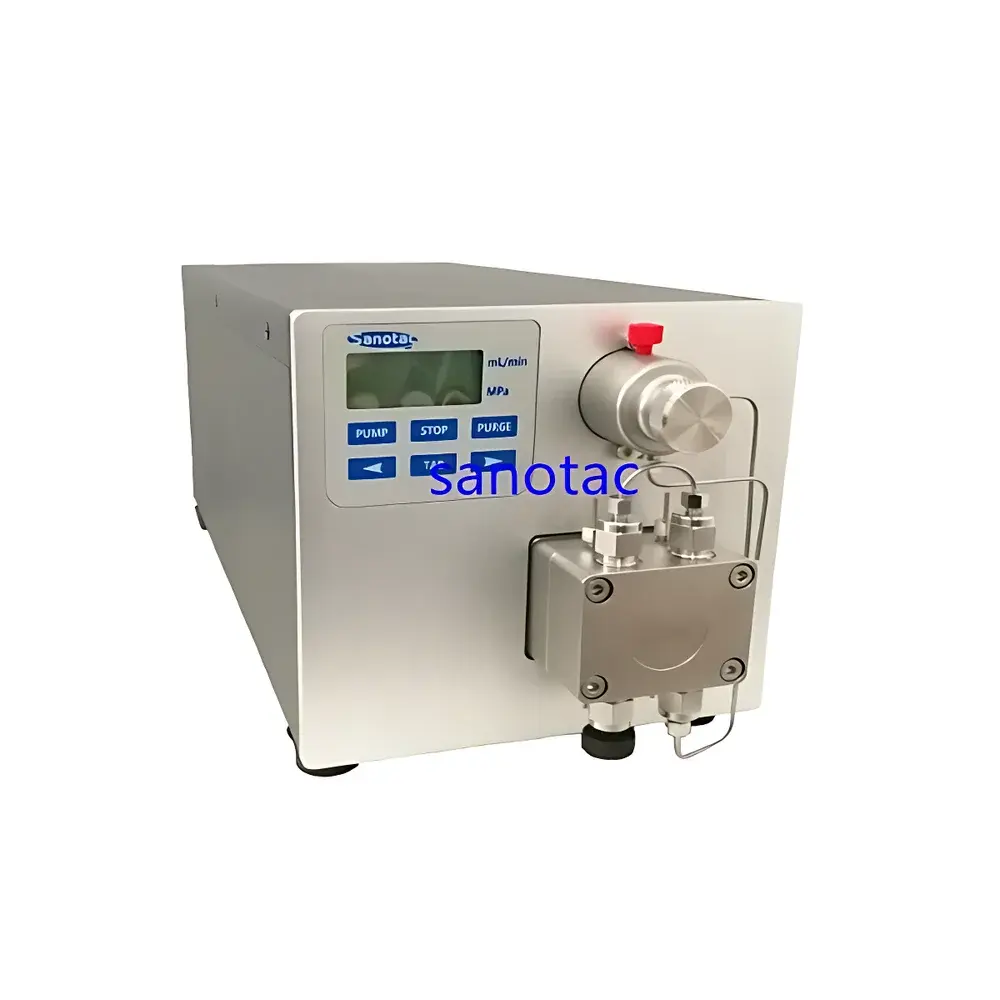
Sanotac WH-50 High-Precision Constant Flow Nebulization System with Dual-Piston Parallel Pump
| Key | Brand: Sanotac |
|---|---|
| Origin | Shanghai, China |
| Manufacturer Type | OEM/ODM Manufacturer |
| Country of Origin | China |
| Model | WH-50 |
| Flow Range | 0.01–50.00 mL/min |
| Flow Increment | 0.01 mL/min |
| Flow Accuracy | ±0.5% |
| Flow RSD | ≤0.1% |
| Max Pressure | 30 MPa |
| Pressure Pulsation | ≤0.2 MPa |
| Wetted Materials | 316L SS, Sapphire, PTFE, Ceramic |
| Tubing Connection | 1/16" Standard |
| Display | 256×64 Dot Matrix Backlit LCD |
| Control | Front Panel or RS232/Ethernet Remote (Open Protocol) |
| Power | 85–264 VAC, 50 Hz |
| Dimensions | 370 × 240 × 152 mm |
Overview
The Sanotac WH-50 High-Precision Constant Flow Nebulization System is an integrated laboratory-scale fluid delivery and atomization platform engineered for reproducible, low-pulse chemical aerosol generation under controlled pressure and flow conditions. Built around a dual-piston parallel high-pressure metering pump with floating plunger architecture, the system delivers stable volumetric flow across a wide dynamic range (0.01–50.00 mL/min) at pressures up to 30 MPa. Its core principle relies on positive displacement pumping combined with real-time solvent compressibility compensation and multi-point flow calibration—enabling consistent nebulization performance essential for applications such as spray drying precursor delivery, inhalation formulation screening, catalyst precursor atomization, and microreactor feed control. Unlike peristaltic or syringe-based systems, the WH-50 eliminates pulsation-induced droplet size variability through cam-profile optimization and active electronic pulse suppression, ensuring uniform aerosol morphology when interfaced with precision spray nozzles (e.g., two-fluid, ultrasonic, or pressure-swirl atomizers).
Key Features
- Dual-piston parallel pumping mechanism with floating plunger design—reduces seal wear and extends service life of high-pressure wetted components.
- Microprocessor-controlled flow regulation with multi-point calibration curves across the full operating range (0.01–50 mL/min), achieving ±0.5% flow accuracy and ≤0.1% RSD.
- Low-pressure pulsation (<0.2 MPa) enabled by optimized cam geometry and real-time electronic pulse damping—critical for stable droplet formation in sensitive nebulization processes.
- Chemically resistant fluid path constructed from 316L stainless steel, sapphire check valves, PTFE seals, and ceramic plungers—compatible with aggressive solvents, acids, bases, and halogenated media.
- Open-protocol remote control interface (RS232/Ethernet) supporting integration with third-party chromatography data systems (CDS), LIMS, or custom automation frameworks.
- Front-panel operation with backlit 256×64 dot-matrix display and 10 programmable user methods—including gradient profiles (isocratic, linear, step) for time-resolved spray composition modulation.
Sample Compatibility & Compliance
The WH-50 system accommodates a broad spectrum of liquid-phase samples including aqueous buffers, organic solvents (e.g., methanol, DMF, THF), viscous polymer solutions (<500 cP), suspensions (≤5 µm particle size), and corrosive reagents (e.g., HCl, HNO₃, HF-diluted formulations). All wetted materials comply with USP Class VI and ISO 10993-5 biocompatibility standards. The pump architecture meets mechanical safety requirements per IEC 61010-1 for laboratory equipment. When deployed in regulated environments (e.g., pharmaceutical development labs), the open communication protocol supports audit-trail-capable integration with 21 CFR Part 11–compliant software platforms. Optional documentation packages include Factory Acceptance Test (FAT) reports, material traceability certificates (EN 10204 3.1), and pressure vessel compliance statements for ASME B31.3 process piping integration.
Software & Data Management
The WH-50 operates natively via its embedded firmware, supporting standalone method programming and real-time parameter monitoring. For automated workflows, Sanotac provides an open ASCII-based command set compatible with LabVIEW, Python (PySerial), MATLAB, and commercial CDS platforms (e.g., Empower, Chromeleon, OpenLab). Logged operational data—including flow rate, pressure, temperature (via optional external sensor input), and alarm status—is timestamped and exportable in CSV format. Firmware updates are performed via USB or Ethernet, with version rollback capability. All configuration changes generate immutable event logs stored in non-volatile memory—supporting GLP/GMP traceability requirements for method validation and equipment qualification (IQ/OQ/PQ).
Applications
- Pharmaceutical: Precise delivery of API solutions to lab-scale spray dryers and inhalation test systems (e.g., Andersen Cascade Impactors).
- Materials Science: Controlled atomization of metal-organic precursors for flame spray pyrolysis (FSP) or aerosol-assisted CVD synthesis.
- Environmental Analysis: Calibration aerosol generation for optical particle counters and condensation particle counters (CPCs).
- Food & Cosmetics: Emulsion and flavor encapsulation studies using microfluidic or ultrasonic nebulizers.
- Academic Research: Fundamental studies of droplet breakup dynamics, evaporation kinetics, and jet instability under variable Reynolds/Weber numbers.
- Quality Control: Reproducible sample introduction into ICP-MS, ICP-OES, or laser ablation systems requiring pulse-free carrier gas entrainment.
FAQ
What nozzle types are compatible with the WH-50 system?
The WH-50 interfaces with standard 1/16″ tubing and supports all commercially available nebulizer heads rated for ≤30 MPa inlet pressure—including two-fluid, ultrasonic, pressure-swirl, and effervescent nozzles.
Can the WH-50 be used with viscous or particulate-laden fluids?
Yes—provided suspended particles are ≤5 µm and fluid viscosity remains below 500 cP at operating temperature; optional 5 µm in-line filters and heated manifold kits are available.
Is firmware update support provided after purchase?
Yes—Sanotac offers lifetime firmware updates via secure download portal, with change logs and validation notes provided for each release.
Does the system meet regulatory requirements for GMP environments?
While the hardware itself is not certified as GMP-compliant, its open-control architecture and audit-trail-ready data logging enable seamless integration into validated workflows compliant with FDA 21 CFR Part 11, EU Annex 11, and ISO/IEC 17025.
What maintenance intervals are recommended?
Plunger seals and check valves should be inspected every 500 operational hours; full recalibration is advised annually or after any component replacement affecting flow path integrity.



