
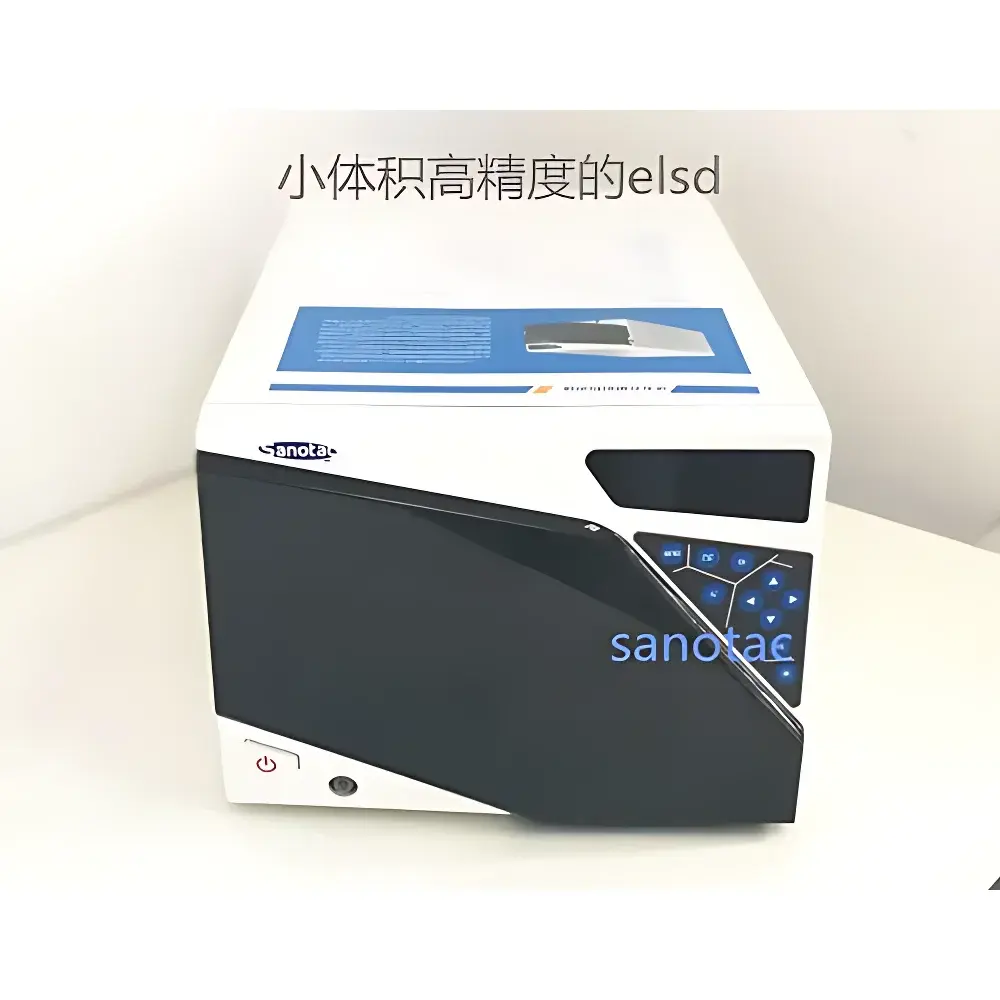
Sanotac Z9000 Evaporative Light Scattering Detector (ELSD) for Pharmacopoeial Analysis of TCM Active Ingredients
| Brand | Sanotac |
|---|---|
| Model | Z9000 |
| Detector Type | Evaporative Light Scattering Detector (ELSD) |
| Wavelength | 650 nm |
| Detection Principle | Low-Temperature Evaporation Mode |
| Light Source | Semiconductor Laser |
| Temperature Control Accuracy | ±1 °C |
| Evaporator Temp Range | Ambient to 150 °C (1 °C increment) |
| Nebulizer Temp Range | Ambient to 60 °C (1 °C increment) |
| Gas Flow Range | 1–4 L/min (±1% or ±0.02 L/min) |
| Mobile Phase Flow Rate | 0.01–3 mL/min |
| Baseline Noise | ≤0.01 mV |
| Baseline Drift | ≤0.2 mV/30 min |
| Quantitative Repeatability (RSD₆) | ≤1.5% |
| Minimum Detectable Mass | 0.5 ng |
| Typical Linear Quantitation Range | 0.1–30 μg |
| Analog Output | −1200 to +1200 mV with adjustable offset (−1000 to +1000 mV) and gain (0.3–30×) |
| Digital Output Rate | 20 Hz |
| Data Interface | RS-232, RS-485, USB, LAN (TCP/HTTP) |
| Software Compliance | FDA 21 CFR Part 11 with audit trail |
| Power Supply | 85–264 VAC, 50 Hz |
| Dimensions (W×H×D) | 260×190×460 mm |
| Weight | 10 kg |
Overview
The Sanotac Z9000 Evaporative Light Scattering Detector (ELSD) is a high-performance, universal mass-sensitive detector engineered for robust integration with HPLC, preparative LC, and medium-pressure chromatography systems. Operating on the principle of nebulization, solvent evaporation, and light scattering detection, the Z9000 detects non-volatile and semi-volatile analytes—including saponins, flavonoids, alkaloids, polysaccharides, lipids, and synthetic polymers—without requiring chromophores or derivatization. Its low-temperature evaporation mode minimizes thermal degradation of thermolabile compounds, making it especially suitable for pharmacopoeial compliance testing of Traditional Chinese Medicine (TCM) active ingredients as specified in the Chinese Pharmacopoeia (ChP), United States Pharmacopeia (USP), and European Pharmacopoeia (Ph. Eur.). The detector employs a 650 nm, 30 mW semiconductor laser and a high-gain photomultiplier tube (PMT) to ensure stable signal generation across wide dynamic concentration ranges.
Key Features
- Compact horizontal architecture with optimized internal thermal field design for spatial efficiency and operational safety
- Dual-stage temperature control: independently adjustable evaporator (ambient to 150 °C) and nebulizer (ambient to 60 °C), both with ±1 °C accuracy and 1 °C resolution
- Integrated drift tube auxiliary cooling system enabling rapid method switching and consistent baseline recovery
- Front-accessible nebulizer tube for real-time visual inspection and simplified maintenance
- 16-point self-diagnostic routine covering gas pressure, heater status, laser output, PMT voltage, and flow integrity
- Programmable external event interface supporting automated zeroing, laser shutdown, gas valve actuation, and heater modulation
- Energy-efficient operation with standby mode reducing nitrogen consumption by >50% and lowering power draw during idle periods
Sample Compatibility & Compliance
The Z9000 reliably detects analytes lacking UV absorbance or electrochemical activity—including glycosides, terpenoids, fatty acids, surfactants, and macromolecules—common in botanical extracts, fermentation broths, and polymer synthesis workflows. It supports pharmacopoeial methods requiring mass-based quantitation where UV detection fails due to poor extinction coefficients or spectral overlap. The detector complies with GLP/GMP-aligned data integrity requirements: its embedded Sanotac Chromatography Software implements full FDA 21 CFR Part 11 compliance, including electronic signatures, role-based access control, immutable audit trails, and secure user authentication. All instrument parameters, method files, and raw signal data are timestamped, version-controlled, and exportable in vendor-neutral formats (e.g., CSV, .cdf) for third-party review or regulatory submission.
Software & Data Management
Sanotac’s dedicated chromatography software provides intuitive method development, real-time signal monitoring, peak integration, and calibration curve generation. It supports up to 10 stored methods, each containing 25 configurable parameters—including temperature ramps, gas flow profiles, gain settings, and event triggers. Raw analog output (−1200 to +1200 mV) is digitized at 20 Hz with selectable gain (0.3–30×) and programmable offset (−1000 to +1000 mV). The detector offers simultaneous analog and digital output via RS-232, RS-485, USB, and Ethernet (TCP/HTTP), enabling seamless integration with legacy and modern data systems—including Empower, Chromeleon, OpenLab CDS, and custom LabVIEW or Python-based acquisition platforms.
Applications
- Quantitative analysis of ChP-listed TCM markers (e.g., ginsenosides, puerarin, berberine, and astragalosides) in crude extracts and finished products
- Stability-indicating assays for degradation-prone natural products under ICH Q1–Q5 conditions
- Method development and validation per ICH Q2(R2) for ELSD-based release testing in herbal pharmaceutical manufacturing
- Characterization of oligosaccharide and glycoprotein fractions in bioprocess intermediates
- Residual solvent and excipient profiling in generic drug formulations where UV-inactive components dominate
FAQ
Does the Z9000 support gradient elution without baseline disturbance?
Yes—the integrated drift tube cooling system and precise gas flow regulation minimize thermal lag and aerosol density fluctuations, enabling stable baselines across binary and ternary gradients.
Can the Z9000 be validated for GMP production environments?
Yes—its firmware and software comply with FDA 21 CFR Part 11, include full audit trail logging, and support IQ/OQ/PQ documentation packages upon request.
What carrier gases are compatible, and how is gas purity monitored?
Clean dry nitrogen or compressed air (oil-free, dew point ≤ −40 °C) is required; built-in pressure transducers with 0.01 bar resolution continuously monitor inlet pressure and trigger alarms if deviations exceed user-defined thresholds.
Is remote diagnostics and firmware update supported?
Yes—LAN connectivity enables secure remote access via HTTP for configuration review, log export, and over-the-air firmware updates compliant with ISO/IEC 17025 traceability requirements.
How does the Z9000 handle high-salt mobile phases commonly used in ion-pair chromatography?
The nebulizer geometry and optimized evaporation chamber design reduce salt deposition; optional heated nebulizer tip and angled雾化管 (nebulizer tube) alignment further suppress crystallization and extend service intervals between cleanings.
Related Products



