
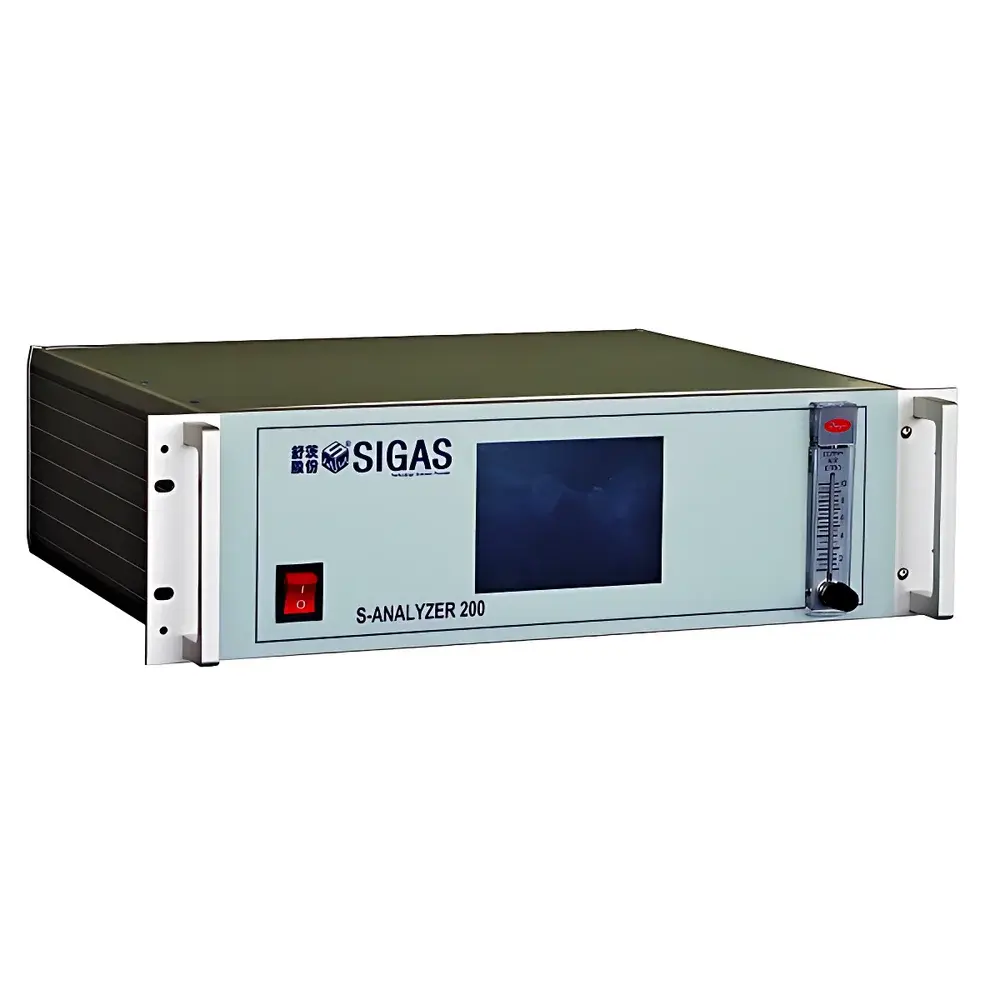
Schütz S-ANALYZER 200 CEMS Flue Gas Analyzer
| Brand | Schütz / SIGAS |
|---|---|
| Origin | Jiangsu, China |
| Model | S-ANALYZER 200 |
| Instrument Type | Continuous Emission Monitoring System (CEMS) |
| Measurement Principle | Non-Dispersive Infrared (NDIR) Spectroscopy |
| Accuracy | ±<2% FS |
| Repeatability | ≤±1% FS |
| Response Time | T90 < 2 s (at 60 L/h sample flow) |
| Long-Term Stability | <2% FS drift over 30 days |
| Gas Components | SO₂, NOₓ, CO, CO₂ (up to 7 components total) |
| Display | 7-inch capacitive touchscreen with triple-screen interface |
| Calibration Options | Zero, span, and third-point calibration (35–75% FS) |
| Language Support | English & Chinese |
| Enclosure | 19-inch rack-mount chassis (4U height) |
| Compliance | Designed for ISO 14001-aligned monitoring |
Overview
The Schütz S-ANALYZER 200 is a rack-mounted, multi-component flue gas analyzer engineered for continuous emission monitoring system (CEMS) applications in industrial combustion processes, waste incineration, power generation, and cement kiln operations. It employs non-dispersive infrared (NDIR) spectroscopy—a well-established, interference-resistant optical absorption technique—to quantify gaseous pollutants in real time. Each analyte—SO₂, NOₓ (NO + NO₂), CO, CO₂, and up to three additional configurable components—is measured using dedicated, temperature-stabilized S-MODULE or SAE-MODULE infrared sensor units. These modules integrate high-luminance IR sources, precision optical filters, and low-noise photodetectors to deliver stable baseline performance under fluctuating stack conditions. The analyzer operates within a defined sample flow rate of 60 L/h and is calibrated against certified reference gases traceable to NIST or equivalent national standards. Its architecture meets the foundational functional requirements of EN 15267-3 and EN 14181 for automated monitoring systems, supporting both QAL1 (initial type approval) and AST (annual surveillance testing) documentation workflows.
Key Features
- Rack-integrated 19-inch 4U chassis with front-access service panel and integrated sample conditioning interface (particulate filtration, moisture removal, and pressure regulation)
- 7-inch capacitive touchscreen display with intuitive triple-screen navigation: (1) real-time concentration readouts for three user-selected gases, (2) comprehensive parameter view including temperature, pressure, flow rate, and sensor status, and (3) dynamic concentration trend curves with adjustable time scale (1 min to 24 h)
- Three-point calibration protocol (zero, span, and mid-range) with programmable third-point constraint (35–75% FS) to enhance linearity across the full measurement range
- Role-based access control: password-protected calibration menus, alarm threshold configuration, and system reset functions to prevent unauthorized modification
- Bilingual UI (English/Chinese) with context-sensitive help tooltips and standardized IEC 61508-compliant alarm hierarchy (warning, fault, critical)
- Factory-reset function accessible via software menu—eliminates need for hardware intervention after configuration errors
- Embedded diagnostics including sensor health monitoring, optical path integrity checks, and automatic zero-drift compensation algorithms
Sample Compatibility & Compliance
The S-ANALYZER 200 accepts conditioned extractive gas samples with operating temperatures from 0 to 50 °C and dew point ≤5 °C. It is compatible with standard heated sample lines (120–180 °C) and common conditioning systems (e.g., permeation dryers, chiller-based condensers, or Nafion® dryers). All gas inlet connections conform to ISO 15767 thread specifications. While not certified to EPA PS-11 or MCERTS as a standalone unit, the analyzer is designed to integrate into full CEMS configurations compliant with 40 CFR Part 60, Subpart JJJJ (for stationary engines) and Subpart GG (for boilers), provided ancillary components—including probe, heated line, and data acquisition system—meet applicable QA/QC requirements. Data output supports Modbus RTU/TCP and analog 4–20 mA outputs per channel, enabling seamless integration with DCS, SCADA, or third-party CEMS reporting platforms.
Software & Data Management
The embedded firmware includes a timestamped data logger with ≥30 days of on-device storage (configurable sampling interval: 1–60 seconds). Logged parameters include raw absorbance values, compensated concentration outputs, calibration timestamps, alarm events, and environmental sensor readings (internal temperature/humidity). Export is supported via USB mass storage or Ethernet file transfer (CSV format). Audit trails record all user actions—including login/logout, calibration execution, and configuration changes—with operator ID and ISO 8601 timestamps. Optional PC-based configuration tool (Schütz ConfigStudio v3.x) provides remote setup, firmware updates, and diagnostic report generation. Data integrity conforms to ALCOA+ principles (Attributable, Legible, Contemporaneous, Original, Accurate, Complete, Consistent, Enduring, Available) and supports 21 CFR Part 11 readiness when deployed with external electronic signature infrastructure.
Applications
- Regulatory compliance monitoring for SO₂, NOₓ, CO, and CO₂ emissions from coal-fired and gas-fired boilers
- Process optimization in cement clinker production—tracking O₂ and CO for combustion efficiency control
- Waste-to-energy plant stack monitoring with simultaneous detection of HCl and HF (when configured with optional electrochemical sensors)
- QA/QC verification of scrubber and SCR system performance through pre- and post-treatment gas comparisons
- Research-grade flue gas characterization in pilot-scale combustion test rigs requiring sub-second response dynamics
- Mobile CEMS validation campaigns where rapid deployment, touchscreen operability, and robust mechanical packaging are essential
FAQ
What gas components can the S-ANALYZER 200 measure simultaneously?
It measures up to seven components concurrently, with standard configurations covering SO₂, NOₓ, CO, CO₂, O₂, CH₄, and H₂O (as vapor concentration), depending on module selection and optical path design.
Is third-party certification available for this analyzer?
The base unit is not independently certified to EPA PS-11 or TÜV Rheinland MCERTS, but it may be included in a full-system CEMS certification when integrated with qualified sampling and conditioning subsystems.
How often does the system require calibration verification?
Per EN 14181, daily zero/span checks are recommended; full multi-point calibration should be performed at least every 15 days or after maintenance, with documented results stored in the internal audit log.
Can the analyzer operate in high-dust environments?
Yes—when paired with an approved heated probe and ceramic filter assembly, it maintains reliable operation in particulate concentrations up to 10 g/m³ (dry basis), typical of cement kiln or biomass boiler stacks.
Does the system support remote diagnostics and firmware updates?
Yes—via secure Ethernet connection using TLS 1.2 encrypted communication; remote access requires prior authorization and network-level firewall configuration per IEC 62443-3-3 guidelines.
Related Products







