
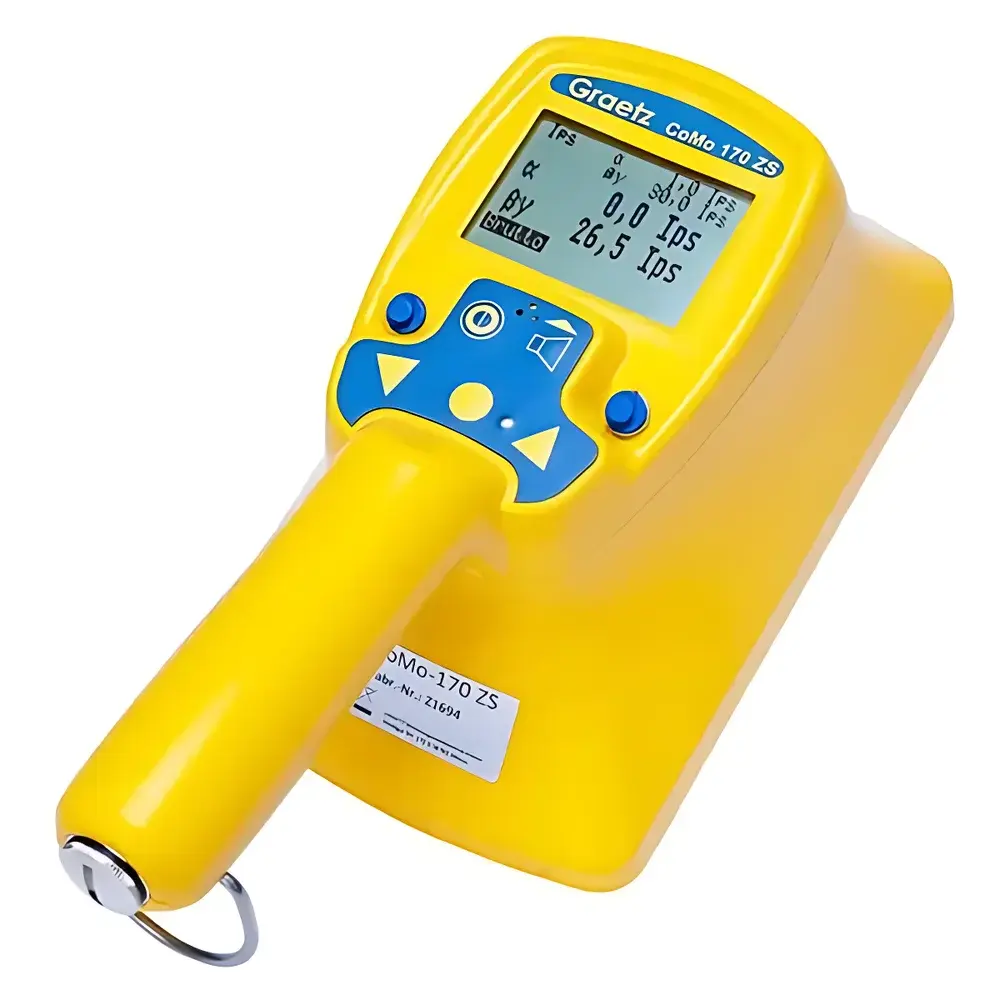
Schutz CoMo 170 Alpha/Beta Surface Contamination Monitor
| Brand | Schutz SIGAS |
|---|---|
| Origin | Germany |
| Model | CoMo 170 Portable High-Sensitivity Alpha/Beta/Gamma Surface Contamination Monitor |
| Detector Type | Plastic Scintillation Detector (Alpha/Beta/Gamma Sensitive) |
| Detection Area | 170 cm² |
| Measurement Units | cps, Bq, Bq/cm² |
| Power Supply | Rechargeable Battery (Portable Operation) |
| Compliance | CE, DIN 6818-1, IEC 60846-1 |
| Optional Accessories | External GM Dose Rate Probe, Desktop Stand, Data Export Software |
Overview
The Schutz CoMo 170 Alpha/Beta Surface Contamination Monitor is a field-deployable, battery-powered radiation survey instrument engineered for rapid, quantitative assessment of alpha-, beta-, and gamma-emitting surface contamination in regulatory, industrial, and emergency response environments. Based on thin-film plastic scintillation detection technology, the CoMo 170 operates without gas fillings, high-voltage biasing, or purge gas systems—eliminating operational dependencies common in gas-proportional or ZnS(Ag)–based alpha detectors. Its 170 cm² active detection area enables statistically robust counting statistics during rapid scanning of large surfaces (e.g., floors, vehicles, PPE, or equipment). The instrument implements nuclide-specific calibration factors traceable to national standards, allowing direct conversion from counts per second (cps) to activity concentration (Bq/cm²) for commonly monitored radionuclides including 239Pu, 241Am, 90Sr/90Y, and 137Cs. Real-time alpha presence verification is performed automatically via pulse-shape discrimination logic embedded in the front-end electronics, ensuring reliable alpha identification even in mixed-field scenarios.
Key Features
- Plastic scintillation detector with intrinsic sensitivity to alpha, beta, and gamma radiation—no gas supply, no quenching agents, no vacuum maintenance required
- 170 cm² large-area detection window optimized for rapid survey coverage and low minimum detectable activity (MDA)
- Automatic alpha recognition algorithm using pulse amplitude and decay time analysis—no manual mode switching needed
- Simultaneous or selective alpha-only / beta-gamma-only measurement modes with independent energy discrimination thresholds
- Five-button ergonomic interface with backlit LCD; all configuration parameters protected by user-defined password
- Onboard non-volatile memory stores up to 10,000 measurement records with timestamp, location tag (optional GPS integration), and operator ID
- Hot-swap compatible design: detector foil replacement is user-serviceable using standard tools—no return-to-factory requirement
- Modular architecture supports optional external probes (e.g., GM-based dose rate probe for H*(10) measurement per IEC 60846-1)
Sample Compatibility & Compliance
The CoMo 170 is validated for use on non-porous and semi-porous surfaces including stainless steel, concrete, painted metal, vinyl flooring, and Tyvek® suits. It complies with DIN 6818-1 (German standard for surface contamination monitoring instruments) and meets essential requirements of IEC 60846-1:2014 for portable radiation protection instrumentation. Calibration certificates are issued with traceability to PTB (Physikalisch-Technische Bundesanstalt) reference sources. For regulated environments—including nuclear medicine departments, decommissioning sites, and NORM handling facilities—the device supports audit-ready data export (CSV/ASCII) compatible with LIMS integration. When used with optional software, full electronic records meet ALARA documentation requirements and support GLP-compliant reporting per ISO/IEC 17025:2017 Annex A.
Software & Data Management
Schutz CoMoView software (Windows-based, USB or Bluetooth connectivity) enables post-processing of stored measurements, spatial mapping of contamination gradients, statistical trend analysis, and automated report generation (PDF/Excel). All data files include cryptographic checksums and immutable timestamps to satisfy FDA 21 CFR Part 11 requirements for electronic records and signatures. Audit trails log every parameter change, calibration event, and user login. Raw spectral data (where applicable) and detector health diagnostics (e.g., background drift, PMT gain stability) are archived alongside measurement values. Optional cloud synchronization allows centralized fleet management for multi-unit deployments across civil defense or utility networks.
Applications
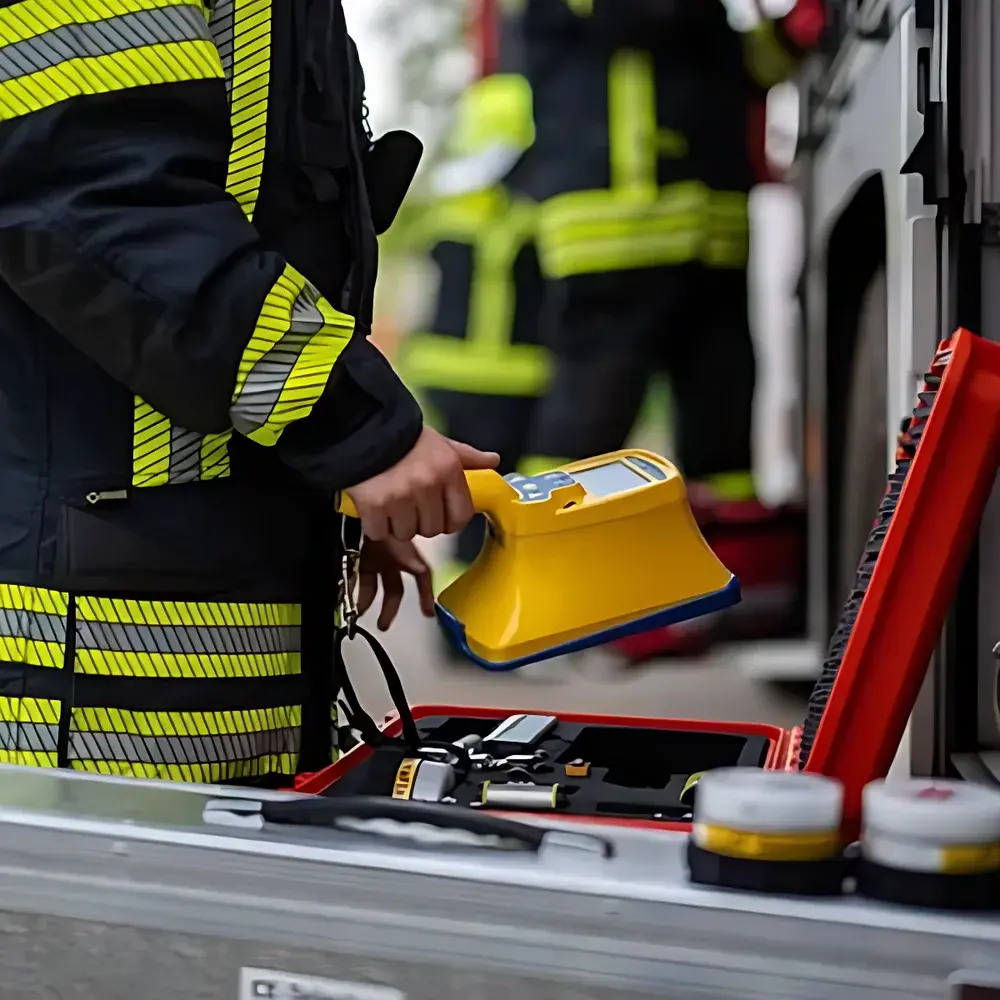
- Civil Defense & Fire Response: Rapid triage of radiological dispersal device (RDD) contamination; pre-entry screening of shelters and evacuation routes
- Nuclear Medicine: Routine wipe test validation for 99mTc, 18F, and 223Ra workstations; QC of fume hoods and syringe shields
- Industrial Radiography: Post-inspection verification of Ir-192 or Se-75 source containment integrity on pipelines and welds
- Research Laboratories: Monitoring of alpha-emitting actinide handling in gloveboxes; beta contamination control in radiochemistry synthesis labs
- Decommissioning & Waste Management: Clearance surveys per IAEA RS-G-1.7; characterization of scrap metal and concrete rubble
FAQ
Does the CoMo 170 require periodic gas refills or detector purging?
No. The plastic scintillator detector is solid-state and operates independently of ambient atmosphere or supplemental gases.
Can the instrument distinguish between 238U and 239Pu based on alpha energy?
No. It provides gross alpha activity quantification; isotopic identification requires alpha spectrometry with silicon PIPS detectors.
What is the typical minimum detectable activity (MDA) for 241Am on stainless steel?
Under standard conditions (10 s count time, background ≤ 0.2 cps), MDA is ≤ 0.08 Bq/cm² (95% confidence, ISO 11929).
Is firmware upgrade supported in the field?
Yes—via USB stick or CoMoView software; version history and digital signature verification ensure integrity.
Does the CoMo 170 meet ANSI N42.33-2022 for radiation detection instrumentation?
It satisfies performance criteria for Category 2 portable contamination monitors per ANSI N42.33-2022 Annex A, including environmental ruggedness (IP54), electromagnetic compatibility (IEC 61000-4 series), and battery endurance (>12 h continuous operation).







