
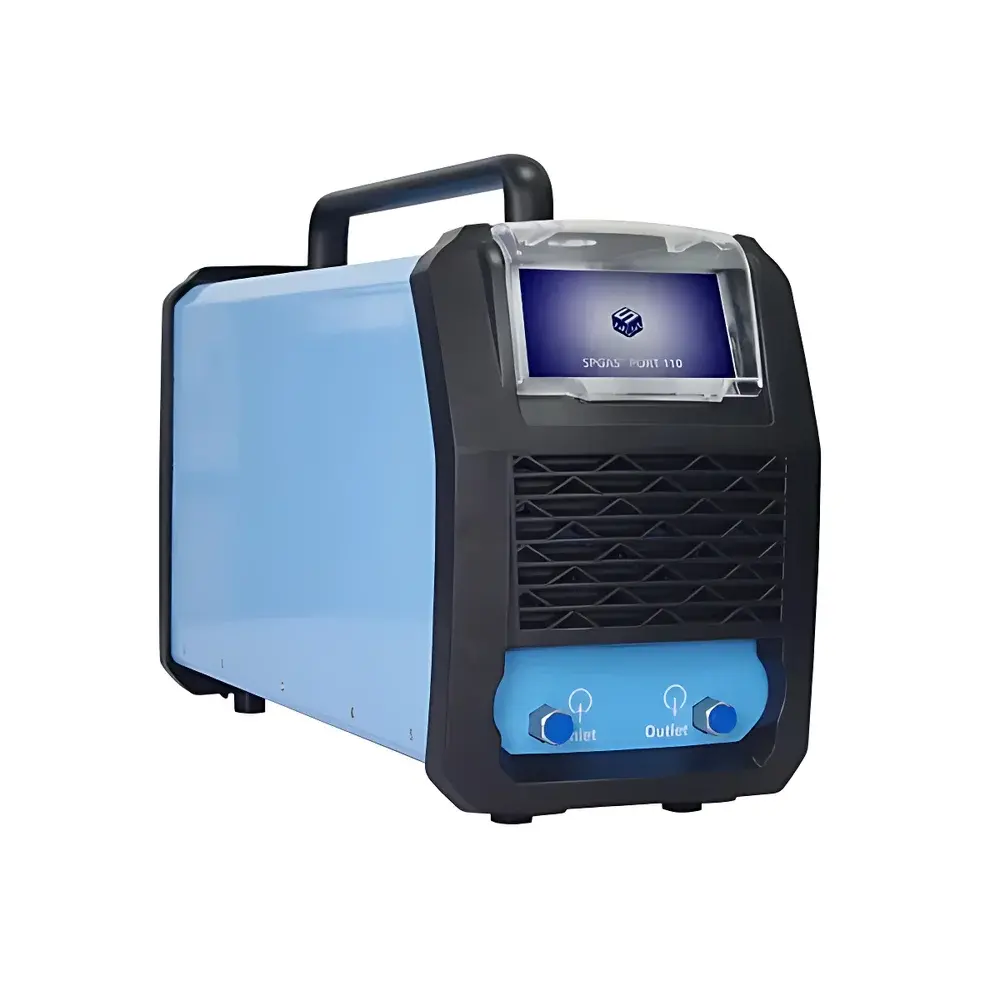
Schütz SPGAS PORT 110 Portable Multicomponent Gas Analyzer
| Brand | Schütz SIGAS |
|---|---|
| Origin | Jiangsu, China |
| Model | SPGAS PORT 110 |
| Type | Portable |
| Response Time | <30 s (t₉₀ @ 36 L/h stable flow) |
| Repeatability | H₂S, SO₂F₂, CH₃Br, CO, CO₂, O₂, etc. |
| Measurement Channels | Up to 3 |
| Display | 4.9" TFT LCD |
| Power | Rechargeable Li-ion battery (≥8 h operation @25°C) |
| Communication | RS232 (DB-9F), USB, optional Bluetooth 2.0 (10 m range, BQB/FCC certified) |
| Safety Certifications | UL 62368-1, CSA C22.2 No. 62368-1, TÜV EN 62368-1, CCC GB4943.1 |
| Preheat Time | NDUV ≤1 h, NDIR ≤15 min, EC ≤10 min (cold start @25°C) |
| Sampling Flow | 3 ± 0.5 L/min (integrated low-noise diaphragm pump) |
| Operating Temp | 5–40°C (measurement), 0–45°C (charging) |
| Humidity | 0–95% RH (non-condensing) |
| Pressure Range | 76–116 kPa |
| Sample Gas Requirements | 5–40°C, no condensate, particulates <100 µg/m³ (<1 µm), external filtration recommended |
| Data Storage | Internal memory + USB export (FAT32, up to 16 GB) |
Overview
The Schütz SPGAS PORT 110 is a field-deployable, multi-channel portable gas analyzer engineered for quantitative real-time detection of industrial and environmental gases across diverse operational settings. It operates on a modular sensor architecture—integrating non-dispersive infrared (NDIR), non-dispersive ultraviolet (NDUV), electrochemical (EC), thermal conductivity (TCD), and photoionization detection (PID) principles—enabling simultaneous measurement of up to three target analytes within a single compact enclosure. Unlike fixed-station analyzers, the PORT 110 is purpose-built for mobility without compromising analytical integrity: its internal high-stability sampling pump maintains consistent 3 ± 0.5 L/min flow under variable backpressure, while integrated particulate and moisture protection safeguards sensor longevity in demanding field conditions. The system complies with international safety standards (UL 62368-1, CSA C22.2 No. 62368-1, TÜV EN 62368-1, CCC GB4943.1), and supports trace-level detection of critical gases including CO, CO₂, O₂, H₂S, SO₂F₂, CH₃Br, NOₓ, SO₂, CH₄, and H₂—making it suitable for applications requiring regulatory-grade data acquisition in semiconductor cleanrooms, combustion stack monitoring, landfill emissions verification, fumigation validation, and emergency response scenarios.
Key Features
- Modular sensor bay supporting interchangeable NDIR, NDUV, EC, TCD, and PID modules—enabling configuration flexibility without hardware modification.
- Integrated low-noise diaphragm pump with flow stability control, ensuring repeatable sample delivery at 3 ± 0.5 L/min across ambient pressure fluctuations (76–116 kPa).
- Onboard zero-calibration function with programmable auto-zero at power-on—reducing drift-induced baseline error in extended deployments.
- Intuitive 4.9″ TFT display showing real-time concentration values, battery status, alarm flags, calibration progress, and system diagnostics—including visual indicators for pump health and filter saturation.
- Dual-stage inlet filtration (particulate + hydrophobic membrane) protecting sensitive optical and electrochemical sensors from contamination and condensation.
- Robust mechanical design with 1/8″ NPT gas port compatibility, enabling rapid connection to standard sampling lines, probe assemblies, or dilution systems.
- Extended runtime via high-capacity Li-ion battery (≥8 h continuous operation at 25°C); 5–90% recharge completed in ≈5 h using included 24 VDC adapter.
- Full local control via front-panel buttons (start/stop measurement, pause, purge/flush sequence) — no PC dependency for routine field use.
Sample Compatibility & Compliance
The SPGAS PORT 110 accepts gaseous samples within 5–40°C temperature range and ≤95% RH (non-condensing). Particulate loading must not exceed 100 µg/m³ (≤1 µm diameter); external heated or cyclonic pre-filters are recommended for high-dust environments (e.g., cement kilns, biomass boilers). For moisture-sensitive measurements (e.g., NH₃, HCl, HF), optional Nafion™ dryers or chilled-mirror dew point controllers may be deployed upstream. All sensor modules undergo factory calibration traceable to NIST-certified reference standards. While not intrinsically safe for Class I Div 1 zones, the device meets general-purpose industrial safety requirements per IEC 61000-6-2/6-4 and carries full electromagnetic compatibility (EMC) certification. Data integrity protocols align with GLP/GMP expectations: timestamped records include sensor ID, calibration date, flow rate, ambient temperature/pressure, and operator-defined metadata fields.
Software & Data Management
The included Windows-based PC software provides comprehensive instrument configuration, real-time data visualization, and compliant data export. Users can define custom alarm thresholds (ppm, %vol, g/m³, µmol/mol), configure logging intervals (1 s–24 h), and assign units per channel. Raw datasets export directly to CSV or TXT formats—fully compatible with LIMS integration and statistical process control (SPC) platforms. USB mass-storage mode allows direct file transfer to FAT32-formatted USB drives (up to 16 GB). Optional Bluetooth 2.0 module enables wireless telemetry (BQB/FCC certified, 10 m line-of-sight range) for remote monitoring via third-party SCADA gateways. Cloud connectivity and mobile app control (iOS/Android) are available as validated add-ons—supporting TLS 1.2 encrypted transmission and audit-trail-enabled parameter changes per FDA 21 CFR Part 11 requirements.
Applications
- Industrial process monitoring: Real-time tracking of CO/CO₂ ratios in syngas production; H₂S breakthrough detection in amine scrubbers; O₂ depletion alerts in confined-space entry operations.
- Environmental compliance: Stack emission testing per EPA Method 320 and ISO 12039; landfill CH₄/NMHC fugitive leak surveys; ambient air quality screening in urban or industrial buffer zones.
- Fumigation validation: Quantitative verification of CH₃Br, SO₂F₂, or phosphine concentrations during structural or grain commodity treatment—meeting FAO/WHO and AQIS regulatory thresholds.
- Power generation: Combustion efficiency analysis (O₂, CO, NOₓ) in gas turbines and coal-fired boilers; transformer oil-gas DGA support via H₂ detection.
- Emergency response: Rapid identification of toxic (H₂S, Cl₂, NH₃) or flammable (CH₄, H₂) hazards during chemical spills, pipeline ruptures, or fire investigations.
FAQ
What sensor technologies does the SPGAS PORT 110 support?
It accommodates NDIR, NDUV, electrochemical, thermal conductivity, and PID sensor modules—each optimized for specific gas families and detection ranges.
Can the device operate unattended for extended periods?
Yes—internal battery supports ≥8 hours of continuous operation; optional external power supply enables indefinite stationary use.
Is the data export format compatible with laboratory information management systems (LIMS)?
Yes—CSV/TXT exports include timestamps, sensor IDs, calibration history, and environmental metadata required for LIMS ingestion and audit readiness.
Does the analyzer meet regulatory requirements for stack emission reporting?
While not certified as a CEMS (Continuous Emission Monitoring System), it satisfies Method 320 field verification criteria when used with NIST-traceable calibration gases and documented QA/QC procedures.
How is sensor cross-interference managed?
Each module includes built-in compensation algorithms for common interferents (e.g., humidity correction for NDIR CO₂, NO₂ cross-sensitivity mitigation in NDUV SO₂ channels); full spectral deconvolution is available in optional firmware upgrades.







