
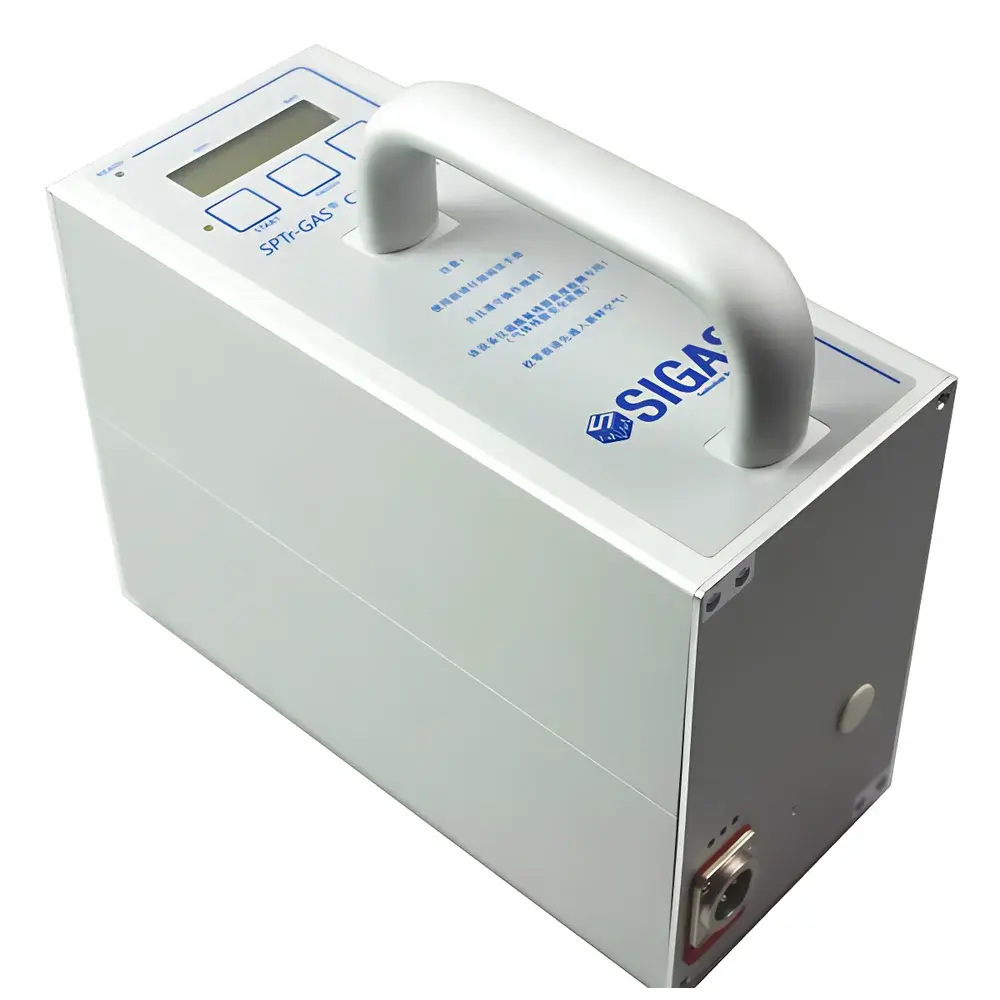
Schütz SPTr-GAS PORT 200 Portable Photoacoustic Fumigant Gas Analyzer
| Brand | Schütz SIGAS |
|---|---|
| Origin | Germany |
| Model | SPTr-GAS PORT 200 |
| Type | Portable Multicomponent Gas Analyzer |
| Detection Principle | Photoacoustic Spectroscopy (PAS) |
| Response Time | ≤10 s |
| Repeatability | ±1% FS for SO₂F₂ and CH₃Br |
| Detection Gases | Sulfuryl Fluoride (SO₂F₂), Methyl Bromide (CH₃Br), Phosphine (PH₃) |
| Measurement Ranges | SO₂F₂: 1–150 g/m³ (PRO) / 0.5–200 ppm (CLIR) |
| CH₃Br & PH₃ | matching trace/high-range configurations |
| Accuracy | ±1% FS (full scale) or ±0.5 ppm (<10 ppm) |
| Resolution | 0.1 g/m³ (PRO) / 0.5 ppm (CLIR) |
| Warm-up Time | 5 min (PRO) / 15 min (CLIR) |
| Display | 1×8-character LCD |
| Power Supply | NiMH Battery Pack (19.2 V, 72 Ah) |
| AC Input | 100–240 VAC, 47–64 Hz, max. 110 W |
| Battery Runtime | >26 h (PRO) / >5 h (CLIR) |
| Charging Time | 3.5 h |
| Operating Temperature | +5 °C to +40 °C |
| Storage Temperature | −10 °C to +60 °C |
| Relative Humidity | 0–95% RH, non-condensing |
| Dimensions | 230 × 105 × 270 mm |
| Weight | 3.5 kg (PRO) / 4.3 kg (CLIR) |
Overview
The Schütz SPTr-GAS PORT 200 is a field-deployable, photoacoustic spectroscopy (PAS)-based multicomponent fumigant gas analyzer engineered for quantitative, real-time measurement of sulfuryl fluoride (SO₂F₂), methyl bromide (CH₃Br), and phosphine (PH₃) in industrial, quarantine, and phytosanitary applications. Unlike conventional NDIR or electrochemical sensors, PAS leverages modulated infrared light absorption followed by acoustic wave detection in a resonant cell—enabling exceptional selectivity, immunity to ambient humidity interference, and high signal-to-noise ratio at both high-concentration (PRO variant) and sub-ppm trace-level (CLIR variant) regimes. The instrument’s dual-configurable architecture supports compliance-driven workflows across fumigation validation, post-treatment clearance verification, occupational exposure monitoring, and regulatory residue assessment under ISO 11312, EN 13217, and FAO/WHO International Code of Conduct on Pesticide Management.
Key Features
- Two operational variants in a unified platform: SPTr-GAS PORT 200 PRO (red housing) optimized for high-concentration fumigation monitoring (1–150 g/m³ SO₂F₂), and CLIR (green housing) configured for ultra-low residual detection (0.5–200 ppm), with distinct warm-up times (5 min vs. 15 min) and battery endurance profiles.
- Photoacoustic detection core eliminates optical drift and cross-sensitivity to water vapor—a critical advantage over traditional IR systems when operating in humid storage facilities, shipping containers, or greenhouses.
- Integrated single-line LCD display shows concentration values simultaneously in ppm and mg/m³, with intuitive three-button navigation enabling operation without training or external software.
- Ruggedized portable design (230 × 105 × 270 mm; 3.5–4.3 kg) meets IP54-rated ingress protection for dust and splash resistance during field use.
- NiMH battery pack (19.2 V, 72 Ah) delivers >26 hours of continuous operation for PRO mode and >5 hours for CLIR mode—sufficient for full-day fumigation cycle audits without mid-shift recharging.
- Calibration traceability supported via factory-certified span gas protocols; zero-point stability maintained through temperature-compensated reference cell architecture.
Sample Compatibility & Compliance
The SPTr-GAS PORT 200 interfaces directly with standard fumigation sampling lines (¼” OD PTFE tubing) and accommodates gas stream temperatures from +5 °C to +40 °C and relative humidity up to 95% non-condensing. Its PAS-based transduction mechanism ensures stable performance across variable matrix conditions—including air, nitrogen, and CO₂-enriched atmospheres common in modified-atmosphere fumigation chambers. The analyzer conforms to EU Directive 2014/68/EU (PED) for pressure equipment safety and carries CE marking for EMC and low-voltage directives. Data integrity aligns with GLP and GMP expectations: all measurements are time-stamped, non-editable, and stored internally with device serial number and calibration history. While not inherently 21 CFR Part 11 compliant, audit-ready data export (via USB) supports integration into validated laboratory information management systems (LIMS) where electronic records are required.
Software & Data Management
The analyzer operates autonomously without embedded firmware requiring PC connectivity. All measurement data—including date/time stamps, concentration units (ppm and mg/m³), and instrument status flags—are retained in non-volatile memory for up to 10,000 readings. Data export is performed via USB interface using vendor-provided PC utility software, which generates CSV files compatible with Excel, MATLAB, and statistical process control (SPC) platforms. The software includes tools for batch calibration verification reports, drift trend analysis over 30-day intervals, and comparative overlay of PRO/CLIR datasets from the same fumigation event. No cloud synchronization or remote telemetry is implemented—ensuring full data sovereignty and alignment with ITAR and GDPR-compliant deployment policies.
Applications
- Quarantine fumigation validation for wooden packaging (ISPM 15), grain silos, and shipping containers prior to international shipment.
- Residual gas clearance testing in food processing plants, pharmaceutical cleanrooms, and archival storage facilities following PH₃ or SO₂F₂ treatment.
- OEL (Occupational Exposure Limit) monitoring per OSHA PEL and ACGIH TLV thresholds during fumigant application and aeration phases.
- Regulatory reporting for EPA FIFRA submissions, EU Biocidal Products Regulation (BPR) dossiers, and national plant protection organization (NPPO) documentation.
- Field service diagnostics for fumigation contractors performing third-party verification under ISO/IEC 17020 accreditation scopes.
FAQ
What gases does the SPTr-GAS PORT 200 detect, and how are they differentiated?
It quantitatively measures sulfuryl fluoride (SO₂F₂), methyl bromide (CH₃Br), and phosphine (PH₃) using gas-specific infrared absorption bands. Each target compound is resolved via dedicated optical filters and digital signal processing tuned to its unique photoacoustic response signature.
Is humidity compensation required during operation?
No—photoacoustic spectroscopy is inherently insensitive to water vapor interference, eliminating the need for separate humidity sensors or algorithmic correction routines.
Can the PRO and CLIR variants be interchanged or upgraded in the field?
No—the PRO and CLIR configurations represent hardware-differentiated versions with distinct laser sources, detector gain settings, and firmware calibration maps. They are sold as discrete models and are not field-upgradable.
What is the recommended calibration frequency?
Schütz recommends functional verification with certified span gas before each daily use and full two-point (zero/span) calibration every 30 days or after exposure to concentrations exceeding 80% of full scale.
Does the device support analog output or Modbus communication?
No—the SPTr-GAS PORT 200 is a standalone, battery-operated instrument with no analog I/O or industrial protocol interfaces. Data retrieval is exclusively via USB mass-storage mode.
Related Products







