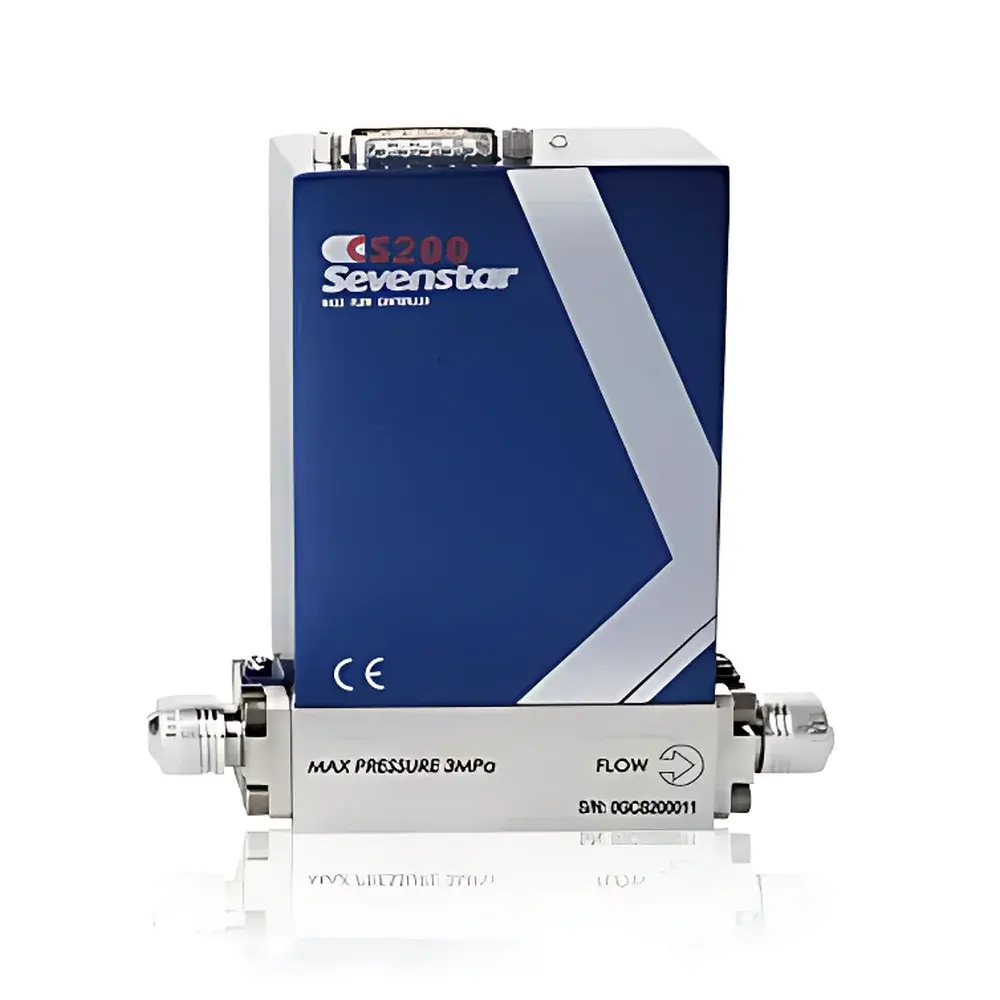
SevenStar CS200(A) Digital Mass Flow Controller
| Brand | SevenStar |
|---|---|
| Origin | Beijing, China |
| Model | CS200(A) |
| Type | Volumetric Mass Flow Controller |
| Flow Range | 5 sccm to 50 slm |
| Accuracy | ±0.35% F.S. (<35% F.S.), ±1.0% S.P. (≥35% F.S.) |
| Repeatability | ±0.2% F.S. |
| Linearity | ±0.5% F.S. |
| Response Time | ≤1 sec |
| Operating Temperature | 5–45 °C |
| Max Pressure Rating | 3 MPa |
| Seal Material | Viton® fluoroelastomer |
| Input/Output Signals | 0–5 VDC, 0–20 mA, 4–20 mA, RS-485, DeviceNet®, Profibus® |
| Power Supply | ±15 VDC, 24 VDC, or +14–+28 VDC |
| Valve Configuration | Normally Open (≤30 slm), Normally Closed (>30 slm) |
| Zero Drift | <0.6% F.S./year (without auto-zero) |
| Temperature Coefficients | Zero ≤±0.05% F.S./°C |
| Pressure Drop Range | 0.05–0.35 MPa (F.S. ≤10 slm), 0.1–0.35 MPa (10–30 slm), 0.2–0.45 MPa (>30 slm) |
| Helium Leak Rate | ≤1×10⁻¹⁰ Pa·m³/sec |
| Standard Fittings | Dual Ferrule 1/4", 1/8", Φ3 mm, Φ6 mm, Φ10 mm, 3/8", VCR 1/4", VCO 1/4" |
| Surface Roughness | 25 µin |
| EMC Compliance | CE |
| Weight | 1 kg |
Overview
The SevenStar CS200(A) Digital Mass Flow Controller is an engineered solution for precise, real-time regulation and measurement of gas mass flow in demanding industrial, analytical, and research environments. Unlike volumetric flow devices, the CS200(A) employs thermal-based mass flow sensing—specifically constant-temperature anemometry—to directly measure mass flow rate independent of pressure and temperature fluctuations. This principle enables traceable, repeatable control across a broad range of gases—including N2, O2, Ar, He, CO2, H2, and custom gas mixtures—without requiring gas-specific calibration factors for standard configurations. Designed for integration into gas delivery subsystems, semiconductor process tools, environmental simulation chambers, and laboratory-scale reaction systems, the CS200(A) delivers high stability under dynamic load conditions while maintaining compliance with fundamental metrological requirements for process instrumentation.
Key Features
- Digital architecture with embedded microprocessor for on-board signal conditioning, auto-zero compensation, and non-linear correction algorithms
- Viton® fluoroelastomer sealing system ensuring chemical compatibility with aggressive and inert process gases and long-term zero stability
- Ultra-low thermal drift: zero point drift ≤±0.05% F.S./°C and span drift ≤±0.1% F.S./°C (for models ≤30 slm), enabling reliable operation across ambient temperature gradients typical in non-climate-controlled labs and production floors
- Sub-second dynamic response (≤1 sec T90) suitable for closed-loop feedback control in fast-cycling processes such as plasma etching, CVD precursor delivery, and gas chromatography carrier flow regulation
- Multi-protocol digital interface support—including RS-485 (Modbus RTU), DeviceNet™, and Profibus® DP—facilitating seamless integration into PLC-based automation architectures and SCADA systems
- Flexible power input options (±15 VDC, 24 VDC, or wide-range +14 to +28 VDC) accommodating diverse system-level power distribution schemes
- Configurable valve actuation: normally open configuration for low-to-medium flow ranges (≤30 slm); normally closed for high-flow or safety-critical applications
Sample Compatibility & Compliance
The CS200(A) is validated for use with dry, non-corrosive, particle-free gases. Its Viton® wetted seals provide compatibility with halogenated compounds, hydrocarbons, and common industrial gases per ASTM D1418 and ISO 1629 classifications. The device meets CE marking requirements for electromagnetic compatibility (2014/30/EU) and low-voltage directive (2014/35/EU). While not intrinsically safe certified, it may be deployed in Class 1, Division 2 hazardous locations when installed per NEC Article 500 guidelines and paired with appropriate barrier systems. For regulated environments—including pharmaceutical manufacturing (cGMP) and clinical diagnostics—the unit supports audit-ready operation when used with external logging systems compliant with FDA 21 CFR Part 11 (electronic records/signatures) via time-stamped Modbus data registers and configurable event flags.
Software & Data Management
The CS200(A) operates autonomously without proprietary host software. All configuration—including flow range selection, analog output scaling, digital address assignment, and auto-zero scheduling—is performed via standardized Modbus register mapping or DeviceNet object dictionary entries. Raw flow data, valve position, internal temperature, and diagnostic status (e.g., over-pressure, sensor fault, communication timeout) are accessible in real time through any Modbus master or DeviceNet scanner. For long-term trending and validation, users may integrate the controller into third-party platforms such as Ignition SCADA, LabVIEW™ DAQmx, or MATLAB® via OPC UA or serial-to-Ethernet gateways. Firmware updates are delivered via UART bootloader protocol using industry-standard terminal emulators—no vendor lock-in or subscription licensing applies.
Applications
- Semiconductor fabrication: Precise dopant and etchant gas dosing in PECVD, ALD, and reactive ion etching tools
- Environmental testing: Controlled gas blending for accelerated corrosion chambers and emissions analyzers
- Materials science: Atmosphere regulation in gloveboxes, thermal gravimetric analyzers (TGA), and catalyst evaluation reactors
- Medical device manufacturing: Calibration gas delivery for breath analyzers and oxygen concentrator validation
- Research laboratories: Multi-gas mixing for combustion studies, fuel cell testing, and isotope ratio mass spectrometry sample introduction
- Industrial automation: Leak testing purge control, pneumatic cylinder sequencing, and inert blanketing in chemical synthesis reactors
FAQ
Does the CS200(A) require gas-specific calibration for different media?
The base model is calibrated for air or nitrogen. Optional multi-gas calibration kits (NIST-traceable) are available for up to six user-defined gases, enabling direct mass flow readout without correction factors.
Can the device maintain accuracy under varying inlet pressure conditions?
Yes—its thermal sensing mechanism inherently compensates for moderate upstream pressure changes. However, stable differential pressure across the flow body (within specified ΔP ranges per flow range) is required for optimal valve linearity and repeatability.
Is firmware update capability supported in-field?
Yes—firmware upgrades are performed via UART using standard serial terminal software and do not require proprietary utilities or vendor service visits.
What mechanical certifications apply to the wetted materials?
All Viton® components comply with USP Class VI biocompatibility testing and meet FDA 21 CFR 177.2600 for indirect food contact applications.
How is long-term zero stability verified during qualification?
Zero drift is characterized per ISO 9001 Clause 7.6 and documented in the Certificate of Conformance shipped with each unit; annual verification can be performed using zero-air purge or integrated auto-zero cycles.