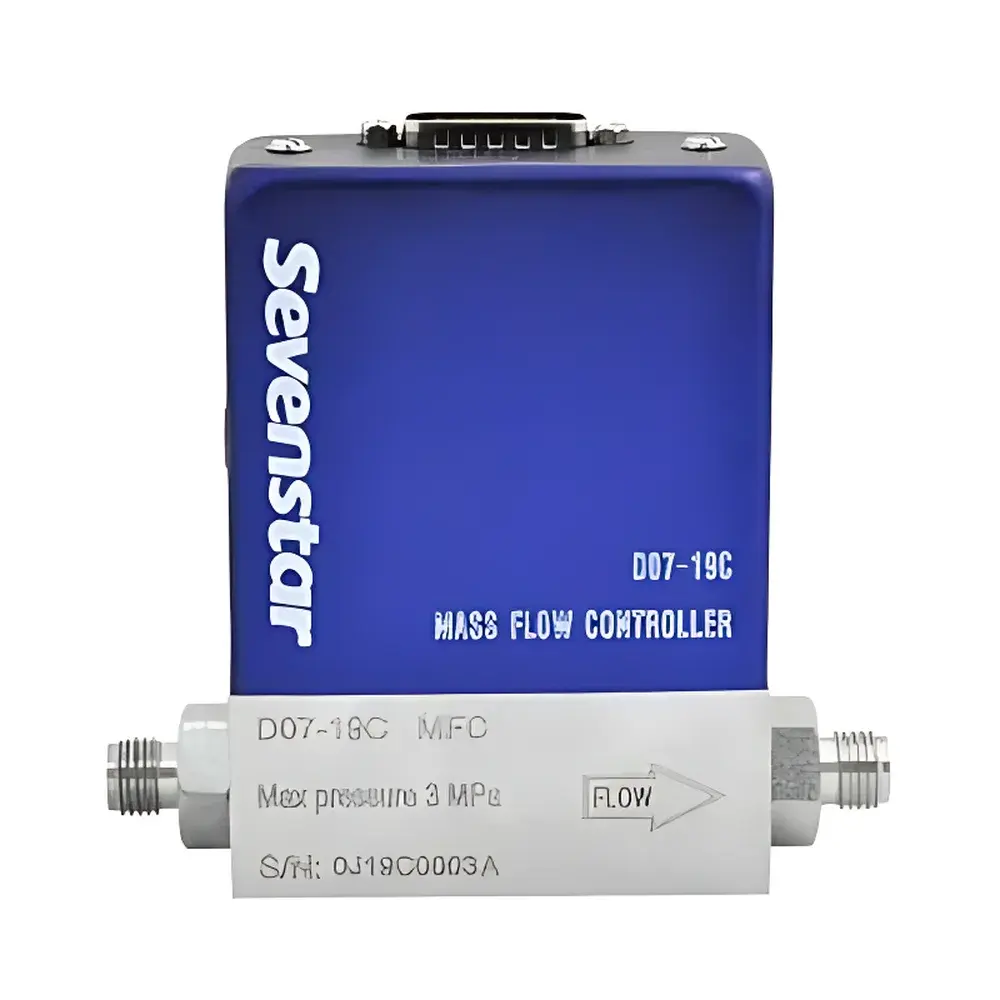
SevenStar D07-19C Mass Flow Controller
| Brand | SevenStar |
|---|---|
| Origin | Beijing, China |
| Model | D07-19C |
| Flow Type | Thermal Mass Flow |
| Full-Scale Range (N₂) | 5 SCCM to 20 SLM |
| Control Range | 2–100% F.S. |
| Valve Type | Solenoid-Controlled Proportional Valve (Normally Closed) |
| Accuracy | ±1% F.S. (≤10 SLM), ±2% F.S. (>10 SLM) |
| Linearity | ±0.5–1% F.S. (≤10 SLM), ±2% F.S. (>10 SLM) |
| Repeatability | ±0.2% F.S. |
| Zero Temp. Coefficient | ≤±0.05% F.S./°C |
| Span Temp. Coefficient | ≤±0.1% F.S./°C |
| Response Time | ≤1.5 s |
| Operating Temperature | 5–45°C |
| Operating Differential Pressure | 0.1–0.5 MPa (≤10 SLM), 0.1–0.3 MPa (>10 SLM) |
| Burst Pressure | 3 MPa |
| Leak Rate | ≤1×10⁻⁹ SCCS He |
| Sealing Materials | Fluoroelastomer (FKM), Polytetrafluoroethylene (PTFE), Chloroprene Rubber (CR) |
| Mechanical Interface Options | VCR 1/4", φ4 mm / φ6 mm hose, Swagelok 1/8" / 1/4", φ3 mm / φ6 mm tubing |
| Electrical Interface | DB15 Male Connector |
| EMC Compliance | CE |
| Weight | 1.2 kg |
Overview
The SevenStar D07-19C Mass Flow Controller (MFC) is a thermally based, analog-output gas flow control instrument engineered for high-reproducibility mass flow regulation in process-critical environments. Unlike volumetric flow devices, the D07-19C measures and controls gas mass flow rate directly—compensating for temperature and pressure variations—by leveraging constant-temperature anemometry (CTA) principles. Its sensor element consists of a heated microbridge or capillary tube with upstream and downstream platinum resistance temperature detectors (RTDs). Gas flowing across the sensor removes heat asymmetrically; the differential cooling effect is converted into a linear voltage signal proportional to mass flow rate. Calibration is traceably referenced to nitrogen (N₂) under standard conditions (0 °C, 101.325 kPa), ensuring metrological consistency across global installations. Designed for integration into OEM systems and laboratory-scale process lines, the D07-19C delivers stable, low-drift performance without requiring external pressure or temperature compensation hardware.
Key Features
- Thermal mass flow sensing architecture with built-in temperature compensation—eliminates need for separate T/P transducers
- Solenoid-driven proportional control valve with normally closed (NC) default state, providing fail-safe shutoff during power loss
- Analog I/O interface: 0–5.00 V DC input for setpoint command and 0–5.00 V DC output for real-time flow feedback—compatible with PLCs, DAQ systems, and legacy industrial controllers
- DB15 male electrical connector compliant with IEC 60603-2 and MIL-DTL-26482 standards, enabling robust, vibration-resistant signal integrity
- Multi-material wetted path: FKM O-rings, PTFE-sealed valve seats, and CR gaskets ensure broad chemical compatibility with inert, corrosive, and mildly reactive gases (e.g., N₂, Ar, O₂, CO₂, NH₃, HCl)
- CE-marked electromagnetic compatibility (EMC) per EN 61326-1:2013, validated for operation in industrial electromagnetic environments
- Compact form factor (1.2 kg) with standardized mechanical interfaces including VCR 1/4″, Swagelok 1/8″/1/4″, and metric tube ports (φ3/φ4/φ6 mm)
Sample Compatibility & Compliance
The D07-19C is calibrated for nitrogen but supports multi-gas operation via user-applied correction factors (K-factors) per ISO 14111 and ASTM D7213. It maintains specified accuracy for gases with thermal properties within ±25% of N₂’s specific heat ratio and thermal conductivity. The device complies with ISO 9001-certified manufacturing protocols and meets mechanical safety requirements per ISO 10297 for pressurized components. Its maximum working differential pressure (0.5 MPa at low ranges) and 3 MPa burst rating align with ASME B31.3 process piping design margins. For regulated industries—including pharmaceutical cleanroom gas delivery, semiconductor CVD/PVD tooling, and analytical instrument carrier gas control—the unit supports audit-ready documentation packages upon request, including calibration certificates traceable to NIM (National Institute of Metrology, China) and uncertainty budgets per GUM (JCGM 100:2008).
Software & Data Management
As an analog-only MFC, the D07-19C does not incorporate embedded firmware or digital communication protocols (e.g., RS-485, Modbus, or Fieldbus). However, it integrates seamlessly into data acquisition ecosystems via third-party analog-to-digital converters supporting IEEE 1620 or IEC 61000-4-30 compliance. When deployed in GLP/GMP environments, its analog signals are logged using validated SCADA or LabVIEW-based systems configured with 21 CFR Part 11-compliant electronic signatures, audit trails, and raw-data archiving. Optional external signal conditioners (e.g., isolation amplifiers with 4–20 mA conversion) enable compatibility with DCS platforms requiring current-loop inputs. All calibration records—including as-found/as-left data, environmental conditions, and reference standard IDs—are retained per ISO/IEC 17025 clause 7.7.
Applications
- Precise gas dosing in plasma etching, sputtering, and atomic layer deposition (ALD) tools
- Carrier and purge gas regulation for GC, GC-MS, and FTIR analyzers
- Controlled atmosphere generation in metallurgical heat treatment furnaces and optical fiber preform consolidation
- Gas blending systems for medical air, calibration gas mixtures, and synthetic air standards
- In-line monitoring and feedback control in catalytic reaction studies and fuel cell test benches
- Leak testing instrumentation requiring stable, low-flow gas supply (down to 5 SCCM)
FAQ
Is the D07-19C suitable for use with hydrogen or other flammable gases?
Yes—provided system-level safety measures (e.g., leak detection, ventilation, explosion-proof enclosures) are implemented per IEC 60079-10-1. The wetted materials (FKM, PTFE, CR) are compatible, but hydrogen permeation rates must be evaluated for long-term seal integrity.
Can the device be recalibrated for gases other than nitrogen?
Yes—using certified K-factors derived from ISO 14111 Annex B or manufacturer-provided gas-specific coefficients. Recalibration requires traceable reference standards and controlled environmental conditions.
What is the minimum measurable flow at the 5 SCCM full-scale range?
The lower limit of control is 2% F.S., i.e., 0.1 SCCM, with repeatability maintained at ±0.2% F.S. (±0.002 SCCM) under stable thermal conditions.
Does the unit support digital communication or fieldbus protocols?
No—the D07-19C is strictly analog I/O. For digital integration, external analog-to-digital gateways or programmable logic controllers with analog I/O modules are required.
How is traceability ensured for calibration certificates?
Certificates include NIM-traceable references, measurement uncertainty budgets, environmental parameters (T, P), and technician accreditation details—fully compliant with ISO/IEC 17025 requirements for accredited calibration laboratories.