
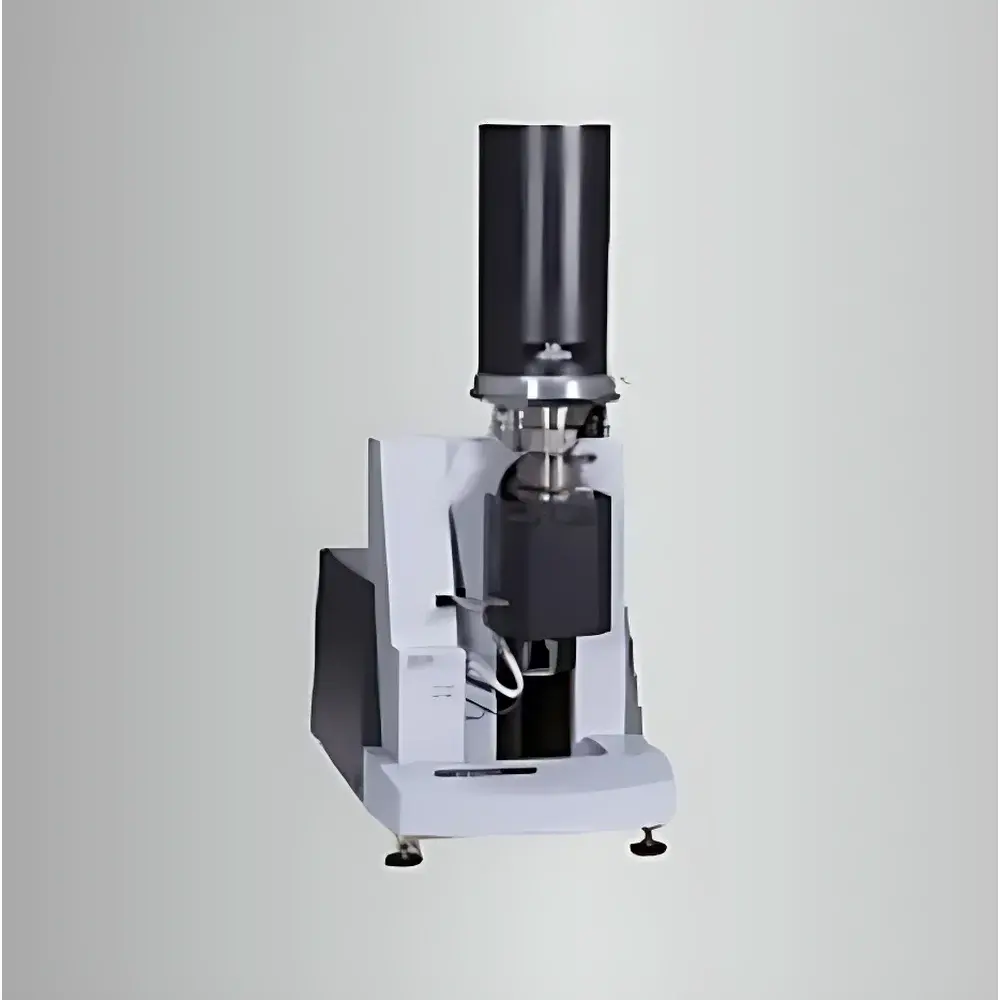
Shimadzu TMA-60/TMA-60H Thermomechanical Analyzer
| Brand | Shimadzu |
|---|---|
| Origin | Japan |
| Model | TMA-60/TMA-60H |
| Measurement Principle | Expansion, Tensile, and Penetration Modes |
| Temperature Range | −150 °C to 1500 °C (with optional furnaces) |
| Displacement Resolution | ≤0.1 nm |
| Force Control Range | 0.01–500 mN |
| Compliance | ASTM E831, ISO 11359-2, USP <1241>, GLP-ready software architecture |
Overview
The Shimadzu TMA-60 and TMA-60H are high-precision thermomechanical analyzers engineered for quantitative measurement of dimensional changes in solid materials under controlled temperature, time, and mechanical load conditions. Based on the fundamental principle of thermomechanical analysis—monitoring sample deformation (expansion, contraction, creep, or stress relaxation) as a function of temperature—the TMA-60 employs absolute expansion mode, while the TMA-60H implements differential expansion mode using a reference rod, enabling enhanced accuracy for high-temperature applications involving ceramics, glasses, and refractory materials. Both instruments utilize a high-stability, low-drift digital linear variable differential transformer (LVDT)-based displacement sensor with sub-nanometer resolution, ensuring traceable, reproducible measurements across dynamic thermal profiles. The modular furnace design supports interchangeable heating units—including the LTB-60 cryo-cooling furnace (−150 °C), standard air furnace (up to 600 °C), and high-temperature furnace (up to 1500 °C)—allowing seamless adaptation to diverse material classes and regulatory testing requirements.
Key Features
- Two operational configurations: TMA-60 (absolute expansion mode) for general-purpose polymer, elastomer, and composite characterization; TMA-60H (differential expansion mode) optimized for low-expansion materials requiring minimized thermal artifact correction.
- True automatic zero-point calibration and real-time drift compensation via integrated digital position sensing—eliminating manual baseline adjustments and reducing operator-induced variability.
- Modular furnace interchangeability with tool-free mounting; rapid hot/cold swap capability between LTB-60, HTF-60, and standard air furnaces without recalibration.
- Dual-gas flow system with independent inlet channels for purge gas (N₂, Ar, He), reactive atmosphere (O₂, H₂), or humidified vapor—compatible with FC-60A automated gas switching module for programmed atmosphere transitions during multi-step thermal protocols.
- Integrated forced-air cooling fan with programmable post-run cooldown ramping, reducing turnaround time between sequential experiments by up to 40% compared to passive cooling systems.
- Quick-release sample holder design with standardized probe geometry (expansion, tensile, penetration) and adjustable force application (0.01–500 mN range) for consistent contact pressure across heterogeneous sample morphologies.
Sample Compatibility & Compliance
The TMA-60/60H accommodates a broad spectrum of solid-state specimens—including rods, films, fibers, powders (in compacted form), coatings, and multilayer laminates—without requiring specialized fixtures. Its mechanical probing versatility supports ASTM E831 (linear thermal expansion of plastics), ISO 11359-2 (thermomechanical behavior of polymers), and DIN 53765 (thermal expansion of rubber). For pharmaceutical solid dosage forms, the system meets USP guidelines for thermal stability assessment of excipients and active ingredients. Data acquisition and reporting comply with GLP and GMP environments through TW-60WS software’s audit-trail functionality, electronic signature support, and 21 CFR Part 11–compliant user access control and data integrity safeguards.
Software & Data Management
TW-60WS is a Windows-native analytical platform designed specifically for thermomechanical instrumentation. It provides synchronized temperature–displacement–force data acquisition at up to 10 Hz sampling rate, real-time derivative calculation (dL/dT), and automated event detection (e.g., glass transition onset, softening point, sintering start). Method templates conform to ASTM and ISO test standards are preloaded, with customizable report generation supporting PDF, CSV, and XML export formats. Raw data files are stored in vendor-neutral HDF5 format, enabling third-party analysis interoperability. Version-controlled method libraries, instrument calibration history tracking, and secure network deployment options support centralized lab management across multi-site R&D and QC operations.
Applications
- Polymer science: Coefficient of linear expansion (CLTE), glass transition temperature (Tg), cold crystallization, and filler-matrix interfacial stability in composites.
- Ceramics & glasses: Sintering kinetics, phase transition detection, and residual stress evaluation in transparent oxides and low-α materials.
- Electronics packaging: Warpage analysis of PCB substrates, CTE mismatch quantification in die-attach adhesives, and solder joint reliability modeling.
- Pharmaceutical development: Thermal-induced delamination in bilayer tablets, excipient compatibility screening, and lyophilized cake structural integrity assessment.
- Automotive materials: Dimensional stability of carbon-fiber-reinforced thermoplastics under cyclic thermal loading, brake pad binder degradation profiling.
FAQ
What is the difference between TMA-60 and TMA-60H?
The TMA-60 operates in absolute expansion mode, measuring total sample length change relative to a fixed reference frame. The TMA-60H uses differential expansion mode, where sample displacement is measured against a thermally stable reference rod—reducing systematic error from furnace thermal expansion, especially above 800 °C.
Can the same furnace be used for both TMA-60 and TMA-60H?
Yes—both models share identical furnace interfaces and mechanical mounting specifications, enabling full hardware interchangeability without recalibration or alignment procedures.
Is humidity-controlled testing supported?
Yes—via optional FC-60A gas controller and vapor generator modules, enabling precise water vapor partial pressure control (1–95% RH) during dynamic thermal scans.
Does the system support ISO/IEC 17025-compliant calibration documentation?
Shimadzu provides NIST-traceable calibration certificates for displacement, temperature, and force transducers upon request, with documented uncertainty budgets aligned with ISO/IEC 17025:2017 Annex A.2 requirements.
How is data security managed in regulated environments?
TW-60WS implements role-based user permissions, immutable audit trails for all method edits and data exports, and encrypted local database storage—fully satisfying FDA 21 CFR Part 11 and EU Annex 11 validation prerequisites.



