
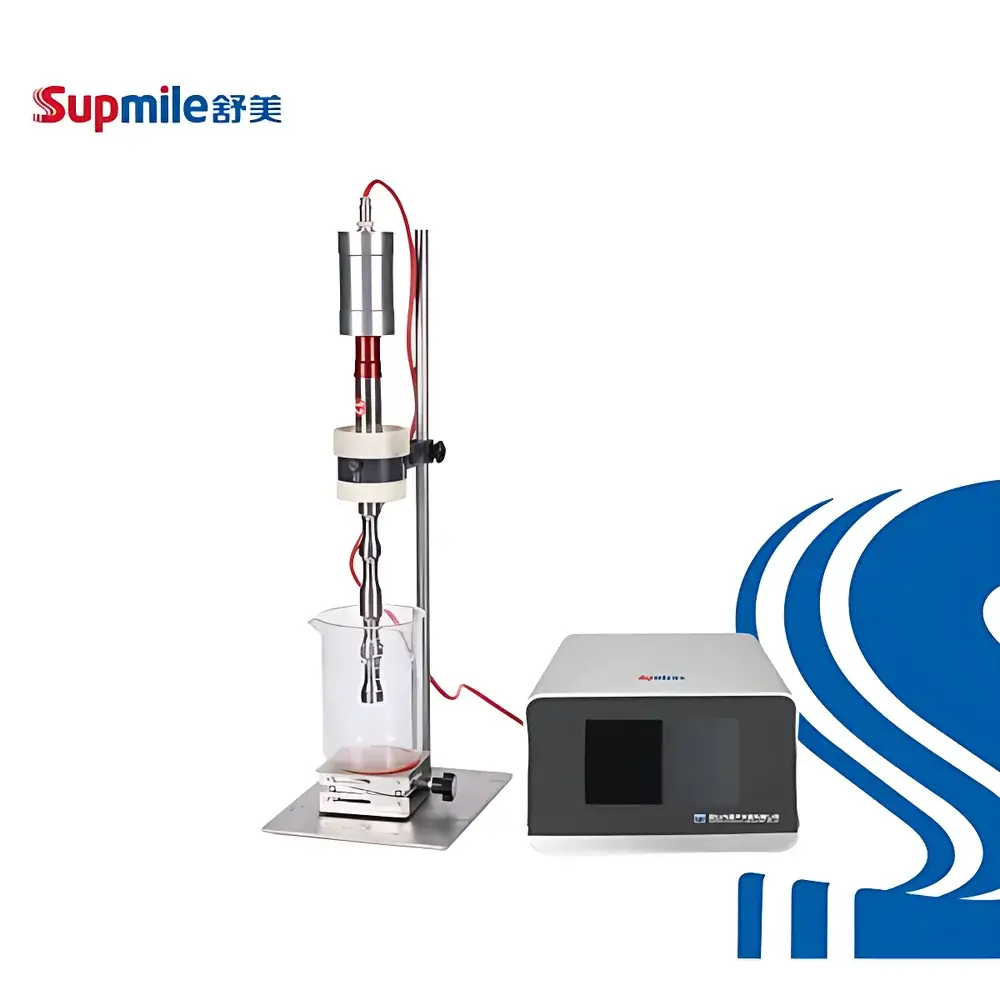
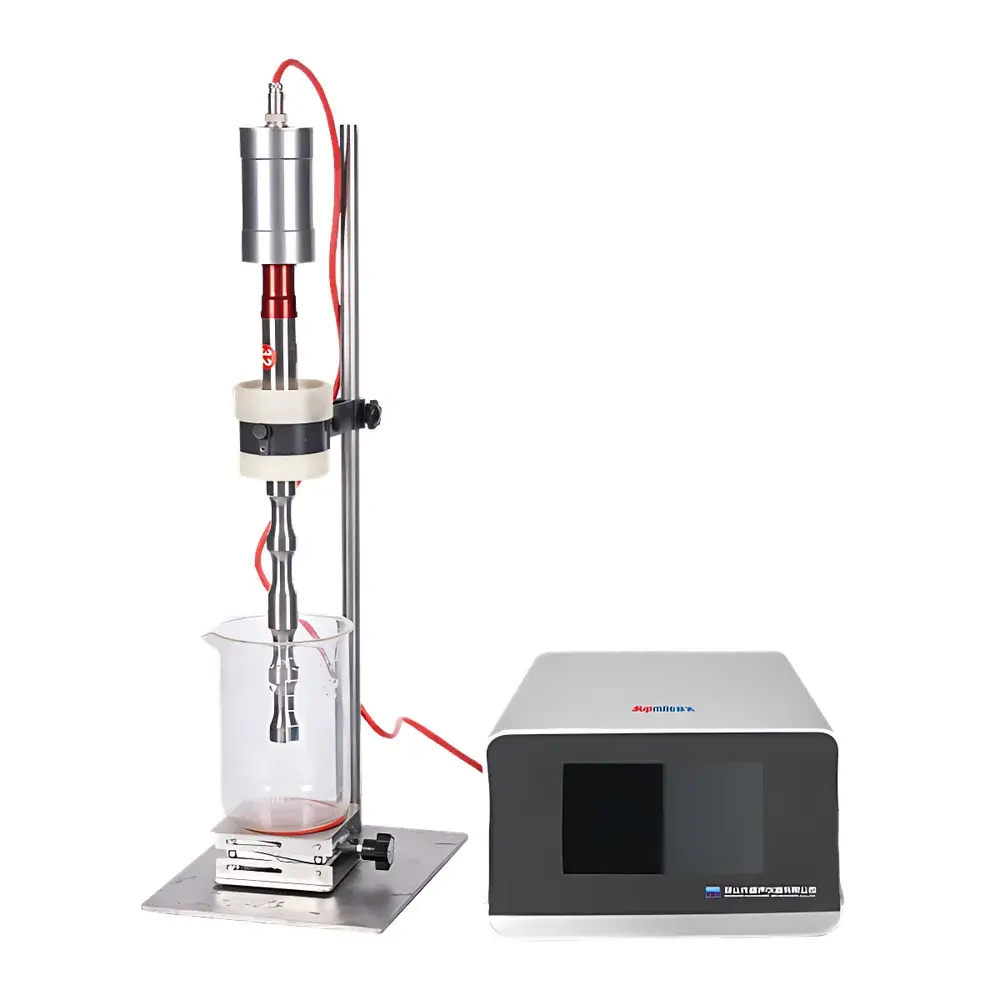
Shumei KBC-2000D High-Power Immersion Ultrasonic Processor (Horn-Type)
| Brand | Shumei |
|---|---|
| Origin | Jiangsu, China |
| Manufacturer Type | Direct Manufacturer |
| Country of Origin | China |
| Model | KBC-2000D |
| Price | USD 6,200 (FOB Jiangsu) |
| Generator Dimensions | 348 × 275 × 175 mm |
| Ultrasonic Frequency | 20 kHz (auto-tracking range: 19–26 kHz) |
| Output Power | 2000 W |
| Power Adjustment Range | 0–100% |
| Processing Volume | 0.5–12 L |
| Timer Range | 1 min – 99 h 59 min |
| Pulse Duration | 1 s – 59 min 59 s |
| Horn Diameter Options | Φ25 mm / Φ40 mm / Φ50 mm (standard: Φ40 mm) |
| Transducer Material | CV33 piezoelectric stack with PZT (lead zirconate titanate) ceramic |
| Horn Material | Ti-6Al-4V titanium alloy |
| Control Interface | Color industrial touch screen |
| Communication | RS-485 (optional) |
| Safety Features | Overload, overtemperature & fault auto-protection (optional) |
Overview
The Shumei KBC-2000D High-Power Immersion Ultrasonic Processor is an industrial-grade horn-type ultrasonic system engineered for high-intensity sonication in demanding laboratory and pilot-scale applications. It operates on the principle of piezoelectric energy conversion: high-voltage AC signals drive a PZT-based transducer stack (CV33 grade), inducing mechanical resonance in a precisely tuned titanium alloy horn (Ti-6Al-4V). This generates intense cavitation fields in liquid media via longitudinal pressure waves at a nominal frequency of 20 kHz—dynamically maintained within a 19–26 kHz auto-tracking bandwidth. Unlike bath-type systems, the immersion horn design delivers focused, scalable acoustic energy directly into the sample volume, enabling efficient cell disruption, nanoparticle dispersion, emulsification, and sonochemical synthesis across volumes from 0.5 L to 12 L. Its robust architecture supports continuous or pulsed operation under controlled thermal and mechanical load conditions, making it suitable for reproducible process development aligned with GLP-compliant workflows.
Key Features
- Industrial color touch-screen interface with intuitive parameter navigation and real-time status feedback
- Auto-frequency tracking (19–26 kHz) ensures stable resonance despite impedance shifts caused by temperature, viscosity, or sample composition changes
- Intelligent energy compensation algorithm dynamically adjusts output amplitude and frequency to maintain optimal cavitation efficiency during variable-load processing
- Dual operational modes: continuous ultrasonication and programmable pulse mode (pulse width: 1 s – 59 min 59 s; duty cycle fully configurable)
- Three-dimensional exponential horn geometry enhances acoustic coupling efficiency and reduces lateral vibration-induced fatigue—extending service life beyond conventional cylindrical designs
- Nine user-defined protocol slots stored locally on the controller for rapid recall and repeatable method execution
- RS-485 serial interface (optional) enables integration with SCADA systems or centralized lab automation platforms for remote monitoring and data logging
- Comprehensive hardware safety suite—including overtemperature cutoff, current-limiting circuitry, and real-time impedance monitoring—prevents transducer damage and ensures operator safety
Sample Compatibility & Compliance
The KBC-2000D accommodates a broad spectrum of sample types, including aqueous suspensions, organic solvents, viscous polymer solutions, and heterogeneous slurries. Its Ti-6Al-4V horn exhibits excellent corrosion resistance to common reagents (e.g., dilute acids, alcohols, chlorinated solvents), while the CV33/PZT transducer stack maintains stable electromechanical coupling under prolonged duty cycles. The system meets CE marking requirements for electromagnetic compatibility (EMC Directive 2014/30/EU) and low-voltage safety (LVD Directive 2014/35/EU). While not certified to ISO/IEC 17025 or FDA 21 CFR Part 11 out-of-the-box, its deterministic timer, pulse logic, and non-volatile protocol storage support audit-ready documentation when deployed in validated environments adhering to ISO 13485, USP , or ASTM E2810 standards for particle size analysis preparation.
Software & Data Management
The embedded firmware supports full local control without external PC dependency. All operational parameters—including power setpoint (%), total elapsed time, cumulative pulse count, and real-time temperature alerts (when connected to optional external probe)—are logged internally with timestamping. Data export is available via USB flash drive in CSV format for traceability and post-processing in MATLAB, Python, or LIMS-compatible tools. Optional RS-485 connectivity permits Modbus RTU communication for integration into automated batch reporting systems compliant with GMP Annex 11 requirements. Audit trail functionality (user login, parameter changes, alarm events) can be enabled through firmware update, satisfying basic ALCOA+ data integrity criteria for regulated R&D use.
Applications
- Biological sample preparation: lysis of bacterial, yeast, and mammalian cells for protein extraction and nucleic acid isolation
- Nanomaterial processing: exfoliation of graphene, dispersion of carbon nanotubes, and stabilization of metal oxide colloids (e.g., TiO₂, ZnO)
- Pharmaceutical formulation: nanoemulsion development, liposome sizing, and active pharmaceutical ingredient (API) micronization
- Chemical synthesis: acceleration of Friedel-Crafts acylations, esterifications, and oxidative degradation reactions via localized hot-spot generation
- Environmental testing: homogenization of soil/water extracts prior to ICP-MS or GC-MS analysis per EPA Method 3050B
- Quality control: standardized dispersion protocols for pigment rheology testing in coatings and ink manufacturing
FAQ
What is the maximum recommended operating temperature for the Ti-6Al-4V horn?
The horn is rated for continuous operation up to 60 °C ambient liquid temperature; extended exposure above 70 °C requires active cooling and reduced duty cycle to prevent microstructural degradation.
Can the KBC-2000D be used with corrosive solvents such as concentrated HCl or HF?
No. While Ti-6Al-4V resists mild acids and halogenated organics, it is not compatible with hydrofluoric acid, hot concentrated sulfuric acid, or aqua regia. Consult chemical compatibility charts before solvent selection.
Is firmware upgrade supported in-field?
Yes—firmware updates are delivered via USB stick and applied through the touch interface; version history and checksum verification are provided in release notes.
Does the system include validation documentation (IQ/OQ)?
Factory-issued IQ/OQ templates are supplied upon request; site-specific qualification must be performed by the end user in accordance with their internal SOPs and regulatory obligations.
How is amplitude calibrated and verified?
Amplitude is inferred from drive voltage and current phase relationship; absolute calibration requires external laser vibrometry. Shumei provides a reference calibration certificate traceable to NIM (China National Institute of Metrology) for initial setup verification.



