
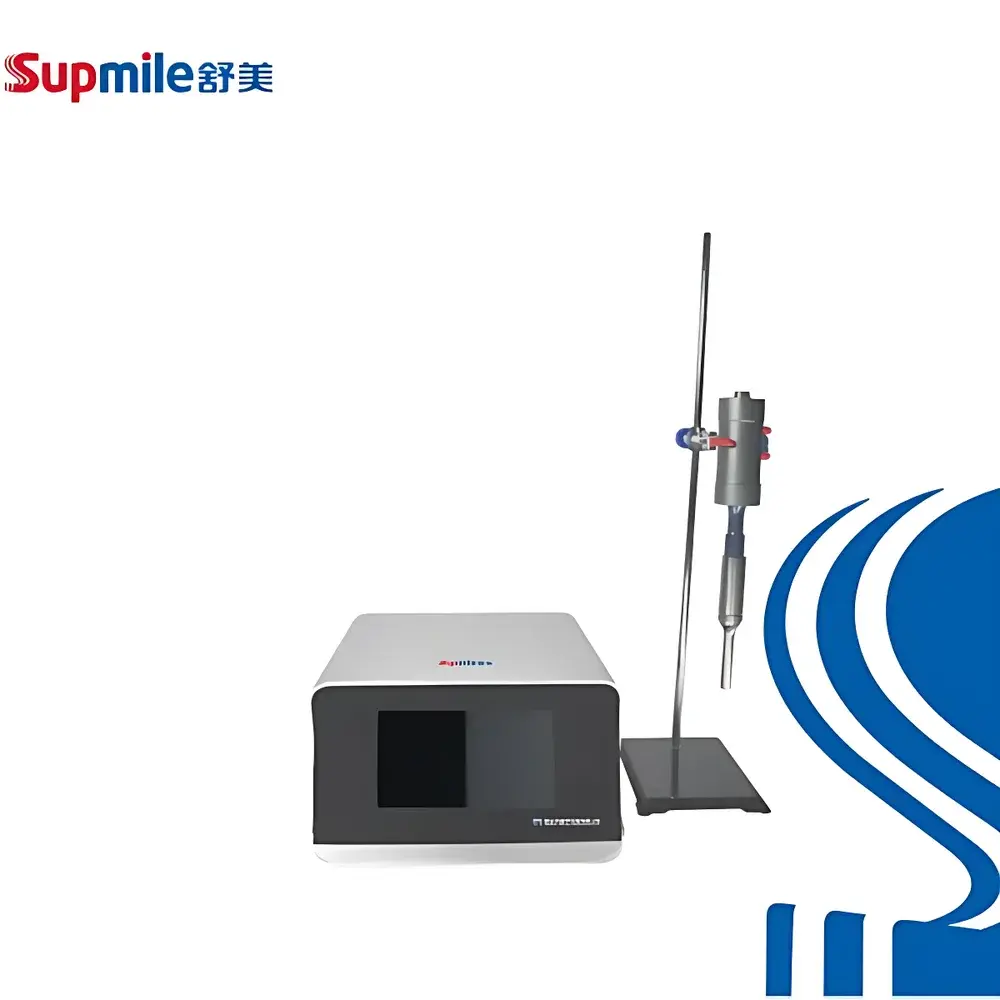
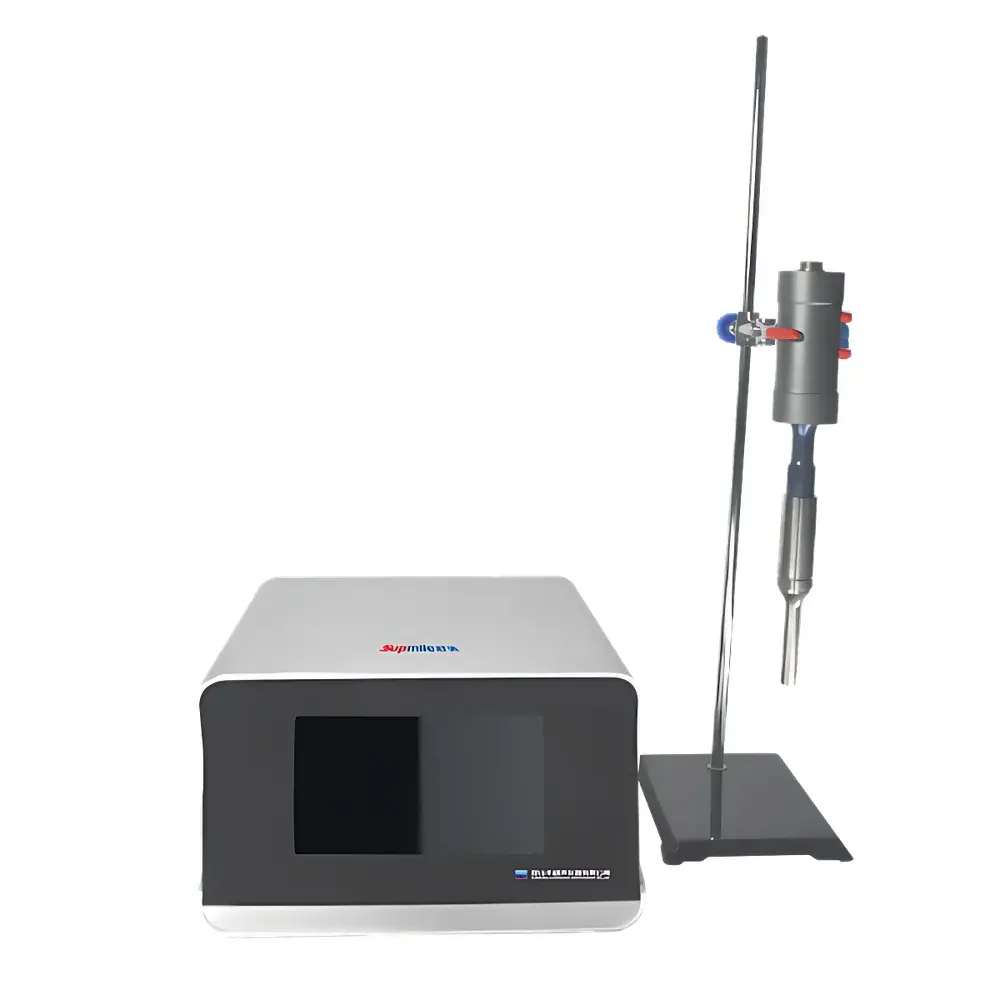
Shumei KBC-500F Split-type Ultrasonic Processor
| Brand | Shumei / SHUMEI |
|---|---|
| Origin | Jiangsu, China |
| Manufacturer Type | Manufacturer |
| Origin Category | Domestic |
| Model | KBC-500F |
| Price | USD 3,200 (approx.) |
| Generator Dimensions | 288 × 245 × 175 mm |
| Ultrasonic Frequency | 20 kHz (auto-tracking range: 19–22 kHz) |
| Output Power | 500 W (0–100% adjustable) |
| Processing Volume | 0.1–150 mL |
| Operating Time Range | 1 min – 99 h 59 min |
| Pulse Duration | 1 s – 59 min 59 s |
| Standard Horn | Φ6 mm titanium alloy (Grade Ti-6Al-4V) |
| Transducer Material | CV33 piezoceramic + PZT (lead zirconate titanate) |
| Control Interface | Color industrial touchscreen |
| Memory Presets | 9 user-defined protocols |
| Optional Accessories | Temperature probe (real-time monitoring), overload/overheat/fault protection, additional horns (Φ6/Φ8/Φ10/Φ13 mm) |
Overview
The Shumei KBC-500F Split-type Ultrasonic Processor is an engineered solution for laboratory-scale ultrasonic homogenization, cell disruption, emulsification, and nano-dispersion. It operates on the principle of high-intensity ultrasonic cavitation—generated via piezoelectric transduction at a nominal frequency of 20 kHz—where rapid pressure fluctuations in liquid media induce microbubble formation, growth, and violent collapse. This process delivers localized energy densities sufficient to shear biological membranes, deagglomerate nanoparticles, and accelerate chemical reactions. Unlike integrated benchtop units, the KBC-500F adopts a split architecture: a dedicated generator module and a physically separable ultrasonic horn assembly, enabling flexible setup in fume hoods, glove boxes, or custom reactor configurations. Its auto-frequency tracking (19–22 kHz) ensures stable cavitation output despite load variations, while real-time impedance compensation maintains consistent acoustic power delivery across sample viscosity changes.
Key Features
- Industrial-grade color touchscreen interface with intuitive navigation and real-time parameter visualization—including active power output, elapsed time, and pulse status.
- High-efficiency piezoelectric transducer using CV33 substrate and PZT-8 ceramic elements for enhanced electroacoustic conversion stability and thermal resilience.
- Titanium alloy (Ti-6Al-4V) sonotrode with proprietary three-dimensional exponential taper design—optimized for acoustic impedance matching and reduced mechanical fatigue under prolonged duty cycles.
- Dual operational modes: continuous ultrasonication and programmable pulse mode (adjustable on/off intervals from 1 second to 59 minutes 59 seconds), minimizing thermal accumulation in heat-sensitive samples.
- Nine non-volatile memory slots for storing and recalling complete protocol sets—including power level, duration, pulse parameters, and horn ID—enabling reproducible workflows across users and shifts.
- Integrated LED status indicators showing real-time transducer excitation state, facilitating visual verification without instrument interaction.
- Robust generator housing with IP20-rated enclosure, optimized for laboratory environments with moderate ambient humidity and temperature fluctuations (10–35°C).
Sample Compatibility & Compliance
The KBC-500F accommodates a broad range of sample types—from aqueous suspensions and organic solvents to viscous polymer solutions—within its 0.1–150 mL processing volume range. The standard Φ6 mm sonotrode is suitable for low-to-medium viscosity liquids requiring fine particle size reduction (e.g., liposome preparation, bacterial lysis). Optional horns (Φ8/Φ10/Φ13 mm) extend applicability to higher-volume homogenization or lower-energy density applications such as catalyst dispersion. While not certified for GMP manufacturing, the system supports GLP-aligned documentation through its protocol memory and optional temperature monitoring (via calibrated Pt100 sensor). All electrical components comply with IEC 61010-1 safety standards for laboratory equipment. No FDA 21 CFR Part 11 compliance features are built-in; however, raw operation logs (time-stamped start/stop events and parameter settings) can be manually exported for audit trail reconstruction.
Software & Data Management
The KBC-500F does not feature PC-based software or network connectivity. All configuration, execution, and data retention occur locally on the embedded touchscreen controller. Parameter values—including setpoints and actual output levels—are retained in volatile memory during operation and preserved across power cycles via internal EEPROM. Timestamped run history (up to 100 entries) records start time, total duration, selected protocol number, and final status (normal completion, timeout, or fault interruption). For integration into validated workflows, users may document operational parameters manually or interface the unit with external environmental monitoring systems via optional analog voltage output (0–5 V DC proportional to instantaneous power output, available upon request).
Applications
- Biological sample preparation: genomic DNA shearing, nuclear extraction, microbial cell lysis (E. coli, yeast, algae), tissue homogenization.
- Nanomaterial processing: exfoliation of 2D materials (graphene, MoS₂), dispersion of carbon nanotubes, stabilization of metal oxide nanoparticles (TiO₂, ZnO) in colloidal suspensions.
- Chemical synthesis acceleration: sonochemical oxidation/reduction, catalyst activation, crystallization control in API intermediates.
- Food & cosmetic R&D: emulsion stabilization (oil-in-water, water-in-oil), viscosity modification, flavor compound extraction.
- Environmental analysis: sediment digestion, microplastic fragmentation for FTIR/Raman identification, heavy metal leaching enhancement.
FAQ
Is the KBC-500F suitable for continuous operation over 8 hours?
Yes—provided adequate cooling of the sonotrode (e.g., immersion in ice-water bath or use of recirculating chiller) and periodic inspection for acoustic coupling integrity. Duty cycle should not exceed 70% in extended runs to mitigate thermal stress on the transducer stack.
Can the system be used with corrosive solvents such as concentrated acids or halogenated organics?
Titanium alloy (Ti-6Al-4V) offers excellent resistance to most common laboratory solvents, including HCl (≤10%), HNO₃, and chloroform. However, prolonged exposure to HF, hot concentrated alkalis, or bromine-containing compounds is not recommended and may compromise horn surface integrity.
Does the unit include validation documentation (IQ/OQ/PQ templates)?
No. As a general-purpose laboratory instrument, the KBC-500F ships without vendor-provided qualification templates. Users must develop site-specific protocols aligned with internal quality systems and applicable ISO/IEC 17025 requirements.
What maintenance is required for long-term reliability?
Monthly visual inspection of horn threads and tip erosion; annual torque verification of transducer-horn coupling (recommended value: 25–30 N·m); biannual cleaning of generator ventilation grilles; replacement of horn upon visible pitting or >10% diameter reduction at the tip.



