
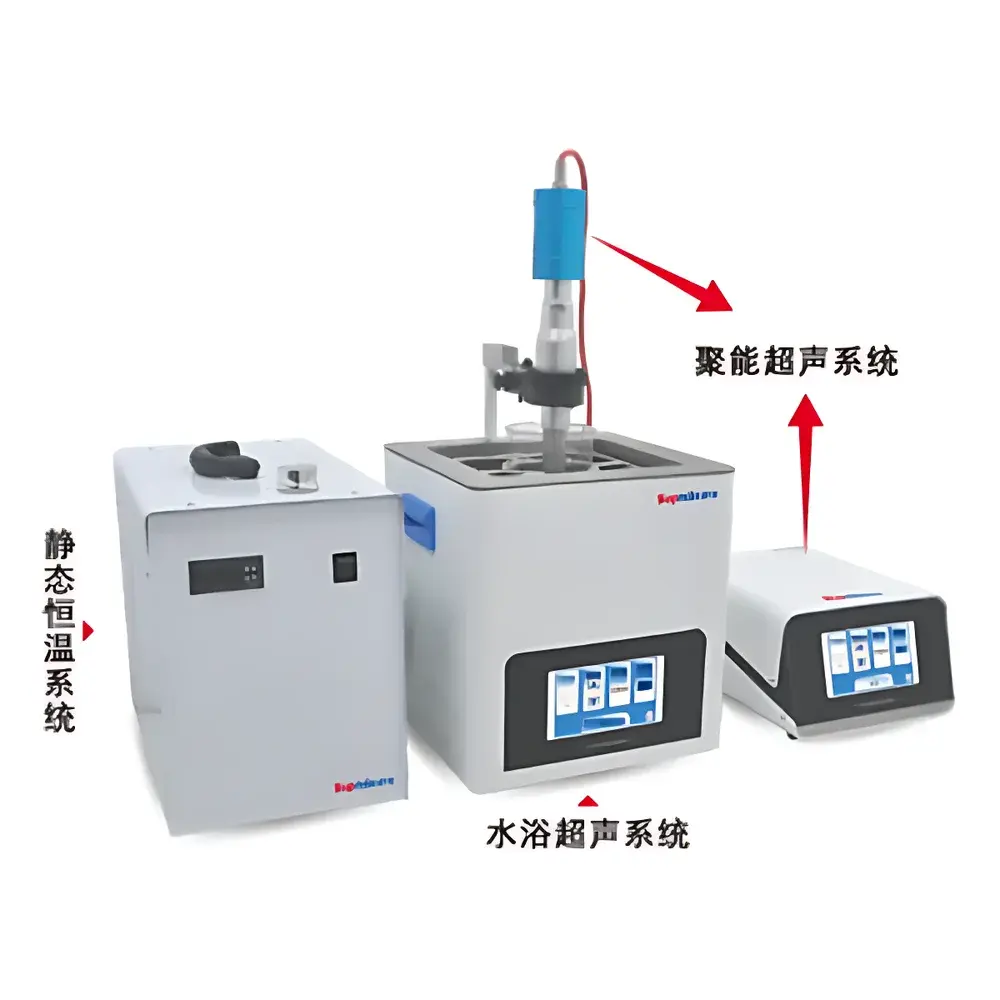
SHUMEI KBC-500ZH Tri-Mode Ultrasonic Processing System (Static Temperature-Controlled Bath + Immersion Ultrasonication + High-Intensity Probe Sonication)
| Brand | SHUMEI |
|---|---|
| Origin | Jiangsu, China |
| Manufacturer Type | OEM/ODM Manufacturer |
| Product Category | Domestic |
| Model | KBC-500ZH |
| Instrument Type | General-Purpose Laboratory Ultrasonic Processor |
| Ultrasonic Frequency | 20 kHz ±1 kHz |
| Total Ultrasonic Power Output | 1000 W (Bath) + 1000 W (Probe) |
| Power Adjustment Range | 0–100% (Independent Control for Bath & Probe) |
| Timer Range | 1 min – 99 h 59 min (Bath) |
| Temperature Control Range | −60 °C to +300 °C (via External Circulating Chiller/Heater, Not Integrated) |
| Cooling Method | Forced-Circulation Refrigeration with External Coolant or Tap Water |
| Max Flow Rate | 10 L/min |
| Heating Power | 3000 W |
| Refrigeration Power | 600 W |
| Display | 7-inch TFT Touchscreen Interface |
| Construction | Stainless Steel Housing with Epoxy Powder Coating |
| Safety Protections | Over-Temperature, Over-Voltage, Over-Current Indication |
Overview
The SHUMEI KBC-500ZH Tri-Mode Ultrasonic Processing System is an engineered platform integrating three complementary ultrasonic modalities—temperature-stabilized water bath sonication, immersion ultrasonication, and high-intensity probe-based sonication—within a single, modular architecture. Unlike conventional benchtop ultrasonic cleaners, this system operates on dual physical principles: cavitation-driven acoustic energy delivery in liquid media (bath mode), and direct mechanical energy transfer via titanium alloy probe tip vibration (probe mode), both synchronized with active temperature regulation through an external circulating chiller/heater unit. The static temperature control module eliminates convective turbulence in the bath, ensuring thermal homogeneity without compromising ultrasonic field uniformity—a critical requirement for reproducible sample preparation in quantitative analytical workflows. Designed for laboratories requiring strict process control across diverse sample matrices—from heat-sensitive biological extracts to thermally stable nanomaterial dispersions—the KBC-500ZH meets foundational requirements for method validation under GLP and ISO/IEC 17025 frameworks.
Key Features
- Triple-mode operational flexibility: Independent or simultaneous activation of water bath sonication (22.5 L tank), static temperature-controlled bath (−60 °C to +300 °C range), and high-power probe sonication (1000 W, Φ13 mm titanium horn)
- Precision frequency stability: Fixed 20 kHz output with ±1 kHz tolerance, optimized for consistent cavitation threshold across varying solvent viscosities and surface tensions
- Full digital control via 7-inch capacitive touchscreen: Real-time monitoring of bath temperature, ultrasonic power %, elapsed time, and fault diagnostics (over-temperature, over-current, over-voltage)
- Modular design enables standalone use of each subsystem—ideal for labs scaling from routine cleaning to advanced nanoparticle dispersion or cell lysis protocols
- Corrosion-resistant stainless steel housing with epoxy powder coating ensures long-term durability in aggressive chemical environments (e.g., organic solvents, acidic/basic aqueous solutions)
- Energy-efficient transducer drive circuitry: >85% electroacoustic conversion efficiency; minimal reactive power loss reduces thermal load on internal electronics
Sample Compatibility & Compliance
The KBC-500ZH supports broad sample compatibility across life sciences, environmental analysis, pharmaceutical development, and materials engineering. It accommodates vessels from microcentrifuge tubes (1.5 mL) to large-volume beakers (up to 2 L) in bath mode, and offers scalable probe processing volumes from 200 mL to 1000 mL. Its static temperature control architecture minimizes thermal gradients during extended sonication—critical for preserving labile biomolecules during chromatin immunoprecipitation (ChIP) or RNA extraction. For regulated environments, the system supports audit-ready operation when paired with validated external chillers meeting ASTM E2877-22 (Standard Guide for Temperature Calibration of Liquid Baths) and complies with general electrical safety standards IEC 61010-1. While not inherently 21 CFR Part 11 compliant, its digital log export capability (CSV via USB) facilitates integration into validated data management systems adhering to ALCOA+ principles.
Software & Data Management
The embedded firmware records all operational parameters—including start/stop timestamps, setpoints, actual bath temperature, power output %, and fault events—with automatic timestamping and non-volatile memory retention. Data export is supported via USB flash drive in comma-separated value (CSV) format, enabling traceable linkage to laboratory information management systems (LIMS). No proprietary software installation is required; raw logs are human-readable and compatible with common spreadsheet and statistical analysis tools. Optional RS-485 communication interface allows integration into centralized facility monitoring networks for remote status verification and preventive maintenance scheduling.
Applications
- Cell disruption and subcellular fractionation (e.g., nuclear extraction, membrane protein solubilization)
- Nanomaterial dispersion and deagglomeration in polymer composites, battery slurries, and catalyst suspensions
- Accelerated solvent extraction (ASE) of soil-bound organic pollutants (PAHs, PCBs) per EPA Method 3550C
- Preparation of uniform emulsions for topical pharmaceutical formulations and food-grade nanoemulsions
- Ultrasonic-assisted synthesis of metal–organic frameworks (MOFs) and covalent organic frameworks (COFs)
- Cleaning of precision optics, semiconductor wafers, and microfluidic devices under controlled thermal conditions
FAQ
Is the temperature control fully integrated within the main unit?
No—the static temperature control module requires connection to an external circulating chiller/heater (e.g., Huber CC-K or similar) via standardized quick-connect fittings. This design enables wider temperature range and higher thermal capacity than integrated systems.
Can the bath and probe operate simultaneously?
Yes, both subsystems can be activated concurrently with independent parameter control, enabling hybrid protocols such as pre-warmed bath sonication followed immediately by focused probe treatment.
What is the maximum recommended continuous operating time for probe mode?
For optimal transducer longevity and thermal stability, continuous probe operation should not exceed 5 minutes without ≥2-minute cooling intervals. Pulse mode (1 s–59 min 59 s adjustable) is recommended for extended treatments.
Does the system support multi-frequency operation?
No—the KBC-500ZH operates at a fixed 20 kHz frequency. Multi-frequency variants (dual/triple-frequency bath modules) are available under custom OEM configurations but are not part of the standard KBC-500ZH specification.
Are calibration certificates provided for temperature or power output?
Factory calibration reports are included for touchscreen sensor accuracy (±0.5 °C) and power metering (±3% full scale). NIST-traceable third-party calibration services are available upon request.



